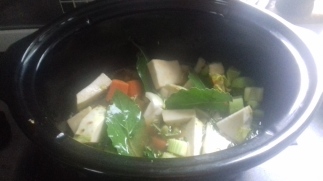
Slow Cooker Low-Carb Beef Pot Roast

slow cooker pot roast beef recipe by Emma Baird of the Diabetes DietSeasonal eating is valuable, I know but here’s a confession… I don’t mind eating soup and stew all year round, even though the dishes are usually associated with autumn and winter.

Can you blame me? Imagine meat and vegetables soaked in lusciously thick and flavoursome sauces, or onions, carrots and celery melded together and used as the basis for the best soup in the world. [Cauliflower cheese soup, since you ask.]

That said, it’s now the tail end of autumn in the UK and I’m digging into beef stews a-plenty. The miracle of carrots and beef is a flavour combination you can’t beat. Cut those carrots in big chunks, nestle them in your stew and leave to bubble away for hours. I could almost fish them out and eat them as a soup with the juices from the stew.

Recently, I adapted a Mary Berry recipe for pot roast. Mary’s method used suede or turnip as we know it in Scotland. I’m not that fond of it (sorry Rabbie*) and I decided to substitute celeriac. It worked a treat.

One of the rules of stews and casseroles is that they improve the day after cooking. This depends on your self-discipline. If you’ve had a pot of stew simmering on your stove for a few hours or cooking away in your slow cooker, your whole home will smell heavenly and resistance will require added steeliness.

Slow cooker Beef Pot Roast with Winter Vegetables

  • Servings: 6
  • Difficulty: easy
  • Print

  • 2tbsp extra virgin olive oil
  • 1.2kgs (roughly) beef topside or brisket
  • 4 onions, cut into wedges
  • Half a celeriac, peeled and cut into chunks
  • 2 celery stalks, chopped
  • 3-4 large carrots, peeled and cut into chunks
  • 150ml white wine
  • 2-3 bay leaves
  • Salt and pepper

Put the oil in a large frying pan or wok and add the beef. Cook over a high heat, turning occasionally until it is browned all over. Place in your slow cooker along with the vegetables tucked all around the meat, and pour the wine around. You might want to add up to 100ml water, but the vegetables will give off a lot of water anyway.

Cook on slow for eight hours. Add plenty of salt and pepper and dot with a little butter to serve. The dish goes well with steamed cauliflower or broccoli.

Allow about 10-15g carbs per serving.

*Scotland’s national dish is haggis, neeps (turnips) and tatties, and it’s traditionally eaten on January 25 to celebrate Robert Burns’ birthday.

Public Health Collaboration Conference 2018: Achieving your optimal blood sugar target

Videos of the lectures given at the Public Health Collaboration conference 2018 which was held in May over the royal wedding weekend have now been released on You Tube.

You can see my talk, Achieving your optimal blood sugar target, as well as others, on the link below. There are a wide variety of lifestyle topics discussed. Happy viewing.


https://www.youtube.com/results?search_query=public+health+collaboration+conference+2018

Extra Virgin Olive Oil and Diabetes

olive oil pic taken by Emma Baird, author of the Diabetes DietWe’re just back from Crete and enthused with the joys of extra virgin olive oil (EVOO). Yes, readers, splash it everywhere with gay abandon just as the Cretans do.

The island’s average inhabitant consumes 36 litres of the stuff every year—more than any other nation in the world. Even the Italians, also fond of the EVOO, manage only ten litres of it and they are the third highest consumers.

Does it have implications for we sugar-challenged folks? The factory I visited while there had a sign claiming health benefits for sufferers of all kinds of things, including type 2 diabetes. The Cretans produce mainly EVOO (and they harvest the olives by hand rather than machine), and they don’t bother with the ‘rule’ that you only use it for salads or to dress vegetables. They stick it in marinades, cook with it and even use it to deep-fry chips.

Positive benefits

In the Mediterranean region where olive oil is the main dietary fat, there are lower levels of deaths from cardiovascular disease. A Medicine News Today article also claimed positive benefits for stroke risk, breast cancer, liver protection, Alzheimer’s, ulcerative colitis, acute pancreatitis, maintenance of healthy cholesterol levels and even depression. [The article quoted from different studies, all of which used the words ‘appear to’.]

Anyone with diabetes has an increased risk of all the above conditions. The so-called Mediterranean ‘diet’ isn’t that dissimilar from the low-carb diet we promote. Broadly, eat tonnes of vegetables, some fruits preferably berries, plenty of fish, full-fat dairy, some beans and pulses if you can tolerate them and dress your salad and veggies with plenty of olive oil*.

Apart from the health benefits, a decent splash of EVOO does miraculous things. Steam some broccoli and then finish it off in the pan frying it with olive oil, thin slices of garlic and sea salt and you get to eat something that is three hundred times nicer than the boiled stuff.

The best Greek salad

And naturally a Greek salad needs the stuff… the best ones are simple. Large chunks of cucumber (peeled for purists) and tomatoes, black olives, thin slices of red onion and topped with a slab of feta cheese, plenty of salt and pepper and a generous drizzle of EVOO.

Sadly, because we’d opted for the hand luggage only flight, we could only bring back a 100ml bottle. One of the big issues with olive oil, and especially the extra virgin variety, is fraud. Most olive oil distribution is done through Italy, including the Cretan stuff. Investigations in recent years have uncovered wide-scale issues where virgin olive oil is passed off as extra virgin. There have even been cases where the oil was blended with sunflower oil and others..

The Guardian has a useful article that contains advice about buying genuine EVOO. Basically, it’s best to buy it in small quantities and if you think that stuff in supermarkets is too cheap to be the real thing, you’re probably right.

Olive oil recipes

Meanwhile, if you’re looking for olive oil recipes here are some suggestions from our blog:

What’s your favourite olive oil recipe or use?

*If you are overweight, you might want to be a little more cautious with your use of it, as it is calorie dense.


Back on the Low Carb!

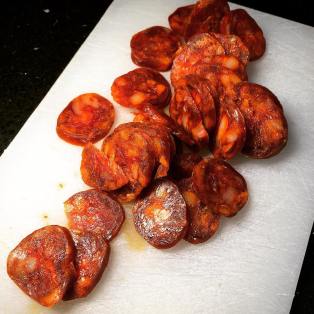
picture of chorizo sausage, the Diabetes Diet
I could probably eat this Every. Single. Day.

Goodbye carbs. It was fun while it lasted, particularly that beef mac and cheese*, but you and I need to rethink our relationship…

While practising for a half-marathon, I upped my carb intakes. Some type 1s have managed endurance training on a low-carb diet, but I wasn’t one of them. My body refused to put one step in front of another without fruit, bread, protein flapjacks or potatoes, but now I’m fed of blood sugar levels that rollercoaster all over the place, and the particularly nasty lows you get thanks to too much rapid-acting insulin where you eventually surface from mental fog surrounded by sweetie packets and the sinking feeling, ‘Blast. I’ve completely over-treated that hypo.’

Hello cheese, meat, eggs and fish! Welcome back butter, cream and mayo in lavish amounts. And planning of course—the writing of endless lists, shopping, menu plans, revisiting old low-carb favourites. I haven’t eaten chorizo for a few months and my mouth waters at the thought of it, dry-fried crispy in the pan, oozing red oil that coats mushrooms and salad leaves… yum.

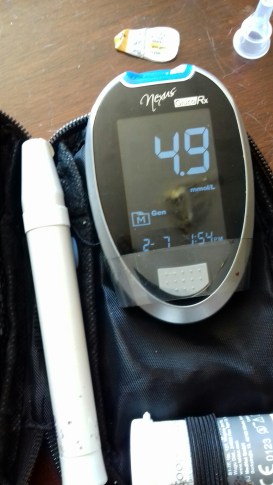
a picture of a blood testing machine on The Diabetes Diet
This will be my blood sugar levels from now on. All the time. Yes sirree.

I’ve eaten low-carb on/off (and mostly on) now for almost ten years. Whenever I come back to it after spells on the bread, a few weeks of super-strict low-carbing make me feel I can conquer the world. I get a rush of energy and mental clarity. Give it a month or so and I’ll be banging on the door of Number 10. Step aside, Theresa May. I’ll deal with Brexit for you!

[Perhaps I should write to Theresa, a type 1 herself, and suggest she try 14 days on a keto diet to help with the thorny issue of how the UK exits the EU. Or keto clarity might give her the strength to say, ‘Citizens! Remain calm. We’re staying in.’]

Then there’s the other thing. Between you and me, reader, the digestive issues of the higher carb diet are a LOT to contend with. We’re talking bloating, rumbling noises and let’s not be coy here—gas. After one race, I ate fish and chips and delicious as it was, the heartburn was horrific. Low carb, high-fat meals don’t make me uncomfortable most of the time. A sore, bloated stomach or having to spend a lot of time trying to hold in gas make a person tired and very grumpy. One of the case studies in our book, the Diabetes Diet reported that several months on a low-carb diet cut out the farting issue for her, much to the relief of everyone around her…

So, full charge forward on the low-carb meal making front. Moussaka via the Diet Doctor, cauliflower cheese, peanut butter cookies via Fit to Serve, lamb with hummus, low carb chicken wings via Yummy Lummy, and crust-less pizza.

Good times!


*For the love of food, good people, please try this. Ragu sauce, macaroni and cheese, topped with bread crumbs and yet more cheese. What’s not to love?

Slow Cooker Sugar-free Pulled Pork

can of diet coke on The Diabetes DietRegular readers will know—I’m upfront about my addiction to a certain fizzy drink. I have, however, never cooked with it before*.
Fair enough. Why would I? I’ve seen recipes that use the regular version for glazing ham or even chocolate cakes. I did try something this weekend though, using the sugar-free kind. I love pulled pork—it’s the most flavoursome thing you can do with the meat. It’s cheap, easy and a crowd-pleaser. I’ve yet to meet anyone who’s tried it and didn’t love it.

Most recipes quote quite a bit of sugar in the sauces for pulled pork. My version uses a big fat zero, unless you include the natural sugars in onions and tomatoes. Try it and see!

Slow Cooker Sugar-Free Pulled Pork

  • Servings: 6
  • Difficulty: easy
  • Print

  • 1.5-2kg pork shoulder
  • 1 tin chopped tomatoes
  • 1 can diet cola
  • 3 tbsp hot smoked paprika
  • One small onion, finely chopped
  • 100ml cider vinegar
  • 1tbsp rape seed or olive oil
  • 2 cloves garlic, crushed
  • Salt and pepper

Cut the skin off the pork shoulder. Slice into strips and put it in the fridge. This will make your crackling.

Heat a wok or large frying pan and add the pork shoulder. Sear all over. Place in your slow cooker and top with boiling water. Mix in two tablespoons of the paprika and cook on slow for 10 to 12 hours.

Half an hour before the pork finishes cooking, heat your oven to 200 degrees. Mix the pork strips with a little salt and half a tablespoon of the paprika. Place on a wire rack over a tray and cook at the top of the oven.

Make the sauce 15 to 20 minutes before you want to serve your pork. Blend the onion, tomatoes and garlic together and add half a tablespoon of paprika. Heat the oil in a saucepan and add the tomato mix with the vinegar and the diet cola. Bring to the boil turn to a simmer and cook for 15 minutes. The sauce should be a little thicker, and smooth.

Remove the pork from the slow cooker, place in a rectangular dish and use two large forks to shred. Add the sauce and mix well. You’ll need plenty of salt and pepper.

Serve with the crackling and home-made coleslaw.

About 5g carbs per portion.


*Partly thanks to those conspiracy theories that went round in the 90s about Gulf War Syndrome.

Sausage, Pepper and Red Lentil Casserole

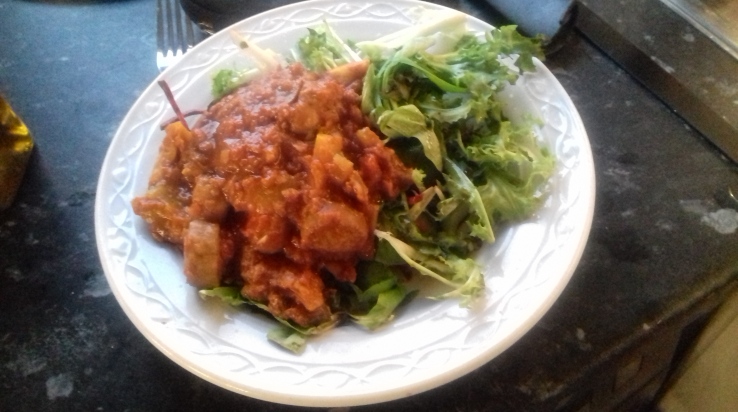
Plate of sausage casserole on The Diabetes DietProving once again, a low-carb diet can be plant-based*, I bring you the sausage, pepper and red lentil casserole!
My ‘beef’ (see what I did there) with the hi-jacking of the term ‘plant-based’, is that it’s assumed to mean vegan, whereas I’d argue you can eat meat, fish and eggs and still have most of your diet made up of plants.

Sausages and lentils have a long dating history. The French twin them together for cassoulets as lentils soak up meat juices and add cheap bulk to a dish. Bulk’s important to me. Who wants a small bowlful of food when you can have a big one?

The better quality your sausages, the better the finished dish. The casserole is great with buttered cauliflower or broccoli. Or you could add another 250-300ml of vegetable or chicken stock to turn it into soup.

And a cheeky helping of grated cheese on top always adds extra deliciousness.

Sausage, red pepper and lentil casserole

  • Servings: 4
  • Difficulty: easy
  • Print

  • Two peppers, insides removed and chopped
  • 100g celery, sliced finely
  • 100g mushrooms, sliced
  • 75ml red wine
  • Four, good quality pork sausages, each cut into chunks
  • 75g chorizo, sliced
  • 75g red lentils
  • 2 cloves garlic, crushed
  • 400g tinned, chopped tomatoes
  • 1 chilli, chopped (optional)
  • 1tsp smoked paprika
  • Salt and pepper

Put everything into your slow cooker, stir well and put on the high setting for four hours.

The mix makes a soupy casserole because it’s done in the slow cooker. You might want to take the lid off yours for the last 20 minutes to get rid of some of the excess liquid.

To make the recipe on the stove, use a large saucepan. Place the chorizo slices in the pan, then turn on a gentle heat so the oils from the sausage run out. Add the other sausages, celery, peppers, mushrooms and garlic, mix well and cover. Cook over the gentle heat for ten minutes. Add the tomatoes, lentils, red wine, chilli and paprika, stir well and bring to the boil. Turn down to a simmer and cook for a further 30 minutes, mixing from time to time.

In both instances, add salt and pepper to taste.

Each portion has 17g carbs and 4g fibre.

*And also that my food styling and photography skills get no better.


Lamb, Hummus—an Ethical Eating Experience?

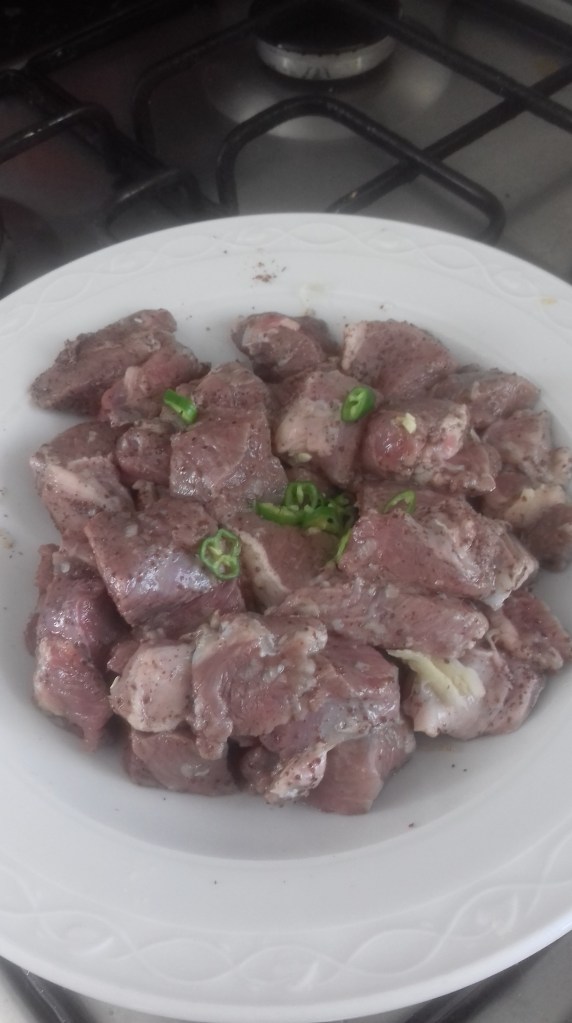
a picture of chunks of lamb marinating in a dish by The Diabetes DietCan you be an ethical carnivore? I asked the question in a post a few weeks ago as I’ve been reading The Ethical Carnivore – My Year Killing to Eat by Louise Gray.
The one-time vegetarian in me wants to feel that the food choices I make cause minimal suffering and don’t impact the environment as negatively as factory farming does. At the same time, I like following an omnivorous diet and think that is the best possible health choice.

So, what to eat?

Eat less meat

I believe in what small-scale producers do. They deserve our support, but their products are expensive and more of an effort to seek out. As many people have discovered before me, the answer is to eat less meat, which is what most people did in years gone by, and buy the best quality you can sourced from farms that treat their animals with respect and dignity.

Chicken, pork and beef are all problematic unless you buy them from farmers’ markets and small co-operatives because of the ways they are farmed before they are killed. The same applies to dairy. As for fish, most of the stuff in supermarkets comes from fish farms and/or is sourced from far-away countries, making it an environmentally unfriendly choice.

Unlike Louise Gray, I can’t bring myself to directly kill anything, hypocritical as that is. But I’m open to eating a lot less meat, trying out plenty of low-carb vegetarian dishes and including more beans and pulses in my diet.

Lamb – the ethical choice

I’m also happy to continue eating lamb, as the production of lamb doesn’t lend itself easily to factory faming. And there are sound arguments for it here. If you want to eat lamb in this country, it can be a challenge sourcing the UK stuff (an irony that appals me as a farmer’s daughter) because most supermarkets import New Zealand lamb.

Nevertheless, if you do find it, lamb lends itself to many delicious dishes, including this one – lamb with home-made hummus. This amount makes enough for two to three dinners.

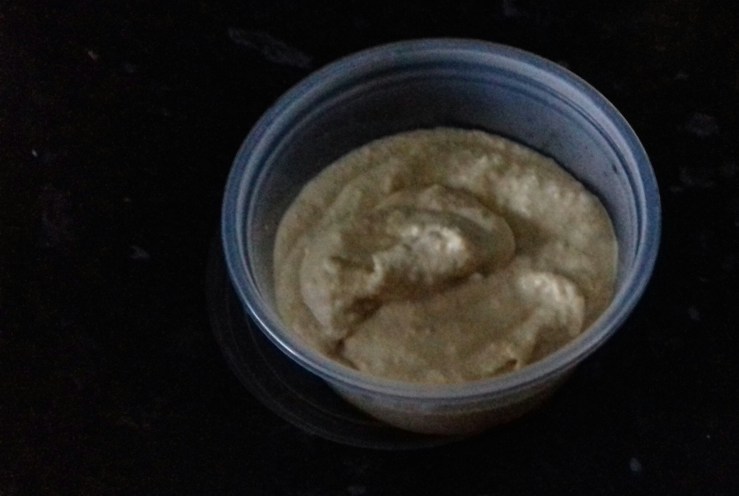
a pot of hummus made by The Diabetes DietFor truly velvet-y hummus, you should take the skins off the chickpeas. I’ve done it—once—and it makes quite a difference. But it’s a tedious job. Skins-on chickpeas will still make a fabulous-tasting dish.

Lamb with Hummus

  • Servings: 2-3
  • Difficulty: easy
  • Print

  • 2 lamb leg steaks, chopped into equal sized chunks
  • Juice of a lemon
  • 2 cloves garlic, crushed
  • I green chilli, sliced finely
  • 1 tbsp sumac
  • Rapeseed oil
  • 1 tin chick peas, drained
  • 3tbsp tahini
  • Salt and pepper

Mix the chopped meat in a bowl with a tablespoon of the lemon juice, salt and pepper, the sumac, chilli and one of the cloves of crushed garlic. Set aside to marinate for at least 30 minutes, though a couple of hours will benefit the dish.

Blend the garlic, lemon juice and tahini in a food processor so a minute or so to get it as smooth and combined as possible. Add the drained chickpeas and two tablespoons of rapeseed oil. Mix well. Add a tablespoon of water if you feel the mix is too thick. You can also use a hand blender to make the dish.

Heat a tablespoon of oil in a frying pan and add the meat. Cook over a high heat—the meat will take about five to ten minutes.

Serve with the hummus.

My carb-loving husband made his own flat breads to go with this, but it’s fine just as it is with a salad on the side—perhaps a Greek one to continue the Mediterranean theme.

Allow about 8-10g carbs per serving.


The Ethics of Eating Meat

Diabetes Diet

Diabetes DietHow do you love animals, hate waste and environmental damage, and yet eat meat, fish, dairy and eggs at the same time?

I ask myself this a lot. I was a vegetarian for years because I called myself an animal lover and meat-consumption didn’t seem to fit. As a long-term lover of vegetables and pulses, I found the food delicious—certainly the stuff I made for myself in the house. I suffered my way through plenty of bad pasta dishes in restaurants staffed by unimaginative chefs.

In 2010, I embraced low-carb living. At first, I only added fish to my diet. You can do a low-carb version of vegetarianism, but it’s limited. Fish added variety and health benefits even if my ethical self shuddered at the thought of being one of ‘those’ vegetarians.

Bacon temptation

I started eating meat in 2013. The stance didn’t feel as big as a jump as going from vegetarian to eating fish, so it wasn’t such a dramatic shake-up of my internal moral compass. And blimey, bacon… it’s a cliché that many a former vegetarian stumbled at the bacon hurdle and it’s well founded.

Diabetes Diet's picture of the cover of Louise Gray's bookThe reason for all this pondering is a book I’ve just bought—The Ethical Carnivore: My Year of Killing to Eat by Louise Gray. The premise is that the Daily Telegraph’s onetime environmental journalist decided she would only eat meat she’d killed herself, and the book begins with her first experience of shooting a rabbit.
I’m 75 percent certain I couldn’t kill an animal deliberately. I’m of the generation that’s become completely detached from the animals we put in our mouths. My father shot rabbits and gutted and skinned them, and he could do the same with birds. I have a razor-sharp memory of him standing at the back door, one back foot of a dead rabbit in each hand, and ripping it apart to allow the cats to dig in

Chickens coming to life

Meat’s almost always appeared in front of me packaged, its origins neatly obscured. Handling chickens makes me flinch as I visualise a head sprouting from that gaping cavity or feathers poking through the skin.

Veganism’s argument for greater health benefits doesn’t convince me. An omnivorous diet of unprocessed foods and plenty of fruit and vegetables will provide the same health gains. But I’m still left with the conundrum—how to eat meat that minimises animal suffering and doesn’t cost the planet dearly?

The ethics thing trips me up all the time. Buy free-range eggs—yes, but they clip the birds’ breaks and kill the male chicks at birth in a horrible way, anyway. Buy Red Tractor meat—not according to this article about what it means for animal welfare standards. Eat meat from the Farmers Market—but it’s so expensive. Eat organic dairy—what about the forced separation of cows from calves and what the industry does to male calves?

I’ve only started the book and I’m hoping it will end with a neat set of guidelines. Follow these and you too can be an ethical carnivore kind of thing. I doubt reading The Ethical Carnivore will turn me into a hunter, but if I emerge with a better understanding of what I can do, I’ll be delighted.

How do you deal with the ethics of eating meat? Any tips or advice gratefully received…

Ethics picture – Madhamathi SV and licenced under a Creative Commons Attribution-Share Alike 4.0 International Licence. 


Public Health Collaboration Conference 2018: a great success for Lifestyle Medicine

I was delighted to attend and speak at the third PHC conference in London this year.  We met at the Royal College of General Practitioners in London on the sweltering weekend of the Royal Wedding. Apart from superb international speakers we were treated to low carb, high protein food, such as one would typically eat on a ketogenic diet. Instead of picking at our dinners as we often have to do with mass catering  we could eat the whole lot. Great!

Dr Peter Brukner from Australia started off the weekend with a review of what was happening in the low carb world. There are more and more reports coming out describing the advantages of ketogenic and low carb diets to different groups of people but the establishment are fighting back viciously as can be seen by the attack on Professor Tim Noakes in South Africa.  Indeed if his defence lawyers and expert witnesses had not worked for free he would be bankrupt.  This is a terrible way to wage war on doctors who are acting in the best interests of their patients.

Dr Aseem Malhotra also described bullying tactics that had been used against him when he was a junior doctor and first becoming publicly engaged in the low carb debate. I have been subjected to this as well.  Professor Iain Broom showed that the proof that low carb diets are superior to low fat diets goes back 40 years.

Dr Zoe Harcombe gave us an explanation of how the calories in- calories out idea just doesn’t add up. The well known formulas about how many calories you need to avoid to lose weight don’t work in practice because of the complex compensatory mechanisms we have to avoid death from starvation.  How you put this over to patients and give them useful strategies for weight loss and blood sugar control was explored by Dr Trudi Deakin.

Food addiction is a real issue, at least it is for the majority of the audience in attendance, who answered the sort of questions usually posed by psychiatrists when they are evaluating drug addiction.  Unlike drugs, food can’t entirely be avoided but ketogenic diets are one tool that can be used to break  unhealthy food dependence. This worked for presenter Dr Jen Unwin who at one point had a really big thing for Caramac bars.  I haven’t seen these in years but they did have a unique taste.

Dr David Unwin showed clearly that fatty liver is easily treatable with a low carb diet.

Dr Joanne McCormick describes how her fortnightly patient group meetings are making change accessible for her patients and how many GPs in the audience could broach the subject in a ten minute consultation.

The website Diabetes.co.uk will shortly be starting up a type one educational programme online that all are welcome to join. I discussed the issue of what blood sugar targets are suitable for different people and how they can achieve this with dietary and insulin adjustment.

Dr David Cavan spoke about reversing diabetes in patients in Bermuda. Although Bermuda looks idyllic the reality is that good quality food is about five times as expensive in the UK as it is all shipped in. Many inhabitants work their socks off but barely cover their costs and cheap sugared drinks and buns are their staple diet. Despite these setbacks he managed to persuade a lot of diabetic patients to ditch the carbs and this had favourable results even after the educational programme had stopped.

A cardiologist Dr Scott Murray described the effects of metabolic syndrome on the heart and really why sticking stents in diseased arteries is too little, too late. He is convinced dietary change is needed to reverse and prevent heart disease. This is the first time I have been told that certain types of heart failure and atrial fibrillation are direct effects of metabolic syndrome on the heart.

The importance of exercise for physical and mental well being was not neglected and we had Dr Zoe Williams describing the great benefits that even the minimum recommended exercise can produce.

Dr Simon Tobin and Tom Williams spoke enthusiastically about Parkrun. This is a free event that runs every Saturday morning in parks all over the world. You can choose to walk, jog or run the course.

Claire McDonnell-Liu is the mother of two children who have greatly benefited from a ketogenic diet. The conditions are urticaria and epilepsy.  Although NHS dieticians do help families with childhood epilepsy who want to use a ketogenic diet, they can’t do it unless drugs have failed, as this is NICE guidance. I wonder how many children would benefit in fit reduction without side effects of drugs if this guidance was changed?

This was a fabulous conference with a positive enthusiastic vibrancy. Thanks to Sam Feltham for organising this event especially since he has become a new dad as well.

The Public Health Collaboration are putting all the talks on You Tube.

I was interviewed about diabetes and women’s health issues for Diabetes.co.uk and Diet Doctor and these interviews and many others will be available for you all to see to improve your lives with diabetes.


Baba Ghanoush – Low Carb Recipes

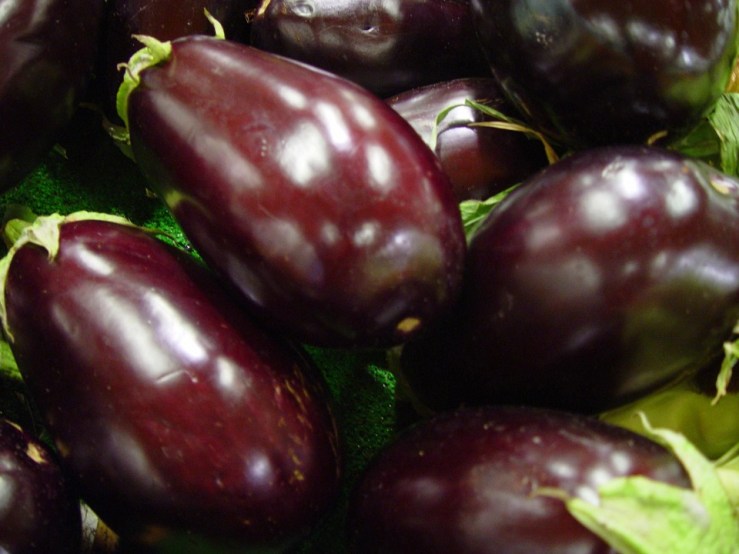
a picture of aubergines on the Diabetes DietAubergines are fan-flippin-tastic done in a pizza oven. Cut the tops off, half them, score the skin and rub with olive or rapeseed oil, sprinkle with sea salt, wrap in foil and place in the heated oven for fifteen minutes.

Done! The best accompaniment to…well, anything if you love aubergines as much as I do. Traditional matches might be lamb steaks. Or you could wrap up some peppers too and make yourself a big bowl of garlic dip to go with them. Ooh, veggie heaven…

Alternatively, why not try some Baba Ghanoush? Ever heard this aubergine dip referred to as poor man’s caviar? If you’ve tasted the real thing, you’re within your rights to argue the supposed paupers’ option is the much better deal. What would you rather eat—a super silky, lemony-garlicky scented paste you can dip things in? (Fingers if you really must; we won’t judge.) Or fish eggs?

Here’s my version, with an alternative method if you don’t have a pizza oven.

Baba Ghanoush

  • Servings: 4-6
  • Difficulty: easy
  • Print

  • 2 medium-sized aubergines
  • 2tbsp tahini paste
  • 4tbsp rapeseed or olive oil
  • 4tbsp fresh lemon juice
  • 1 onion
  • 2 cloves garlic
  • Salt and pepper

Slice the tops off the aubergines, half them lengthways, score the skin and rub with some of the oil. Wrap in foil.

Slice the onion in half too and wrap in foil.

Either cook in a pizza oven (about 250 degrees C) or place in an oven (180 degrees C). The vegetables will take about 15 minutes in the pizza oven. Unwrap from the foil and place in for a few more minutes to char them.

In the oven, allow about 30-40 minutes. You want the aubergines collapsing. Take the foil off for the last five minutes of cooking.

Scrape most of the aubergines from the skin, although you can keep a bit of it for extra smokiness. Place the aubergines, onions and garlic in a food processor with the rest of the oil, the lemon juice and the tahini. Whizz till smooth.

Taste and add salt and pepper as necessary.

The whole dish has about 45g carbs and 18g fibre.