
Weight loss increases hunger: a major obstacle for maintenance

weight-lossWe  know about the issue of slowed metabolism after weight loss due to the lean muscle mass loss that goes along with fat loss. This is one reason why higher protein/low carb diets work better than low fat diets; because muscle mass is maintained better. Well, new information from Diabetes in Control backs up what some of us know intuitively or may have experienced personally….

Losing Weight Increases Hunger

The study showed that for every kg of weight they lost, patients consumed an extra 100 calories a day — more than three times what they would need to maintain the lower weight.

This out-of-proportion increase in appetite when patients lost a small amount of weight may explain why maintaining long-term reduced body weight is so difficult.

A validated mathematical method was used to calculate energy intake changes during a 52-week placebo-controlled trial in 153 patients treated with canagliflozin, a sodium glucose co-transporter inhibitor that increases urinary glucose excretion, thereby resulting in weight loss without patients being directly aware of the energy deficit. The relationship between the body weight time course and the calculated energy intake changes was analyzed using principles from engineering control theory.

Previous studies show that metabolism slows when patients lose weight; however, these results suggest that proportional increases in appetite likely play an even more important role in weight plateaus and weight regain.

Knowing that patients with type 2 diabetes who receive the sodium-glucose cotransporter 2 (SGLT-2) inhibitor canagliflozin (Invokana) as part of a glucose-lowering strategy excrete a fixed amount of glucose in the urine (which causes weight loss), they used a mathematical model to calculate energy-intake changes during a 52-week placebo-controlled trial of the drug, in which 153 patients received 300-mg/day canagliflozin and 89 patients received placebo.  Using this approach meant that the participants who received canagliflozin consistently excreted 90-g/day glucose but were not aware of the energy deficit.

Previously, the researchers had validated a mathematical model to calculate the expected changes in caloric intake corresponding to changes in body weight (Am J Clin Nutr. 2015;102:353-358). They input the current study data into this model.

At study end, the patients who had received placebo had lost less than 1 kg and those who had received canagliflozin had lost about 4 kg. The weight loss with canagliflozin was less than predicted, due to the patients’ increased appetite. On average, patients who received canagliflozin ate about 100 kcal/day more per kg of weight lost — an amount more than threefold larger than the corresponding energy-expenditure adaptations.

“Our results provide the first quantification of the energy-intake feedback-control system in free-living humans,” the researchers write.

They add that in the absence of “ongoing efforts to restrain food intake following weight loss, feedback control of energy intake will result in eating above baseline levels with an accompanying acceleration of weight regain.”

The findings suggest that “a relatively modest increased appetite might explain a lot of the difficulty that people are having in both losing the weight and maintaining that weight loss over time. From the results it was concluded that, while energy expenditure adaptations have often been considered the main reason for slowing of weight loss and subsequent regain, feedback control of energy intake plays an even larger role and helps explain why long-term maintenance of a reduced body weight is so difficult.

The findings suggest that an increased appetite is an even stronger driver of weight regain than slowed metabolism. “The message to clinicians is to not only push physical activity as a way to counter weight regain but also use medications that impact appetite.”

In summary, the researchers conclude the few individuals who successfully maintain weight loss over the long term do so by heroic and vigilant efforts to maintain behavior changes in the face of increased appetite along with persistent suppression of energy expenditure in an omnipresent obesogenic environment. Permanently subverting or countering this feedback control system poses a major challenge for the development of effective obesity therapies.

Practice Pearls:

  • Findings suggest that an increased appetite is an even stronger driver of weight regain than slowed metabolism.
  • Appetite increased by ∼100 kcal/day above baseline per kilogram of lost weight.
  • The message to clinicians is to not only push physical activity as a way to counter weight regain, but also use medications that impact appetite.

Obesity. 2016;24:2289-2295. Abstract

Jovina cooks Italian: Lobster Salad

Cooking the Italian Provinces – Cagliari | jovinacooksitalian

Cagliari Style Lobster Salad

mb1d23_5143_s4x3-jpg-rend-sniipadlarge

Lobster, which is called aragosta in Cagliari, is smaller, clawless and sweeter than New England lobster.

2-3 servings

Ingredients

  • 1/2 pound cooked lobster tail meat
  • 10 cherry tomatoes, stemmed, washed and cut in half
  • 1 tablespoon finely minced Italian parsley
  • Grated zest of 1 large lemon
  • 3 tablespoons Extra-Virgin Olive Oil
  • 1 1/2 tablespoons freshly squeezed lemon juice
  • 1/4 teaspoon fine sea salt, or more to taste
  • 1/4 teaspoon ground white pepper
  • Whole arugula leaves, washed and dried, optional

Directions

Cut the lobster meat up into bite-size pieces and place in a bowl. Gently mix in the tomatoes, parsley and lemon zest.

In a small bowl whisk together the olive oil, lemon juice, salt and pepper.

Pour the dressing over the lobster mixture and toss gently with two spoons.

Cover the bowl and refrigerate for at least 2 hours.

When ready to serve, allow enough time for the lobster mixture to come to room temperature.

Line serving plates with arugula leaves, if using. Divide the lobster mixture evenly and spoon into the center of each plate.

Low-Carb Lunches – Asparagus Soup

asparagusAsparagus – I’m not 100 percent keen on it as a side vegetable, but when you fry it with onions and garlic, add in stock and double cream, it becomes something else entirely…

Try this for lunch. When I have soup for lunch, I always add two boiled eggs for extra protein. It also makes an unbelievably filling dish. You might struggle to finish it all.

Asparagus Soup

  • Servings: 3
  • Difficulty: easy
  • Print

  • 400g asparagus
  • 2tbsp rapeseed oil
  • 1 medium-sized onion, sliced
  • 1 clove garlic, crushed
  • 1tsp salt
  • Freshly-ground black pepper
  • 600ml water or chicken stock
  • 60ml sour or double cream

Chop the asparagus into one-inch pieces. Fry in a saucepan with the rapeseed oil for five minutes. Add the onion and garlic, cover the pan and cook over a gentle heat for another five minutes.

Add the water or stock, and salt and pepper. Bring to a boil and then turn down to a simmer for ten minutes.

Add the cream or double cream and blend until smooth. Adjust the seasoning to taste.

4-5g net carbs per serving.

Asparagus wee… if you’re someone who gets this (your pee smells really strong after eating asparagus), Asparagus soup is going to give you a bad dose of it. There’s an explanation here about what causes asparagus wee why some people get it and others don’t. 


Weight plateaus are a normal, but frustrating, feature of your weight loss journey

frustration

 Here are some words of wisdom and encouragement from a health care professional who knows how discouraging weight loss plateaus can be. Don’t let weight stabilisation lead you to jack in your efforts.
When Losing Weight, Warn ‘em!

Diabetes in Control November 8th 2016

I work in obesity medicine. As many of us know, losing weight isn’t the problem for most, but weight regain is.

As the saying goes for many, you can’t be rich enough or thin enough. Many of our patients come in with unrealistic goals regarding their weight loss, and don’t give themselves enough credit for the weight they have lost. Many, for many reasons, regain.
Woman, 58 years of age, class II obesity, prediabetes (A1C 6.0%), HO depression, on antidepressants, weight of 188, BMI 38. Started on metformin and lower carb meal plan.
Warned her early on it’s not just about losing weight, but what’s important is keeping it off. We need plans for both.
Her treatment plan does not end when she loses weight.  Over 6 months she lost 22 pounds. This is a 12% weight loss. BMI 33.5 now.  No further weight loss since the 6-month period, but no weight gain.
Patient frustrated. She has upped her exercise. No longer wants to continue metformin. Encouraged her to continue her meal plan, metformin and bump up her exercise plan. Praised her for her weight loss and not regaining.  And, reminded her this is what we discussed from the start. She remembered and said she’ll stay with the plan.
Lessons Learned:
  • Keeping weight off is a different stage of the weight loss journey.
  • Reminder that losing 3-5% total body weight can improve health outcomes.
  • 5-7% weight loss was shown in the DPP to prevent or delay type 2 diabetes.
  • From the beginning, let patients know there are stages to losing weight. First is to lose, then it’s to keep off the weight lost. Make a plan for both.
  • Regarding weight loss, put more emphasis on the food side.
  • Regarding weight maintenance, put more emphasis on exercise.
  • Remind patient of discussion and encourage patient to embrace the weight loss they have been able to achieve and keep off.

Anonymous

A Day of Type 1 Diabetes

wp-image-1961591207jpg.jpgWhat’s it like having type 1 diabetes? Like having a part-time job on top of everything else…

I’m like most people – sometimes I manage great control. Sometimes, through no fault of my own, I don’t. And sometimes the fault is my own. My blood sugars go haywire, and I spend the day yawning, wishing people wouldn’t talk to me because it’s too much effort to talk back.

Sorry if you’ve met me when I’m like that.

Anyway, here’s what a day of living with diabetes looks like…

8am. Up and at ‘em! Or something like that. I’m self-employed, and I work from home, so I don’t have to commute. Or go to an office – thanks be to all the stars above. My cat likes to sleep on top of me, so sometimes it takes me ten minutes to get up because I don’t like to shift him…

Blood sugar – 6.6mmol. Oh no, is this going to be one of those terrible goodie two-shoes posts where people show off about their brilliant control?

I take my long-term insulin when I get up – 13 units of Levemir. I give the dose in two injections because I think it works better that way. Being an impatient sort, I need to count to 20 to stop me removing the needle too quickly. (You might not get the full dose if you take the needle out too soon.)

I don’t bother with breakfast. Up and at ‘em feels more do-able when I don’t. I’m accidentally doing the trendy 16-8 thing, where you only eat within an eight-hour window.

I work from 9am to 1 pm. I’m a freelance writer, so I write blogs, website contents, video scripts and more for clients, mainly small businesses that are trying to improve their SEO. Some years ago, my husband built me a standing desk. Once you get used to standing for work, it feels much more comfortable than sitting all day.


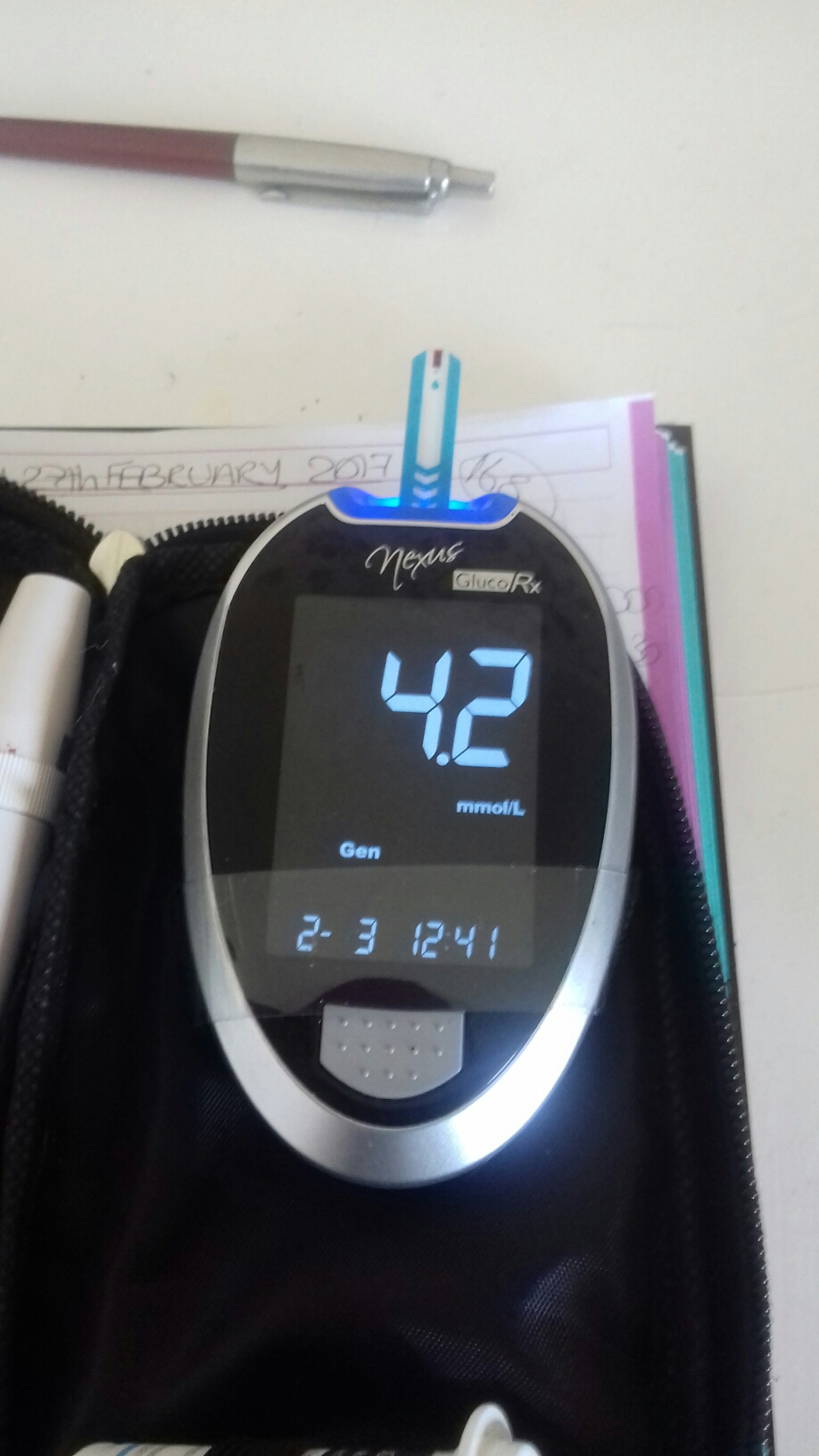
wp-image-282956511jpg.jpgBlood sugar – 4.2mmol
. Oh, no! It IS going to be a humble-brag blog.

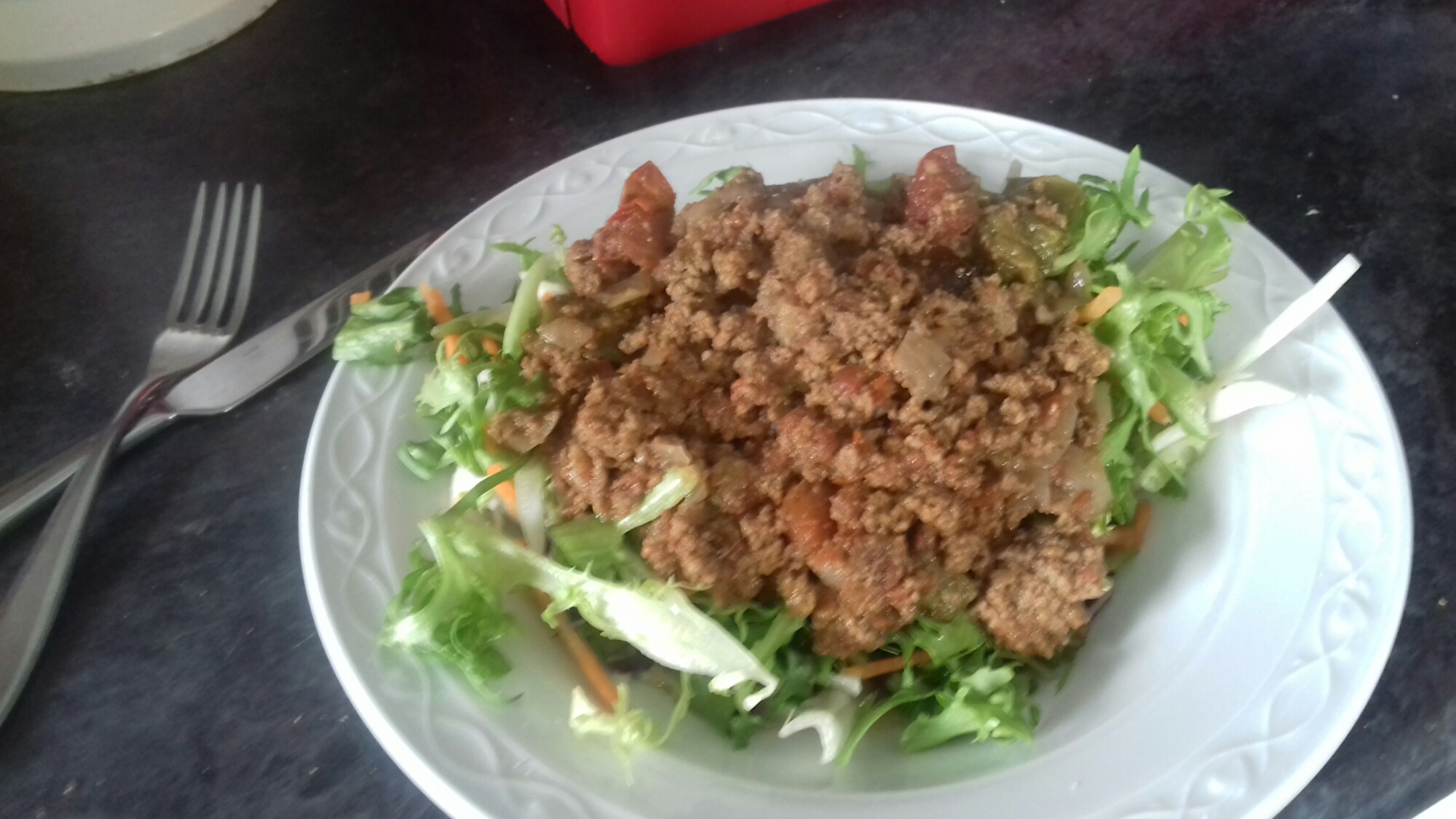
1.30pm-2pm. Lunchtime. Today, I had chilli, salad and some green beans on the side and I finished with some peanuts. I took half a unit of Humalog to cover roughly 20g net carbs. I didn’t take it until after the meal because my blood was low beforehand and because I was planning a walk afterwards.

2pm. I usually go for a walk. I use a Jawbone app to track my sleep and activity. About an hour of walking a day takes you to 10,000 steps.

3.30pm – a bit more work. I write dog blogs for a client, and as I love animals these are my favourite ones to do.

5.30pm – 3.9. I had a banana to cover the low blood sugar, and then I went to a spin class. The instructor LOVES Lady Gaga. I’m beginning to hate her, as I associate the poor woman with nasty hill climbs.

7.30pm. Blood sugar, 11.1. Not so goodie two-shoes now, eh?! Huffing and puffing exercise sometimes does that to me – sends my body into a panic. ARGH, this is hard! Find sugar! Walking doesn’t do this.

I made myself a cheese and onion omelette. Other omelettes are available, but why would you bother?! It was more like cheese, with a bit of onion and egg on the side. I had one unit of Humalog to cover the net carbs.

wp-image-990815369jpg.jpg8pm – oops, how did that get in there? A cheeky little glass of pink fizz… It was so nice, I had another one. And er… maybe another one after that. I reckoned it would help lower blood sugars ;)*

10pm – second dose of Levemir, 6 units. I try to find a spot on my abdomen that doesn’t look too punctured. Medical staff stress the importance of changing injection sites regularly. I’ve got a lump on my belly that’s been there 20 years because I overused the same spot. I don’t go near it now.

10.30pm. I had an Atkins fudge bar. I didn’t take any insulin with it because I’d had a few glasses of wine. Atkins chocolate bars aren’t as carb-free as they boast – but they do contain fewer carbs than a standard chocolate bar.

Bed time. And that was my Friday.


*Usual rules apply – as a condition, type 1 diabetes will vary widely between individuals. What I do isn’t a recommendation or prescription for anyone else.

Anna explains food labels: they can hide as much as they reveal!

Enticing Food Labels, part 1.

I have taken a small break from blogging due to some unforeseen events that I had to take care of first.  Now I am back and decided to write about a subject that I’ve been thinking about for what seems to be the longest time.  Food labels.

It appears that food manufacturers tend to make food labels claims that need to be taken with a grain of salt.  In other words, plain misleading.  I will go over a few of these.

1. ‘Healthy’ Food.

What exactly is ‘healthy’?  Raise your hands if you know the answer. Food and Drug Administration is baffled about this and is looking for the public input.

Most of the claims about general categories of foods, such as fruit and vegetables to maintain good health are actually dietary guidance rather than health claims, hence not subject to authorization by FDA.  Therefore, food manufacturers can state whatever they please in order to promote their products and this is largely unregulated.

Sounds confusing?  You are not alone.

FDA is currently in the process of redefining nutritional claims on food labeling, and is working on an updated definition of ‘healthy’.

I’ve always been big on checking Nutrition Facts Panels when buying just about anything.  The first thing I’m looking for is carbs.  The next is fat content, and after that, an expiration date.  Haven’t noticed too many folks do the same, though.  Most of them just grab a gallon of milk and out on their merry way.  I on the other hand, want to make sure that the milk won’t go bad on me in a few days.  It may be just me.

By the way, fat content in milk is to be discussed later.

In fact, you can’t rely on what some if not all food labels claim.   Statements such as ‘healthy’, ‘low fat’ or ‘good source’ of this substance or the other can turn out to be a sales gimmick that is intended to nothing more than to sell a product.  I’ve always had a nagging feeling that all that the food labels are trying to accomplish is to sell me something.  Such as for example, ‘vitamin water’ sounds like a pure sales pitch.  Or ‘smart chicken’ as was recently advertised in a local grocery store flyer, priced at mere $5 for a pound and two ounces.   Or ‘premium’ anything.

Of course, all of these have a price tag attached accordingly.

Does celery ever come in a variety that is not crisp?  Farmer’s Market — come on now, it’s just a name of a company.  Seedless cucumbers — what is the point?  I understand seedless watermelon but cukes, of all things?  Give me a break.

oct-13-seedless-cucumber

oct-13-dietitian-pick-lettuce-copy

.

.

Dietitian Pick — now this is creative.  A real dietitian came along and picked this head of iceberg lettuce.  I know that is right.

.

.


2.  All Natural.

I don’t know who coined this term but FDA doesn’t define it.  This means that food makers can do as they please and won’t get in trouble.  It leaves lots of room for interpretation every which way.  For example, if a food is labeled natural, it can still contain high fructose syrup — high carbs — while the food makers claim that since it comes from corn, it’s ‘healthy’.

oct-13-saltwater-injected-chicken

Natural chicken can be actually injected with sodium or saltwater in a process called plumping.  This is done in order to enhance flavor and, you guessed it, to increase weight of the meat before it’s sold.  If this is done, the label will state “flavored with up to 10% of a solution” or “up to 15% chicken broth.”

In fact, it is very rare that a package of meat or chicken comes with a Nutrition Label printed on it; most of the time there’s none.   I checked a package of chicken thighs that I had bought earlier today; it does have a Nutrition Label on the bottom but you need to flip it over in order to see it.  Once the label is not in the plain view, I take it most folks won’t bother to look for it.  Mine happened to have it and it doesn’t state anything about added solution or broth.  Now that I know, I can’t help but wonder about meat purchased at the deli counter — it doesn’t even come with a nutrition label.  This is something that had never occurred to me up until now.

Consuming too much salt can lead to high blood pressure and other problems, especially for those who were told to cut down on salt intake.   Buy plumped chicken and you’d be looking for trouble, albeit inadvertently.

How I wish that I had my own chicken farm.


Enticing Food Labels, part 2

In part 1, I have discussed the use of ‘healthy’ and ‘all natural’ statements on the food labels.  Now I will talk about the labels that claim low or no fat or sugar.

3.  No Sugar Added.

This sounds rather confusing, because it prompts you to think that the product contains no sugar at all.  If you have diabetes, you might want to buy it for this very reason.  Now wait a minute.

No sugar added” doesn’t mean that the product is carb-free or calorie-free.  It is sometimes being confused with sugar-free;  in fact, there’s a bunch of websites that do just that.  The problem is that some foods have sugar in them naturally, such as for example, milk or fruit, so anything containing these two can’t be sugar-free.  Besides, no sugar added products can still contain additives with high glycemic index such as Maltodextrin.

oct-16-maltodextrinMaltodextrin is made of corn, rice, potato starch, or wheat;  it’s a common food additive used for expanding the volume of processed food and for increasing its shelf life.
It has 4 calories per gram which is the same as table sugar. However, maltodextrin has a high glycemic index, almost twice as much as table sugar does. GI of maltodextrin is 110, compared to 65 of table sugar. This means that it can raise the blood sugar levels very quickly. Per FDA, Maltodextrin has to be listed in the nutrition panel as what it is, a carbohydrate.

4.  Sugar-free

This doesn’t automatically mean fewer calories; in fact, sugar-free products still have some sugar in them.  By FDA definition, sugar-free foods can have less than 0.5 grams of sugar per serving.  They however still have calories and carbs from other sources.  One of such sources are sugar alcohols that taste just as sweet as sugar while having half the calories.

Most sugar alcohols have no effect on blood sugar.   Some of them however are actually carbohydrates that are well absorbed by the body and can cause blood sugar spikes such as Maltitol.   Sugar alcohols can also act as a laxative so keep that in mind when indulging.

Sugar-free products can also have artificial sweeteners that don’t affect blood sugar directly but can affect insulin sensitivity nevertheless.

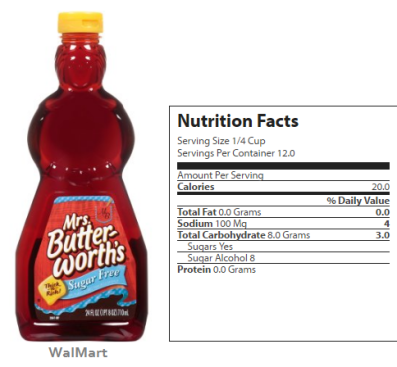
When I was first diagnosed with diabetes, I started buying sugar-free products thinking that I was doing the right thing.  One of the first such products was sugar-free pancake syrup that tasted as sweet as its sugar-containing counterpart.  For a brief while I was proud of myself for being able to find a product that is sugar-free and just as sweet.  This however was short lived when I had a seemingly unexplained blood sugar spike after eating hot cereal with ‘sugar-free’ syrup.  I then took a close look at the Nutrition Panel and low and behold, it listed a few carbs including Sorbitol, a sugar alcohol; corn syrup and molasses.  All of the above are carbs.

After having contacted my nutritionist, I was advised to stay away from everything that ends with ‘ol’ (sugar alcohols).  From now on, I will never take the statement ‘sugar-free’ for granted but will read the labels first and then decide.  A lesson learned.

oct-16-sf-pancake-syrup-wm

Here now, a bottle of pancake syrup; didn’t the label say “sugar-free”?  Yes, it did but the Nutrition Facts panel states Sugars – Yes, and the amount of 8 grams.  This is per serving size that mind you, is a quarter of a cup.

Most if not all of us consume a few times over this in one sitting.  No, really.  A quarter of a cup is a little bitty thing.  Most folks will use at least a cupful of it.  Then all the seemingly ‘healthy’ content goes out the window.

Ever seen a commercial with a pile of pancakes buried under a huge mound of syrup?  There goes your serving size.

5.  Low-fat or fat-free

Many of us associate zero trans fat or fat-free claims with healthy, which is exactly the outcome the food manufacturers are trying to achieve.  And the truth is, while some foods are naturally low in fat, such as fruits and vegetables, processed food is another story. Fat-free versions of food replace fat with sugar which is no better and eventually gets stored in your body as fat anyway.  The keywords to look for are corn syrup and fructose.

Fat-free products are loaded with sugar, and sugar-free are loaded with fat.  Here you have it, a no-win situation.

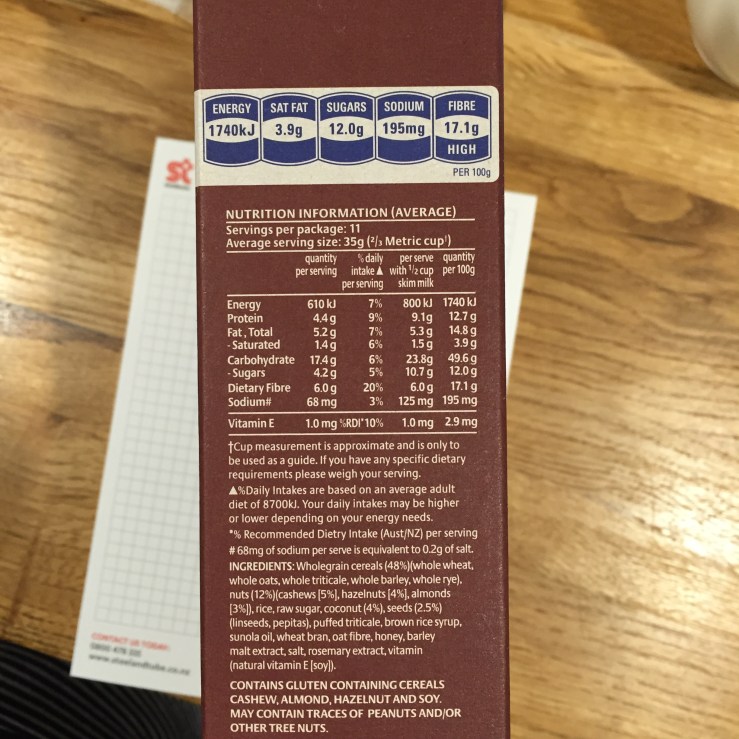
Nutritionpedia website has posted these two labels side-by-side, one is regular, the other, fat-free.

oct-16-nutritionpedia-reg-and-fat-free-nutr-panels

As you can see, the fat-free product contains about three-fold more sugar than the regular version of the same product.  Not only would one serving size of the fat-free food have more calories than the full-fat version but you may be tempted to eat two servings because it comes across as healthy.

By FDA standards, low fat means less than 3 grams of fat per serving size and fat-free, less than 0.5 grams.  How much is the serving size?  This is what the food manufacturers are playing with.  One vs two cookies as a serving size or slices of bread likewise, can make all the difference.  And who is eating only one cookie?  When you or your kids eat more than one, all that low fat content per serving size goes out the window.

THE BOTTOM LINE:  sugar-free products are loaded with fat, and fat-free, with sugar.  To make sure that you are in fact eating healthy food, you need to do your homework.  Check the label of a fat-free or sugar-free product and compare it with the full-fat or full-sugar version.  This of course will take some time.


IMG_0022