The UK Has A New PM – One Who Has Diabetes

theresa mayAs of today, the UK has a new prime minister – Theresa May.

Theresa May has type 1 diabetes. She was diagnosed later in life than is usual with type 1 – and she was misdiagnosed with type 2 initially.

I’ve never harboured political ambitions. I’ve no idea how you would go about devising the best practices and policies for running the country. And Ms May’s biggest job at the moment is negotiating the exit from the EU.

But her appointment did get me thinking. How on earth do you cope with diabetes and the heavy responsibility of country leadership? Fair enough, she’s had a senior political role for some time so the transition probably isn’t that much of a leap, but even so… How do you do it?

What happens if you have a hypo in the middle of Prime Minister’s Question Time? My brain starts to go slightly mushy and I get easily confused when I’m hypo. Mushy brains don’t lend themselves to debate.

How do you cope with the interruption of routine? My diabetes is best controlled when routines stay constant – the same time for meals, the same levels of activity, the same sorts of foods and the same time to bed. Life at any kind of senior level doesn’t lend itself to regular routines.

How do you fit in hospital appointments? At the very least, she should be attending clinics every six months and also having regular retinal screening appointments. If you’re a very senior politician, I imagine hospital appointments often have to be cancelled at very short notice.

Blood pressure. As a diabetic, you are more likely to suffer high blood pressure than most people. Is being prime minister at all good for your blood pressure?

How do you manage with all the eating out? Good blood sugar management means you need to know the carbohydrate values of what you are eating, which is tricky when you are eating out.

Anyway, I don’t agree with her politics, but I don’t – and wouldn’t question – her ability to do the job. It’s interesting to reflect on the impact of a chronic condition on someone working at that kind of level. Diabetes often requires huge efforts of will power – overcoming the tiredness, forcing yourself to be organised enough to remember all your equipment and carry spare food and sweets just in case etc. Sometimes, all you want to do is sleep, the prospect of even a conversation too exhausting to cope with.

When you’re working at Theresa May’s level, you must need vast quantities of that will power and determination. Ms May, I salute you.


EU exit: Winter is here

The vote to take the UK out of the EU has chilled me to the bone. Social well-being is inextricably linked to health and a careless decision taken by a majority of around 52% of voters has just messed up our economic system on which our well-being as citizens and patients depends.

Scotland, Northern Ireland, central London and Gibraltar have unequivocally voted to stay in the EU. There are 1.3 million Brits who study, work or have retired to the EU, and many of these people were not able to vote in the referendum. If they had, the margin of success for Brexit would have been lessened considerably.

The people who voted to stay tended to be younger, have degrees, have jobs, and be wealthier. Those who wanted to leave tended to be older, be on benefits and perhaps feel that they will be more sheltered from the effects of their choice.

Economists, business leaders, bankers, most MPs, and the British Medical Association which represents the majority of UK doctors,   all want to stay in the EU. Reasoned discussion has been going on for months in such papers as the Guardian and the Times. Pictures of the Union Jack, the Queen, and rants about immigration and the millions that could be diverted to the NHS have been on the front pages of the tabloids for months. On the very morning of the result, Mr Farage, leader of the UKIP party, admitted that the slogans on the buses and billboards about money going to the NHS from the EU were lies. “Nothing to do with me”, he said.

Meanwhile the UK has lost David Cameron as Prime Minister. He has been an emotionally stable, sensible, well informed, inclusive, solution seeking head of the government. Very far from Maggie Thatcher or Tony Blair in performance or nature, he has felt the need to step down, despite demonstrating an integrity that Farage and the likes do not appear to emulate.

strasbourg-1166650_960_720

So, what has the EU done for us? Quite a lot as far as I can see. Most of it beneficial.

We have a decimal currency, much easier than the old 12 unit system. We get cheap good quality food, particularly fruit, vegetables, wine, ham, olive oil, nuts and cheese. Many of these items feature heavily in a low carbohydrate Mediteranean style diet which is so important in keeping well if you have diabetes.

For doctors, the European Working Time Directive, which limits junior hospital doctors working hours to 48 hours a week was a God send. I used to work 120-145 hours a week as a junior doctor. It was described as “training” but it was slave labour.  I was paid one third of my basic rate for the extra hundred or so hours I was on evenings and weekends. On Christmas day 1983 I earned 50 pence per hour and that was before tax.  Older doctors and consultants didn’t care. They did nothing about it. If we did it and survived, you can too was the mentality.  It took the EU to get doctors out of that mess and without the working directive it could easily revert back.

There is a workforce crisis in UK medicine as it is. Worsening of terms and conditions for doctors will lead even more of them to jack it in and head for Australia.

What of our working population generally? The EU have brought in laws to give reasonable hours, breaks, holidays and contracts to workers.  Without the EU there will be more likelihood for zero hour contracts to become the norm, if you can even get a job.

When it comes to selling a house, the main thing that estate agents say are important are location, location, location. When it comes to the well -being of a countries citizens the important things are economy, economy, economy.

Like it or lump it, we are all part of a global economy now. The EU is not responsible for all the bad things that are happening that affect the economy.  The immigration crisis is due to an undeclared third world war which is due to Islamic separatists destroying these people’s  homes, countries and own economies.

A government can’t hand out money to sick people, the unemployed, the NHS or anyone else unless they have money raised from taxation. They can’t get this unless people have jobs. If the economists are right, and there is no reason to believe that they will not be, there will be fewer jobs, worse terms and conditions, less money able to be raised from tax and therefore less money for pensions, benefits and health care.

Leaving the EU is not a vote for prosperity.

What can we do about it?

To really improve things we need to get a review of the referendum decision. If it can’t happen for the whole of the UK, the best option in my view, then perhaps it can be achieved in Scotland. This would mean a difficult choice for Scots. Do we stay with England and Wales? Do we stay with Europe?

When people look across at Southern Ireland it would appear that they have not done very well in terms of economic prosperity by staying in the EU. On the other hand do we revert back to the dark ages with the working classes being over worked and underpaid with a deficient social care system but with an elite few at the top as could happen for England and Wales?

What do you think of the result of the vote? What do you think we can do to makes things less awful than what has been predicted for us all?

Dr Katharine Morrison


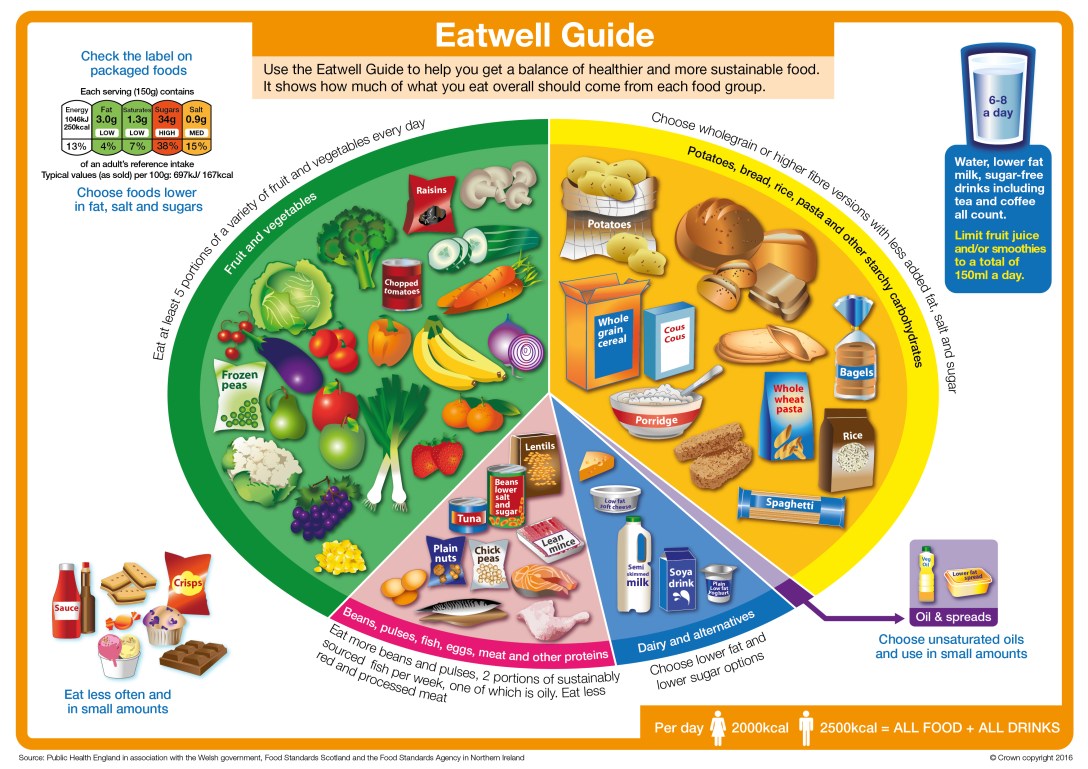
New UK “Eat Well Plate”: same old rubbish!

The UK government has released a new version of the risable “Eat well plate” which gives us at diabetesdietblog.com even more heartburn, if that were possible.

In this they have given due pominence to fruit and vegetables but have also advised even more starch such as bread, potatoes, breakfast cereals, pasta and rice. Low fat dairy is encouraged and protein is under represented again. Vegetable oil and low fat spread is given a little sliver of prominence. They have advised us to eat 30g of fibre a day and limit sugar to 30g a day.  Lordy, some of us don’t even eat this in total carbs a day! carbohydrate.jpgThey have said that 150g of fruit juice or smoothie can count as one of “your five a day”.

Cardiologist Aseem Mahhotra has tweeted, “Is this a joke?” Well, sad to say, probably not.

The government are grimly determined to back a diet that will lead to more obesity, diabetes, acid reflux, cancer and cardiovascular disease. Isn’t the NHS in enough of a mess already? Obviously the government don’t think so.


Freestyle Libre: continuous blood sugar monitor available in the UK

Freestyle have released the first reasonably priced continuous blood sugar monitor in the UK. Unfortunately it is not yet available on the NHS. You can purchase it for £157 and get extra sensors which each last two weeks for just short of £60 each.

Most blood test strips cost between 30p and 50p each. Most type one diabetics will be using 5 or more test strips a day. This costs £9,125 per person based on 5 strips at 50p each. A years supply of sensors for the Freestyle Libre will cost £1,508 so you can see that it has been priced fairly reasonably.

The new system works by having a sensor, about the size of a ten pence piece, inserted in the triceps area of the upper arm for up to two weeks at time. The adhesive is strong enough to withstand daily baths, showers and swimming activities. After an hour the new sensor is good to go.

After initial programming with your personal blood sugar targets, the mobile phone sized monitor picks up not only your blood sugar but shows the trend in which it is directed by means of directional arrows. This is perhaps the most important feature of the new machine. It would be really helpful for most people to know this when they are about to drive for instance, or if they are trying to address rising blood sugars during an attack of flu.

The number of times you can check your blood sugar with the Freestyle Libre is limitless and there are well designed graphics to show you how your blood sugars have performed over time.

80% of the costs of diabetes on the NHS is related to the treatment of complications. It seems to me that it would be money well spent for the NHS to invest in this new technology that can help diabetics control hypoglycaemia better as well as helping them keep their blood sugars in range and avoid high blood sugars. DTR_Libre_6995.jpg


Low carb advocate Dr David Unwin named Innovator of the Year by RCGPs

Congratulations to Merseyside GP and College Fellow David Unwin who has been named ‘Innovator of the Year’ at the national NHS Leadership Recognition Awards 2016.


David, who practises at the Norwood Surgery in Southport, spent three years working on a project combining the benefits of a low carb diet with psychological support to help patients with diabetes. As well as having much healthier patients, the practice now saves around £45,000 a year on diabetes drugs!


David has been a GP for over 30 years yet this award shows that his mission to constantly improve care for patients and his enthusiasm for the job remain undimmed. As well as being a fantastic personal, achievement, it is excellent to see the work of GPs being recognised on the national stage.


The judging panel said that the results of his work were outstanding and that he was ‘passionate about sharing knowledge to achieve a healthier world’. Hear, hear! unwin

Tax on Sugary Drinks Announced

tax on sugary drinksYesterday’s budget news revealed a surprise – the announcement of a tax on sugary drinks.

A surprise because the Government had not previously revealed any enthusiasm for such a tax. More educated commentators and politicians than I have noted that the chancellor George Osborne may well have brought in such a headline move to disguise other less popular cuts, such as the loss of personal independence payments for people with disabilities, cuts in corporation tax and taxes for the very wealthy.

The tax on sugary drinks is due to be introduced in April 2018. It’s expected to be two-tier approach with drinks that contain 5g of sugar per 100ml taxed at one rate and those containing 8g of sugar per 100ml taxed at higher rate. There are 35g of sugar in a 330ml can of Coke for instance.


Doctors, the NHS England boss, celebrity chef Jamie Oliver and health charities were among those welcoming the budget surprise. France, Finland, Mexico and Hungary already tax sugary drinks and sales in Mexico have fallen by 12 percent since the country introduced a surcharge of 12 percent in 2014.

There is one issue – some type 1 diabetics and other diabetics who use insulin to treat their condition consume sugary drinks when they are hypo – i.e their blood sugar levels are too low and they need something that will bring those blood sugar levels up very quickly. Diabetes UK has said it will be involved in the consultation about how tax on sugary drinks can be introduced to raise this concern so that it does not impact negatively on the way people with diabetes treat their condition.


Public Health Collaboration: A Group Of Doctors Are Crowd-funding To Solve The Obesity & Diabetes Epidemic


Eatwell_PlateIn the UK 25% of adults are obese, the highest prevalence in Europe, and type 2 diabetes has risen by 65% in the past 10 years with no sign of slowing down. Together they cost the NHS £16 billion a year and the UK economy at large £47 billion a year.

These perilous percentages and shocking statistics have presented themselves despite the fact that as a population Britons are following the dietary advice that is being recommended.

Based on the latest National Diet and Nutrition Survey published in 2014 by Public Health England, our total food consumption is on average 383 calories below the recommended, our total fat consumption is just below the recommended 35%, we’re just one portion shy of the recommended 5 fruits and vegetables a day, and lastly we’re only 1 g over the recommended amount of daily red meat intake.

Seemingly the issue of obesity and diabetes in the UK isn’t that Britons are over consuming but that they are following the dietary guidelines, known as the Eatwell plate given by the NHS.

A complete overhaul of these dietary guidelines is needed based on the most up to date scientific evidence in order to improve the health of the UK.

From Monday 1st February – Monday 29th February a group of 12 doctors have come together to solve the UK’s obesity and diabetes epidemics by crowd-funding to set up an independent public health charity called the Public Health Collaboration (PHC).

The group of doctors include deputy chair of the British Medical Association Dr. Kailash Chand OBE, dietitian Dr. Trudi Deakin, cardiologist Dr. Aseem Malhotra, psychiatrist Dr. Tamsin Lewis, general practitioner Dr. Rangan Chatterjee, clinical psychologist Dr. Jen Unwin, diabetologist Dr. David Cavan, general practitioner Dr. Katharine Morrison, general practitioner Dr. David Unwin, general practitioner Dr. Joanne McCormack, general practitioner Dr. Ian Lake and general practitioner Dr. Ayan Panja.

The PHC needs to initially raise £5,000 to publish it’s first public report on healthy eating and weight loss guidelines given by the NHS. Alongside funding it’s ambitious campaign for change within the NHS.

Director of the PHC, Sam Feltham, is closing down his fitness business and only taking a London Living Wage in order to fight for the cause and says “Our £5,000 fund-raising target doesn’t sound like it’s enough to change anything on such a large scale, especially if you’re used to big budgets, but we’re in a fortunate position that our founding members of doctors are not taking any money for helping write our reports and supporting our campaigns.

The PHC will have it’s first public report published in April 2016 on what the scientific evidence tells us should be the dietary guidelines for optimal public health. Once published we recommend that the NHS read the report and takes it seriously for the sake of the nation’s health and economy.”

You can contact Sam Feltham for further comment or to get in contact with our group of doctors by emailing info@phcuk.orgor by calling 07734944349. Website http://igg.me/at/PHCUKorg


“A cross-party long-term strategy is needed to combat obesity in children” says Brian Whittle

553c9c59e22f98bc5d30fa62

Brian Whittle is a gold medallist runner who aims to introduce widespread after school childcare focussed on delivering high quality exercise and physical activities. This is a long term strategy which is fun for children yet could provide immense health benefits and even enhance academic performance.

There are studies which support the validity of Brian’s aims.  But do enough politicians have the long sightedness and will to ring fence funding that is needed?

In order to prevent obesity in our youngsters and the disorders associated with sedentary behaviour a culture change is needed. The unhealthy eating, snacking and reliance on screen based entertainment needs to be replaced by three good meals a day and movement to counteract the long hours sitting in the classroom. Many parents work long hours too, and would welcome group based physical activity for their children in a safe environment.

Brian is seeking support from leaders and health ministers from all parties.  Some headmasters are highly supportive and are delighted with the improved behaviour, reduced truancy and improved grades that they are seeing in pupils who have become more engaged as a result of fun activities after school.

More than 2.3 million children in the UK are overweight or obese and even the under 12s are showing signs of high blood pressure, cholesterol abnormalities, type two diabetes and liver disease.

Dr Tim Lobstein, director of the Childhood Obesity Programme says,  “ It will be tragic if it is not tackled. Chronic diseases are moving forward at an ever increasing rate. Our kids are eating themselves into an early grave. We will have the first generation to die at an earlier age than their parents. Britain along with some other southern European countries are at the top of the list. While soft drink and confectionery sales have rocketed, and TV watching, computer games, and other sedentary media have grown, exercise has fallen. Unless the obesity epidemic is brought under control we are facing the prospect of medicating kids at primary school and for the rest of their lives. If we can just find a way of encouraging healthy growth then we can avoid an enormous amount of grief in the future. Unless we start teaching our children in schools about raising children, feeding them properly, exercise and the difference between good and bad food, then we are just going to exacerbate the problem.”

Getting children to become more physically active and achieve normal weights has been found to improve attention, planning and thus have knock on effects on academic performance. ( Davis CL et al Pediatr Exerc Sci. August 6 2015)

Children who are more active in late childhood can demonstrate lower body weight and lower risk factors for cardiovascular disease and diabetes by their mid- teens.  This means an hour of moderate to vigorous exercise a day. A national approach involving the collaboration of various government agencies would be needed to produce widespread benefit. (Stamatakis E. Pediatrics Vol 135 No 6. 6 Jun 2015)

For younger children under the age of 6, three hours of activity, spread throughout the day is recommended by the US Institute of Medicine. They hope that such recommendations can help reduce overweight and obesity which is currently at 27% in this age group.

For adults at least 30 minutes of activity a day is recommended. The good news is that the earlier you get into exercise the more the habit is like to stick.  Swimming, dancing, walking, running, yoga, jogging, tennis, basketball and football are all suitable. The fitter you are in early adulthood, the lower your total mortality rate and cardiovascular disease rate. There is a clear dose response between exercise and fitness and fitness, well-being and mortality rates. (Shah et al. JAMA Internal Medicine 1-9)

Even if you have been sedentary for years or cannot tolerate 30 minutes a day, it is recommended by the American Heart Association that you start with walking.  Apart from benefits to the individual there is a benefit in health care costs in the future. ( AHA 6 Dec 15)

Emma and I are already into the exercise habit. It certainly is more of a challenge in Scotland with our awful weather and long, dark, winter nights. What good ways have you found to keep active and support your children to be active?


Can shared decision making thrive in the current medical culture?

According to a Cochrane review patients are much more satisfied and have better health outcomes when their health care decisions are made in the context of full information and free choice. Patients said that “being in control” was what they most cherished.

At the present time the NHS doesn’t really support true shared decision making and options are likely to become even more limited with a shortage of doctors and strain on budgets. There also is considerable conflict when it comes to following guidelines which are designed for populations rather than individuals. Should a doctor really let the patient take the consequences of their individual choice or would they just be putting themselves at risk from a General Medical Council hearing?

Yet, not all patients want the most expensive treatments. When given full options a fifth of patients decided to avoid or defer surgery for instance.

What is meant to happen is that patients get given option grids with all the risks, benefits and uncertainties of possible investigations and treatments.  They are then asked, “What is the most important thing to you?” and then the doctor is meant to guide the patient accordingly.

Take bowel cancer screening. Currently all 50 year olds get sent a pack for this along with their birthday cards. Nice that someone remembers eh? They then get given the usual barrage of one sided messages about how bowel screening is really easy and could save your life.

If you care to look at this in more depth bowel cancer screening gives a total mortality benefit of six days to the screened population. The main problem is bowel perforation which occurs in 1 in 800 procedures. This is more likely to happen when going round the bends of the bowel.  Diagnosis of this can be delayed. Presumably with the shared decision making model all this is taken into account and the patient gets a truly informed choice.

Breast screening and statins are similarly pushed with considerable information asymmetry in the NHS.  There is no total mortality benefit to women from breast screening or statins yet that does not stop them being promoted. Not much has changed regarding how health care information is put across to patients in decades. An authoritarian stance is taken by the health care promoter and the patient is treated like an idiot.

With shared decision making it is likely that less money would be spent on useless investigations and treatments. If someone particularly wanted to avoid breast cancer “at all costs” they may be happy to be able to have screening perhaps more frequently than occurs at present, or perhaps they may be offered bilateral mastectomy. Many women would however decline to have mammography and that would be a saving not only for the procedure but for the unnecessary surgery and treatments that follow.

Shared decision making certainly doesn’t occur in diabetic clinics. The high carb / low fat diet is a product of “politics based medicine” rather than “evidence based medicine”.  Shared decision making is not for everyone. There will always be people and situations were doing what a doctor thinks is best is the most appropriate option.

But for a lot of non-acute health issues it is appropriate.  I can only hope that shared decision making doesn’t wither on the vine but a large shift in medical culture will be needed before it becomes regular practice.

Based on BMJ Learning module by Alf Collins.

Sugar Reduction Report Publication Delayed

sugarThis week, a UK news report revealed that the publication of a health report that called for the imposition of a sugar tax had been delayed.

The report, Sugar Reduction: The Evidence for Action, compiled by Public Health England (a government advisory group) had set out a number of policies which it believes can help tackle the obesity crisis in this country.

The policies included a sugar tax, a crackdown on the marketing of sugary and other unhealthy products to children, and continued action to push the message that most people need to lower their daily sugar intake.

The report was finally published on Thursday afternoon, although it has been originally scheduled for publication in July. The delay was attributed to the Department of Health (which PHE is part of) so that its findings could be used to inform the government’s forthcoming strategy to combat childhood obesity. The news report revealed that Prime Minister David Cameron had not read the report, dismissing a sugar tax out of hand.

The obesity crisis in the UK is thought to cost the NHS some £5.1 billion a year. The report says its suggested policies, including the sugar tax, are needed to reduce the consumption of sugary foods and drinks that are contributing to this crisis. Continue reading “Sugar Reduction Report Publication Delayed”