Dana Carpender: What Health Conditions Respond to Low Carb Diets?

Dana,  what is the range of health conditions that you have seen respond to a low carb diet in your readers?

The most exciting, perhaps, is polycystic ovarian syndrome, the most common cause of female infertility, and very definitely an insulin-driven illness. Back when I was still self-published, I got an email from a woman who had tried for years to get pregnant, but couldn’t because of PCOS. She read How I Gave Up My Low Fat Diet and Lost 40 Pounds, went low carb, got pregnant, and carried the child to term. That’s the kind of thing that keeps me grinning for days.

Commonly, I hear of vastly improved blood work – one fellow had his triglycerides plummet by 1200 points in 2 weeks. People regularly report low trigs and high HDL.

Blood pressure reliably drops, too. It’s common for detractors to say “Oh, you only lost water weight on that diet.” That’s nonsense, of course, but it is true that the very rapid loss of 5-10 pounds in the first week or so is largely water. That’s because when insulin levels drop the kidneys resume excreting sodium properly, and with it the water it was holding. Because of this, blood pressure comes down quickly. (For this reason, people who are medicated for high blood pressure must be under a doctor’s care when they first go low carb. They may need a reduction in medication within days.)

By the way, the proper excretion of sodium means that many low carbers need to increase their salt intake – I’m one of them. If a new low carber is feeling tired, achy, dizzy, headache-y, the first thing to try is increasing salt – heavily salted broth or bouillon works wonderfully.

Energy swings vanish when the blood sugar swings stop. Many annoying symptoms of generalized inflammation, such as arthritis, are reduced or eliminated.

Gastroesophageal reflux, aka heartburn, generally clears up.

hqdefault (5)

And all kinds of little things – skin conditions, bleeding gums, stuff like that. My husband, who has a mouth full of crowns, hasn’t had a single new cavity since we went low carb 20 years ago. (I still have no fillings at the age of 57.)

Perhaps most surprising was the woman who wrote me to say that since she and her husband had gone low carb, a range of problems had cleared up, including that he had “stopped coughing up blood.” She finished with “You have been a miracle for our family.”

I have no idea how a low carb diet would stop the coughing up of blood, but I’m certainly glad it did.


Dana Carpender is the author of nine cookbooks, including the best-selling 500 Low-Carb Recipes.

A Day of Low Carbohydrate Eating

One person’s low-carbohydrate diet will look very different to another’s. When you eat low-carb, meals start to lose the distinction higher carbohydrate meals have.

At some point in the 20th Century, marketers decided that some foods were breakfast foods and some should be defined as lunch. Therefore, breakfasts should be cereal and/or toast, and at mid-day you should eat sandwiches, or bread and soup for example. That means you need ready-made products – boxes of corn flakes, or packets of pre-prepared slices of bread filled with cheese, ham and various other choices.

A low carb diet doesn’t usually include cereals and sandwiches, so anything can be eaten for breakfast or lunch. Leftovers from last night’s dinner, eggs and bacon for lunch – why limit yourself to a time of day food marketers have decided to earmark for certain foods?

To this end, I thought I’d document a day of low-carb eating. See what you think.

Breakfast

low carb breakfastsCream cheese and cucumber slices. We’ve been growing cucumbers this year – successfully too. I sliced some up and had them with some Asda soft cheese. It looks a bit like ice-cream doesn’t it?

Lunch

diabetes dietPrawns in home-made pesto, with baby sweet corn. I’ve got a couple of basil plants so I stripped the leaves from most of one, and blended them with 150ml extra virgin olive oil, one clove of garlic, salt, 40g sunflower seeds and 40g grated Parmesan. I use sunflower seeds rather than the traditional pine nuts as sunflower seeds are much cheaper.

This quantity will make you enough pesto to last a week. Store it in the fridge and use as a salad dressing, mixed with roast aubergines, peppers and courgettes, or spread on top of roast chicken.

Dinner

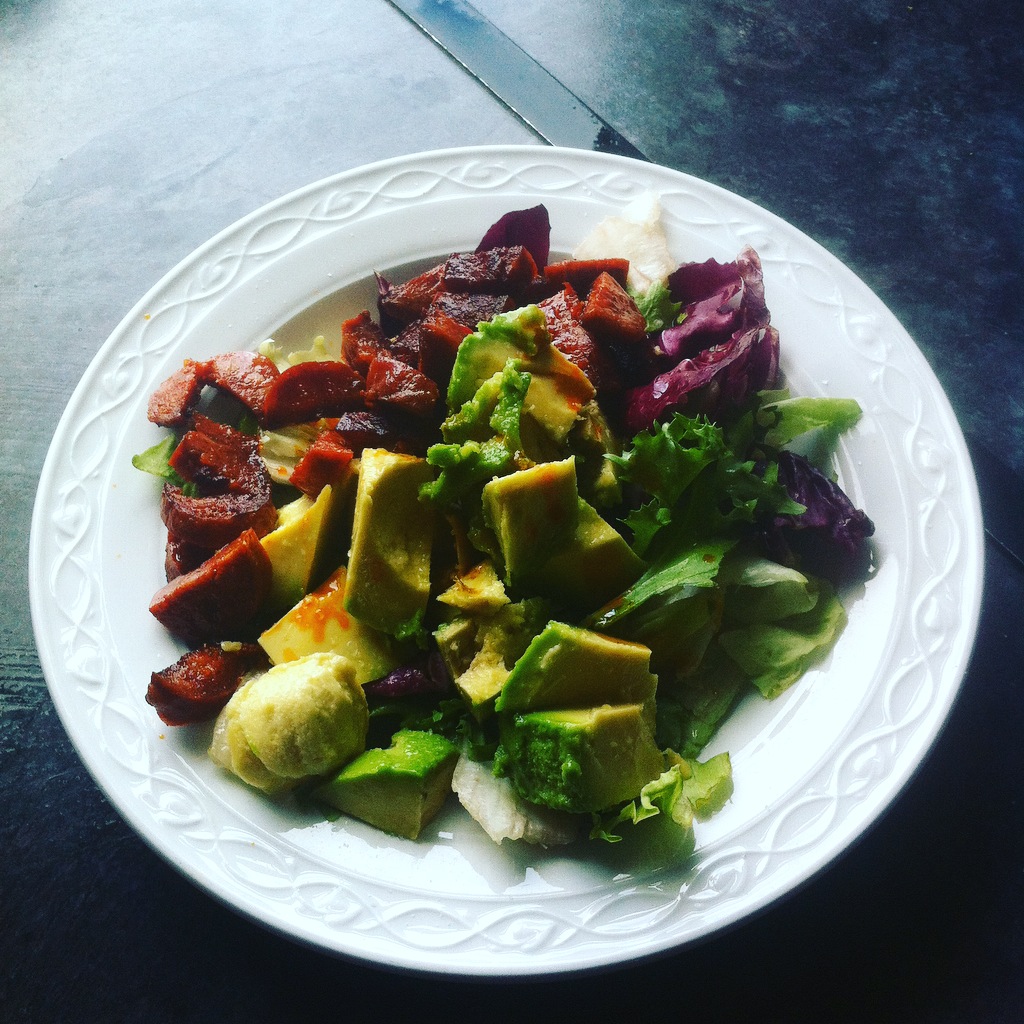
low carb saladsAvocado and chorizo salad. Recipe here.

I also ate an apple and cheese. The carbohydrate count for the whole day was roughly 50g.


What do you eat? What’s your favourite meal of the day – or your best meal? Let us know in the comments.


Disclaimer: my meal choices are not necessarily recommendations – it’s just what I ate one particular day.

Diabetes Self-Care is Often at The End of the List for Patients. Why?

Jim_Gaffigan_making_a_goofy_excited_face,_Jan_2014,_NYC

A team of Swedish medical researchers interviewed 24 people who had diabetes to see if there were factors that got in the way for self-caring behaviours that enhanced diabetes management. They found that some patients didn’t believe diabetes was all that serious, that it was way down the priority list compared to dealing with other life problems, that they didn’t believe it was under their control anyway and that it simply wasn’t worth sacrificing a good time for.

Any of this sound familiar?

Other illnesses, emotional distress, prioritising the needs of others and money problems all seemed to get in the way of getting to grips with self- care routines that are the crux of effective diabetes management.

For patients who are struggling with the condition, the authors think that medical professionals would be far better of focusing on what is desirable and realistic for individual patients rather than trotting out the “usual” advice, which is often perceived as being totally beyond the ability of some people and at some times in their lives.

Family support has been recognised as been a major factor in diabetes management adherence. The health care system and how easily it can be accessed is another environmental factor. Susann Strang, with her nursing background, understands that the patients’ life experiences, current situation, cultural background, beliefs and attitudes all affect their willingness and ability to follow treatment recommendations. If consultations are patient centred rather than protocol centred improvements in glycaemic control can be seen.

The patients who were interviewed for the study came from an area of Sweden with a high number of immigrants and a low socio-economic status. The number of smokers and amount of cardio-vascular disease was higher than more affluent areas in Sweden. A range of type two patients over the age of 18 were given in depth interviews. They were asked, “What does living with diabetes mean to you?”

Many people said that their lives had become more structured and limited by the diagnosis of diabetes. They were aware that food and medicine were basic issues in the control of the condition and had incorporated routines into their lives so that particularly those who had had diabetes for some time almost forgot about it. “For me diabetes is only something I have and I will have it as long as I live. I don’t think so much about it. It is like having a cup of coffee in the morning, or like going to the laundry.”

The lack of symptoms accompanying high blood sugars often led people to relax about diabetes management. Work responsibilities, home problems, lack of support, loneliness, and frank depression all reduced quality of life and put diabetes into the background. Immigrants often missed their old lives and countries or worried about relatives. Some had given up prior religious beliefs as a result of trauma they had witnessed.

Cardiac disease, high blood pressure, inflammatory problems, chronic obstructive lung disease and depression often seemed more important issues than diabetes, particularly when it was almost without any perceptible symptoms.

Some people thought that it was their fate to get diabetes. They also did not believe that changing their lifestyle was their responsibility. “The only thing the doctor complains about is losing weight. No matter how hard I try I can’t get below 84kg. I’m just like my parents. So it has to do with the genes. And you can’t change them.”

Respondents sometimes discussed feeling hopeless and resigned to the situation. One even thought that society was to blame for his lack of motivation to change his lifestyle.

Although most patients had had nutritional advice, most had trouble keeping to the plan. The social factors of enjoyment of food were seen as more important than eating right for diabetes control. The taste of food, perceived boredom of healthy food, and cooking ability all affected the degree to which people were willing to change their diet.

The majority of respondents were well aware of the positive effects of physical activity yet some took no exercise at all. To explain this they said they were lazy, exercise was boring, it was more convenient to sit on the couch or at a computer, it was painful to exercise, they were too tired, they were depressed, they had sleep problems, they had no idea how to go about it and they didn’t have enough money to exercise. Some worried that exercise was bad for the heart.

Sadly other studies by ST Miller and P Jallinoja also have identified the same unwillingness to change to a more beneficial lifestyle is not uncommon among people with diabetes.

The authors recommend that health care professionals learn about the way individual patients view living with diabetes and what type of care they really prefer. As patients can change their views over time, keeping the door open to change is recommended.

The Danish philosopher Soren Kierkegaard said, “If I want to succeed in bringing a person towards a specific goal, I must find out where she is and start from there.”

Adapted from Diabetes in the shadow of daily life: factors that make diabetes a marginal problem. Anders Agard, Vania Ranjbar, Susann Strang. Practical Diabetes March 2016.


Don’t be stuck for words on your holiday with Duolingo

welcome-905562_960_720


Duolingo is a free site that offers you easy to do chunks of language learning in your own time.

Going on holiday with diabetes, particularly if you use insulin, can be trickier than average, so a little basic language can help you a great deal if you need to see a doctor or visit a pharmacy.

Duolingo gives modules on all of the basics that you can cover in 5-20 minutes a day. You set your own learning goals. You can even compete with your friends.

Food, directions, feelings, sports and medical words and phrases are all covered, as indeed are many other topics. For more advanced learners tenses are covered in more depth towards the end of the course.

All European and Scandanavian languages are covered. So are Russian, Ukrainian, many Asian and African languages. You can even learn Esperanto and Klingon! (Well you never know…)


1280px-Klingon_(1305760507)


Dana Carpender: how can low carbers overcome difficulties?

Chris_Sharma_Climbing_in_Yangshuo,_China (1).jpgIn part two of my interview with Dana Carpender, author of several low carb cookbooks, Dana gives words of experience and wisdom concerning lack of support at home, dealing with emotional blackmailers and gives her favourite online resources to help you.

Q. Dana, what do low carb dieters tend to struggle with the most? What strategies help them to overcome these difficulties?

Low carb dieters often feel like the odd man out. This is especially true if they have no support at home, or even face opposition.

I have heard some real horror stories. One that has stuck with me since my self-published days was a woman who wrote to say that she had been morbidly obese and had diabetes, but had committed to low carb, lost a lot of weight, and greatly improved her health. Her husband, for some unpleasant reason of his own, was threatened by this. He would bring home a box of expensive chocolates, open the box, and set it on the sofa next to her. She had taken to slipping a few into a baggie and tucking them under the seat cushion, so her husband would think he was “winning.”

I told her that while I admired her patience and strategic thinking, I would have marched the whole box of chocolates straight to the bathroom and flushed them down the toilet. Let him spend his money feeding the septic tank and maybe he’d cut it the heck out. But then, I’ve never been known to be a shrinking violet.

Support is vital. If a low carber doesn’t find it at home, s/he needs to seek it out. There are hundreds, if not thousands, of low carb Facebook groups and message boards, each with its own culture. Anyone can find a few where they fit in (and quit the ones that aren’t a good fit). A low-carb Meetup (www.meetup.com), perhaps for Saturday brunch, can be a great source of local support. Consider starting one.

It also helps to develop an attitude. No apologizing, no listening endlessly to all the people who are “concerned” that you’re not eating a “balanced diet,” or who parrot “all things in moderation.” A quick “Thanks for your concern,” perhaps — the first time, not the tenth — and then quite deliberately change the subject. (Eventually you’ll very likely be able to say, truthfully, “My doctor says I’m doing great.” When people tell me that a low carb diet will give me heart disease, ruin my kidneys, yadda-yadda, I make big eyes at them and plaintively ask, “When?”)

It helps, too, to read a few blogs or listen to some podcasts that will keep you filled in on the rapidly accumulating research showing just how beneficial a low carb/high fat diet is. Jimmy Moore does a great job both blogging and podcasting. I love Tom Naughton’s Fathead blog. Andreas Eenfeldt’s Diet Doctor is always good for a quick shot of enthusiam, while for geeks like me, Dr. Michael Eades at Protein Power does a terrific job with more detailed medical analysis. Gary Taubes, Dr. Malcolm Kendrick — there are so many smart and credentialed people writing on the topic, there’s no reason to let yourself be scared by the “But all that fat!” boogeyman. Katharine, you are doing one of the most helpful things possible for the low carb community.

Along with feeding your body the right food, feed your brain the right messages.

Sooner or later you will deal with a food pusher. In particular, female relatives tend to do this — Mom, mother-in-law, grandma, etc. You’ll be at Thanksgiving/Christmas/Fourth of July/whatever, and it will start:

“But you can’t diet on a holiday! You have to treat yourself sometime! Anyway, Aunt Suzy made her sweet potato casserole just for you! It’s tradition! You have to have some!” Etc, etc, etc. We all know the 1001 verses to this song.

Be clear on this: It is always polite to say, “No, thank you.” If you feel like you’re being rude, ask yourself how you would react if you were violently allergic to the item being offered, to the point that you would collapse right there from anaphylaxis. Would you feel you were being rude to say “No, thank you?” Would you feel “loved” by the pressure to eat that food, and your health be damned? You would not. You’d wonder if they’d taken out a sizeable life insurance policy on you.

As for “You have to treat yourself,” ask yourself this: Why does no one say this to sober alcoholics? Or people who have finally managed to kick a two-pack-a-day cigarette habit?  Carb addiction is just as deadly. It takes longer, that’s all.

But you know as well as I that the family food pusher will not take a simple “No, thank you” for an answer. There will be endless push-back.

What you must not do is JADE: Justify, Argue, Defend, or Explain. You do not have to justify your choices to anyone, and any argument or explanation will be seized upon as ammunition to argue you out of your stance. Instead, try this neat bit of social ju-jitsu: Say “No, thank you,” and then immediately change the subject. Do this by asking a question of the group at large, or at least of someone other than the food pusher.

Let’s practice, shall we?

“You always loved my homemade banana bread! I made it just for you! You have to have a slice!”

“No, thank you. Hey, does anyone want to hit the sales first thing tomorrow?”

“You can’t diet on Thanksgiving! You have to have at least one piece of pie!”

“No, thank you. Hey, has anyone seen cousin Jamie’s new baby? Any photos?”

“Just a little bit won’t hurt! I made it from Grandma’s recipe!”

“No, thank you. Hey, Henry – you’re graduating this year, right? Have you started applying to colleges?”

I recommend you come up with a list of questions before you attend this sort of event, anything from “Has anyone seen (insert current movie)?” to “I’m thinking of going to Playa Del Carmen on vacation. Has anyone been?” By doing this, you make the food pusher look a trifle obsessed if she continues – she, rather than you, becomes the oddball.


More Children Suffering from Type 2 Diabetes

diabetes lettersThe BBC reported this week that there has been a worrying rise in the number of children developing Type 2 diabetes.

Figures for England & Wales show that 533 children and young people have been diagnosed with type 2 diabetes. Last year’s figure was 500. Most children have type 1 diabetes and the type 2 figure represents 2 percent of all cases of diabetes.

While type 2 diabetes is much more common overall, it is still rare in children. Type 2 diabetes is linked to obesity.

The Local Government Association, which represents local councils who have responsibility for public health, believes cases will continue to rise. They believe the Government’s childhood obesity strategy, which is yet to be published, needs to take bold action.

The LGA has called for teaspoon sugar labelling of products and reduced sugar in fizzy drinks, as well as greater provision of tap water in schools. The association also thinks councils should be given the power to ban junk food advertising near schools.

The government has postponed the publication of its childhood obesity plan a number of times. It is expected to be published later this summer.

The Department of Health said it was determined to tackle obesity and that the strategy would look at everything that contributes to a child becoming overweight.


*Pic thanks to Practical Cures on flickr


Dr Bernstein’s Diabetes University on You Tube

Diabetes in Control Advisory Board member, Dr. Richard K. Bernstein, has recently created, “Dr. Bernstein’s Diabetes University,” a complete course of video classes geared towards patients, which is now available on Youtube. Dr. Bernstein’s Diabetes University Playlist includes these short videos: “Basic Science of Diabetes,” “Values and Methods of Exercise,” “How Much Protein,” plus much more. Just follow this link for more information: Dr. Bernstein’s Diabetes University Playlist
bernstein

Dsolve.com back in action


122124


Ryan Whitaker, a Colorado IT specialist, set up the dsolve.com site nine years ago. The aim was to have an online site for low carbing diabetics to share news and resources and to host the educational course that we developed from the experience of Dr Richard Bernstein’s Forum members at the time. At the time this was the first comprehensive diabetes educational course to go online. And best of all it was free, and still is.  This course, the How to.. course now features on diabetesdietblog. com.

After an absence of two years we are very pleased to say that dsolve.com is back in action.

Feel free to pay a visit.

Ryan is one of the many type one diabetics who has had excellent blood sugar control as a result of following a low carb diet and using insulin techniques originally developed by Dr Bernstein.  These are explained in the course material and of course in our book Diabetes Diet.

Fasting Guidelines for Diabetics During Ramadan Update

empty plateThe International Diabetes Federation (IDF) has updated its advice about how to control diabetes throughout the annual fasting period of Ramadan.

This year, Ramadan starts on 6 June. The start and end dates depend on sighting of the moon. Ramadan is observed by more than 1billion Muslims each year and it commemorates the first revelation of the Quran to Mohammad.

The new guidelines have been drawn up by the Diabetes and Ramadan (DAR) International Alliance. They have been approved by the senior Muslim professor, Sawky Ibrhaim Allam.

During Ramadam, practising Muslims fast from dawn to dusk. The new guidelines say that people with diabetes should make the decision about fasting on an individual basis and in consultation with their physician.

The guidelines state that the decision should take in to account the severity of their illness and the level of risk. They also provide nutrition plans and medication adjustment suggestions that can be used during fasting.

The NHS recommends that people who control their diabetes using diet or tablets can fast with healthcare guidance, but advises those who use insulin to control their diabetes not to do so.

Freestyle Libre: continuous blood sugar monitor available in the UK

Freestyle have released the first reasonably priced continuous blood sugar monitor in the UK. Unfortunately it is not yet available on the NHS. You can purchase it for £157 and get extra sensors which each last two weeks for just short of £60 each.

Most blood test strips cost between 30p and 50p each. Most type one diabetics will be using 5 or more test strips a day. This costs £9,125 per person based on 5 strips at 50p each. A years supply of sensors for the Freestyle Libre will cost £1,508 so you can see that it has been priced fairly reasonably.

The new system works by having a sensor, about the size of a ten pence piece, inserted in the triceps area of the upper arm for up to two weeks at time. The adhesive is strong enough to withstand daily baths, showers and swimming activities. After an hour the new sensor is good to go.

After initial programming with your personal blood sugar targets, the mobile phone sized monitor picks up not only your blood sugar but shows the trend in which it is directed by means of directional arrows. This is perhaps the most important feature of the new machine. It would be really helpful for most people to know this when they are about to drive for instance, or if they are trying to address rising blood sugars during an attack of flu.

The number of times you can check your blood sugar with the Freestyle Libre is limitless and there are well designed graphics to show you how your blood sugars have performed over time.

80% of the costs of diabetes on the NHS is related to the treatment of complications. It seems to me that it would be money well spent for the NHS to invest in this new technology that can help diabetics control hypoglycaemia better as well as helping them keep their blood sugars in range and avoid high blood sugars. DTR_Libre_6995.jpg