
Sheri Colberg: Joint health is critical to staying active

vGqfCBC

Joint Health Is Critical to Staying Active

Diabetes in Control

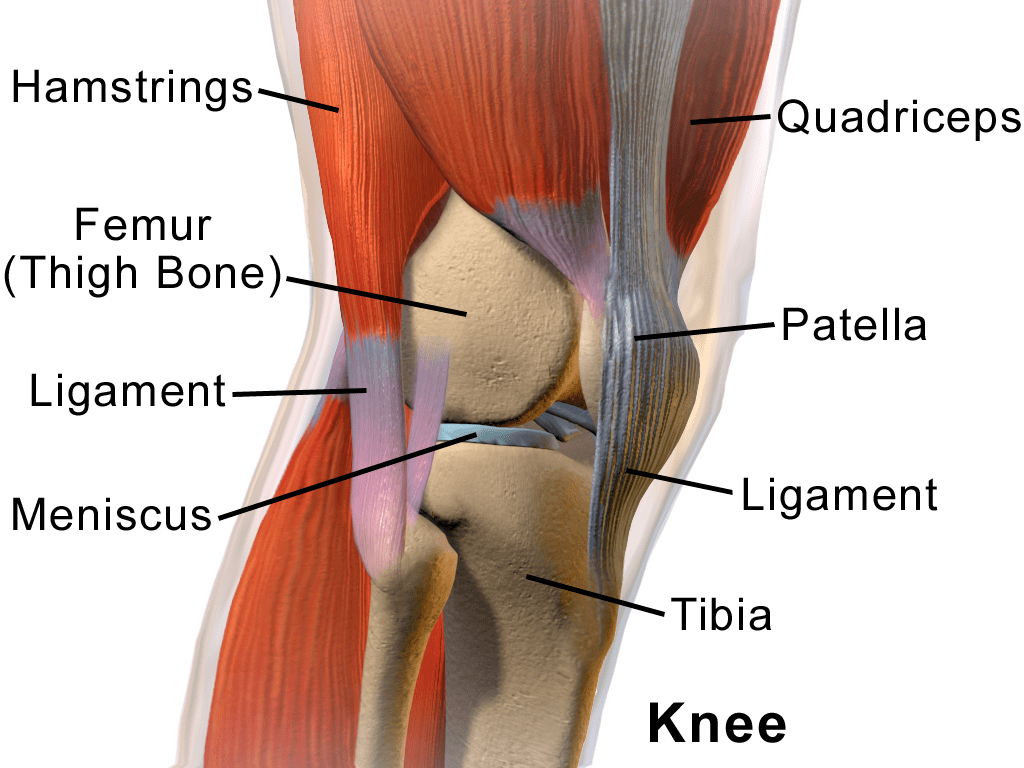
Without properly functioning joints, our bodies would be unable to bend, flex, or even move. A joint is wherever two bones come together, held in place by tendons that cross the joint and attach muscles to a bone on the other side and ligaments that attach to bones on both sides of the joint to stabilize it. The ends of the bones are covered with cartilage, a white substance formed by specialized cells called chondrocytes. These cells produce large amounts of an extracellular matrix composed of collagen fibers, proteoglycan, elastin fibers, and water. Tendons and ligaments are also made up primarily of collagen.

Joints can be damaged, however, making movement more difficult or painful. Joint cartilage can be damaged by acute injuries (i.e., ankle sprain, tendon or ligament tears) or overuse (related to repetition of joint movements and wear-and-tear over time). Damage to the thin cartilage layer covering the ends of the bones is not repaired by the body easily or well, mainly because cartilage lacks its own blood supply.

Aging alone can lead to some loss of this articular cartilage layer in knee, hip, and other joints—leading to osteoarthritis and joint pain—but having diabetes also potentially speeds up damage to joint surfaces. Although everyone gets stiffer joints with aging, diabetes accelerates the usual loss of flexibility by changing the structure of collagen in the joints, tendons, and ligaments. In short, glucose “sticking” to joint surfaces and collagen makes people with diabetes more prone to overuse injuries like tendinitis and frozen shoulder (1; 2). It may also take longer for their joint injuries to heal properly, especially if blood glucose levels are not managed effectively. What’s more, having reduced motion around joints increases the likelihood of injuries, falls, and self-imposed physical inactivity due to fear of falling.

Reduced flexibility limits movement around joints, increases the likelihood of orthopedic injuries, and presents a greater risk of joint-related problems often associated with diabetes, such as diabetic frozen shoulder, tendinitis, trigger finger, and carpal tunnel syndrome. These joint issues can come on with no warning and for no apparent reason, even if an individual exercises regularly and moderately, and they may recur more easily as well (3). It is not always just due to diabetes, though, since older adults without diabetes experience inflamed joints more readily than when they were younger.

So what can you do to keep your joints mobile if you’re aging (as we all are) and have diabetes? Regular stretching to keep full motion around joints can help prevent some of these problems, and also include specific resistance exercises that strengthen the muscles surrounding affected joints. Vary activities to stress joints differently each day. Overuse injuries occur following excessive use the same joints and muscle in a similar way over an extended period of weeks or months, or they can result from doing too much too soon.

Doing moderate aerobic activity that is weight-bearing (like walking) will actually improve arthritis pain in hips and knees (4). People can also try non-weight-bearing activities, such as aquatic activities that allow joints to be moved more fluidly. Swimming and aquatic classes (like water aerobics) in either shallow or deep water are both appropriate and challenging activities to improve joint mobility, overall strength, and aerobic fitness. Walking in a pool (with or without a flotation belt around the waist), recumbent stationary cycling, upper-body exercises, seated aerobic workouts, and resistance activities will give you additional options to try.

Finally, managing blood glucose levels effectively is also important to limit changes to collagen structures related to hyperglycemia. Losing excess weight and keeping body weight lower will decrease the risk for excessive stress on joints that can lead to lower body joint osteoarthritis (5). Simply staying as active as possible is also critical to allowing your joints to age well, but remember to rest inflamed joints properly to give them a chance to heal properly. You may have to try some new activities as you age to work around your joint limitations, but a side benefit is that you may find some of them to be enjoyable!

References:

  1. Abate M, Schiavone C, Pelotti P, Salini V: Limited joint mobility in diabetes and ageing: Recent advances in pathogenesis and therapy. Int J Immunopathol Pharmacol 2011;23:997-1003
  2. Ranger TA, Wong AM, Cook JL, Gaida JE: Is there an association between tendinopathy and diabetes mellitus? A systematic review with meta-analysis. Br J Sports Med 2015;
  3. Rozental TD, Zurakowski D, Blazar PE: Trigger finger: Prognostic indicators of recurrence following corticosteroid injection. J Bone Joint Surg Am 2008;90:1665-1672
  4. Rogers LQ, Macera CA, Hootman JM, Ainsworth BE, Blairi SN: The association between joint stress from physical activity and self-reported osteoarthritis: An analysis of the Cooper Clinic data. Osteoarthritis Cartilage 2002;10:617-622
  5. Magrans-Courtney T, Wilborn C, Rasmussen C, Ferreira M, Greenwood L, Campbell B, Kerksick CM, Nassar E, Li R, Iosia M, Cooke M, Dugan K, Willoughby D, Soliah L, Kreider RB: Effects of diet type and supplementation of glucosamine, chondroitin, and msm on body composition, functional status, and markers of health in women with knee osteoarthritis initiating a resistance-based exercise and weight loss program. J Int Soc Sports Nutr 2011;8:8


In addition to my educational web site, Diabetes Motion (www.diabetesmotion.com), I also recently founded an academy for fitness and other professionals seeking continuing education enabling them to effectively work with people with diabetes and exercise: Diabetes Motion Academy, accessible at www.dmacademy.com. Please visit those sites and my personal one (www.shericolberg.com) for more useful information about being active with diabetes.

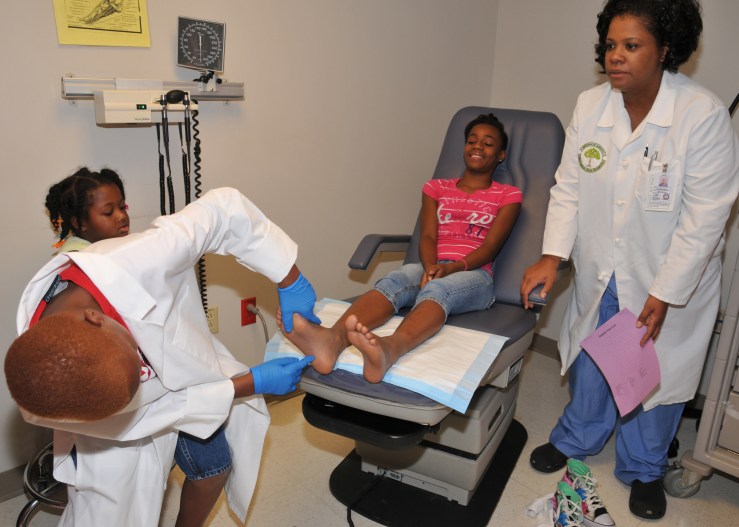
Diabetic children miss out on hospital checks

foot examination.jpg

Paediatric endocrinology clinics have a  non-attendance rate of 11.4% in the south west of the UK. The majority of these patients have diabetes.

Children who did not attend were more likely to  come  from families living in areas of high deprivation and to have a child protection alert in their hospital records.

In 60% of the cases, the GP was not informed that the child had not appeared, so they were not in a position to follow the child up themselves. Some of the children were sent other appointments, some were given an open attendance appointment and some were discharged.

About half of the children were eventually seen within a year and a third attended A and E. Almost a quarter went back to see the GP and half of these were re-referred.

My comments: In my own practice I am aware that a minority of parents are very poor at attending diabetic clinics with their children. We are always informed and keep out an eye for opportunistic intervention when the child attends for another matter. Our hospital has a good nurse liaison service and they do their best to keep a dialogue open with the parents and visit at home. Sometimes lack of money for bus fares is given as an issue. Sometimes work commitments or having to make arrangements to look after other children in the family is the reason. For one reason or another, the child’s diabetes management does not have the priority that it is given in other homes, and that doesn’t work out well on the long term.

Reported in BMJ 24th June 2017 by Ingrid Torjesen BMJ 2017;357:j2983


Smoking rates down in young adults

girl-844051_960_720

Smoking decreased in all age groups in England between 2010 and 2016.  Overall 15.5% of the population smoke compared to 19.9%.

The greatest reduction was seen in young adults in the 18-24 age group, down from 26% to 19%.

Men are more likely to smoke, 19% than women, 14% but those who are unemployed are almost twice as likely to smoke compared to those who have jobs. 16% v 30%.

My comment: Diabetes and smoking is particularly hazardous long term. Unfortunately General Practitioners are reporting that smoking cessation schemes are losing funding due to budget cuts. If you don’t smoke, please don’t start. 

If you do smoke and think that you’ll never find the motivation to give it up, there are some people who managed it, who discuss what was important to them in the videos in this link:


https://www.cdc.gov/tobacco/campaign/tips/resources/videos/index.html?s_cid=OSH_tips_D9390


Rick: I’m a prick when I am low

 Tony the Tiger

I have been many things, husband, father, coworker and patient.  I am also a person with type 1 diabetes.  I have lived with type 1 for 42 years and I have to admit I am at least one more thing.   I can be a prick when I am low.  It’s true.  I acknowledge it.   Of course I often prick my finger to test my blood sugar, but I am also a prick.

Low Blood Sugar?

Having a low blood sugar is like being in an automated car wash without a car.  Having a low blood sugar feels like all the stimuli are coming at one thousand miles per hour and yet all you can think about is food.  It causes those around us to suffer sometimes.  I have many low blood sugar stories, some funny, some sad, and a few dangerous.  It is the accumulation of stories that show up after 42 years of taking an artificial hormone that allows me to live.

Low blood sugar is caused by not adequately matching food, exercise, and insulin. An insulin user can go low if they eat too few carbohydrates, exercise more than estimated, their body is assaulted by emotional stress (good or bad experiences), too much insulin is delivered, or a thousand other inputs that get out of balance.  No matter the cause; the result can be extreme sweating (I hate that one), rapid convulsive movement in hands or legs, unconsciousness, blurry vision, confusion, hunger, crying (I hate that one as well) or in some cases no discernible symptoms at all.  My most typical symptom is anger.  I tend to get defensive when I have a low blood sugar and I can turn into a raging lunatic.

But A Prick?

I can turn into a raging maniac based on the stimuli around me.  I have been known to throw things, yell, take off my clothes, laugh wildly, hit, and disobey those trying to help me.  I once opened and ate a box of Kellogg’s Frosted Flakes in the store.  When the manager asked why I was doing that I said the most important thing I could think of.  Because they’re GREAT!!!!!!

However, when I get upset is when someone remarks about my care while I am low.  These phrases always start with same words,   If you, you need, you should, if only followed by some prescription for what I did wrong or could do better to manage diabetes.  It angers me to hear these things, as if I wanted this outcome, or the speaker could do better.

Inputs and Outputs

Taking insulin is not strictly an input/output arrangement. The human body is much more complicated than the sum of its inputs.  I know this because sometimes I eat the same food, do the same exercise and take the same insulin and I get widely varying results.  It seems unfair that if I am sitting at home I can go low because my body metabolized its inputs differently.  Sometimes stuff happens.

Yes, we can control some parts of the equation.  I can put in less insulin, I can eat more or less carbohydrates and I can stay home while the family goes on a walk or swim, but that is like sitting on a four legged stool with two legs cut off. Most of the time I get it right.  I can usually keep the stool balanced but often, I make a mistake and my blood sugar goes too high or low.

What I have learned after 42 years of managing diabetes 24/7/365 is that no one can do it perfectly.  We miss and sometimes those misses are big. When that happens, I may need some help.  And if I ask for that help, know I do not mean to be a prick, but if I am also know my apology is sincere. After all I hate pricks those on my finger or the one that comes out when I am low.

BBC – Hidden disabilities: Pain beneath the surface


help-686323_960_720Hidden disabilities: Pain beneath the surface

Imagine having to inject yourself thousands of times over the course of your lifetime, but never talking about it to anyone.

Many people live with hidden disabilities – conditions which don’t have physical signs but are painful, exhausting and isolating. Sympathy and understanding from others can often be in short supply.

Georgia Macqueen Black has Type 1 Diabetes.

She was diagnosed at the age of 11.

Type 1 Diabetes cannot be seen until I take out my insulin pen and inject myself, but the mechanical parts – blood tests and injections – are only the surface layers of what I have to manage.

Someone may see me inject, but there’s an isolating exhaustion I take with me afterwards. There will always be another injection and it can generate a disconnection between myself and other people.

Every day I gather the willpower to be a “good” diabetic, but when I follow the rules and still have high blood sugar I feel alone. It makes me feel foggy with a limited ability to concentrate. And the side-effects of too much or too little sugar in your blood can lead to you turning in on yourself.

The biggest challenge is accepting the monotony of managing diabetes. There are days when I’m tired of having a weaker immune system – a lesser known side-effect of diabetes – or when I find lumps under my skin from injections, but then I have to put those feelings to one side and carry on.

Some people might not think diabetes deserves the label “disability”, but if unmanaged it affects my ability to carry out tasks and I have to think how exercise, stress or dehydration will impact my blood sugar levels.

I often worry about how life will be when I’m older. This feeling of uncertainty hangs over me from time to time, and can make me feel lonely and a bit lost.

But I know there’s a silent solidarity out there. Someone with an impairment could be having a day where everything has become derailed and they feel ill, but I bet you they won’t show it. It’s that resilience that I really connect to.

Top tips on hidden disabilities


  • There’s so much mental labour involved so if I seem distracted it’s probably because of that
  • Believe me when I ask for help. Just because I don’t look like I need assistance, doesn’t mean I’m OK
  • Respect priority seats and wheelchair spaces on public transport
  • Listen to access requirements with an open mind – often small changes make a huge difference
  • Ask for what you need – in asking for help you don’t have to pretend to be someone else


Produced by Beth Rose

BBC Disabilties 5.7.17

Why do some consultations go wrong and what can we do about it?

elephant.jpg

One in seven consultations are described as difficult by the doctors doing them. Why this happens can be grouped into several categories: patient, doctor, disease and system. More than one factor may contribute in any consultation.

Patients can come across as uncooperative, hostile, demanding, disruptive and unpleasant. Of course the patient may think exactly the same thing about the doctor! Patients may have unrealistic expectations or be unwilling to take responsibility for their health.

Doctors may be in sub-optimal states even before the consultation has started. They can be hungry, angry, late or tired. Their personal lives may be a mess. Their personality may clash with the patients. They may have pre-conceived ideas about the patient which handicaps the consultation before the patient even opens their mouth.

Some conditions are particularly challenging to deal with. These include chronic pain, ill -defined diagnoses and those with little prospect of improvement. Straightforward conditions where there is a recognised pathway of management broadly understood by both doctor and patient are much easier to deal with.

Limited resources, finances, support, interruptions and particularly time pressures all contribute to the difficulties experienced by doctors.

Difficult interactions with patients can take up a disproportionate amount of the doctor’s time, resources and emotional energy. They can cause the doctor to feel stress, anxiety, anger and helplessness and can lead to a dislike of the patient and the use of avoidance strategies. All this compromises the doctor’s ability to provide good care and can lead to increased mistakes which are bad for both doctor and patient alike.

A difficult interaction makes both parties feel frustrated and dissatisfied and may result in a breakdown of trust. The patient is then likely to seek another doctor in the practice or at the hospital and this uses up more precious health care resources.

A doctor who stops listening to patients, argues, talks over them and interrupts them does nothing to get out of the downward spiral that occurs in these consultations. Instead, these other suggestions, which may be made by either doctor or patient can help set things right again.

The first thing to do is to recognise when these difficult consultations arise and instead of getting sucked into the “I’m right and you’re wrong” game, take a step back and try to say what the problem is.

A doctor may say, “ We both have very different view about how your symptoms should be investigated and that is causing some difficulty between us. Do you agree?”  A patient may say, “We both seem to have very different views about the optimal number of blood sugar tests that a diabetic needs to do. Do you agree?”

This approach names the elephant in the room and avoids casting blame, fun though that sometimes is. It externalises the problem from both the patient and the doctor and creates a sense of shared ownership. Verbalising the difficulty is the gateway to working towards a solution.

Sometimes a person who is coming across as angry and abusive may be highly anxious about for example a terminally ill partner.  A doctor can say,  “You seem to me to be very angry about this.  Tell me more about this.”  It is important to listen to what the patient says, because if the patient really feels that they have been heard they are likely to calm down.

Sometimes what the patient wants really is unreasonable. A doctor may have to be clear about what is and is not acceptable sometimes. It is useful for all members of the practice to have consistent rules regarding such things as prescribing or late appointments. The way to explain this could be, our practice has a policy about this matter and the policy is…..

Doctors and patients will often have different ideas on issues such as diagnosis, investigations, and management options. Sometimes there seems to be no common ground which is often the result of unrealistic expectations.  Dr Google and The Daily Mail may have something to do with this.  If both can strive to achieve some common ground difficulties usually diminish.

A solution focused process helps the patient feel included and that they are not being abandoned. Asking them to come up with different options can take some of the burden off of the doctor.


Adapted from article by Marika Davies, medico legal adviser, Medical Protection Society, London.

Published in BMJ 3 August 2013

Anal injuries in Childbirth: A new charity for this rarely discussed problem

Always_Maxi_pads.jpg

Adapted from Anne Gulland’s interview with surgeon Michael Keighley published in BMJ  25 March 2017.

About one in ten first time mothers who give birth vaginally can develop some sort of anal incontinence. This can lead to soiling, passing wind when you’d rather not, and needing a toilet urgently.

Despite the number of women affected it is rarely talked about. Some women feel trapped in their homes and hide dirty sheets from their partners. Returning to work is a difficulty too.

If the matter has not resolved in a few months surgery is usually required. Even then, this tends to be a patch up job, as getting normal anal function back is difficult. A woman may be able to hold stool in for say three or four minutes after surgery compared to one minute before this.  As the years go on however, anal function can deteriorate again, especially after the menopause.

A study is being done by the Royal College of Obstetricians and Gynaecologists and the Royal College of Midwives to try to get women to hold back in the second stage of labour as the baby’s head is being delivered. Giving a bit more time for the perineum to stretch, rather than just pushing the baby out, can reduce anal tears from 8% to 3%.

If anal tears are detected immediately and repaired by an obstetrician at the time, the success rate is better for the woman. If the tears are left, more scar tissue develops, and this impairs the result of future surgery.

The name of the new charity is: masic.org.uk


Mayo Clinic Statin decision aid

Mayo clinic statin decision aid


https://statindecisionaid.mayoclinic.org/index.php/statin/


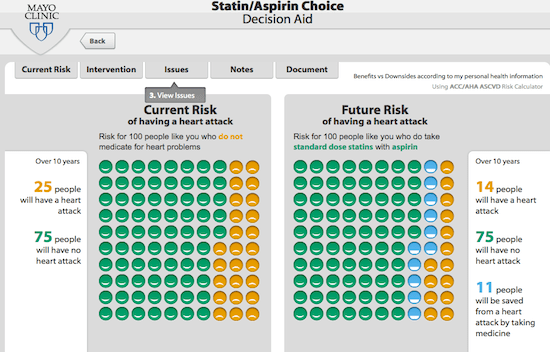
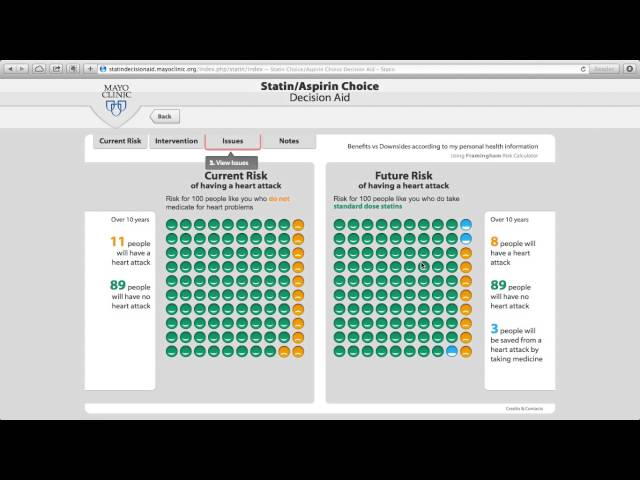
The Mayo Clinic have a free online decision aid which will graphically represent the difference in heart attack risk that you face over the next ten years. You can choose three different calculation algorithms. Each varies a bit regarding factors that they consider important. The units section can transfer according to what system your lab uses for cholesterol results. In the UK they use the mmol/mol and in the US it is mg/dl.

Like other decision aids it has no facility to calculate the possible downside to statin use.

I put my measurements in and got a 3% risk on the AHA figures which would drop to a 2% risk on low dose statins. High dose statins would make no difference to this. Using the Framingham criteria my risk came in at 8% dropping to 6% on low dose statins. The Reynolds criteria uses high sensitivity CRP which we don’t measure in the UK. 


Susan Pierce Thompson: How to be happy, thin and free

the-3-huge-mistakes-report

This March, Susan’s first book, Bright Line Eating: The Science of Living Happy, Thin & Free, arrived in bookstores.

Here’s what she had to say:

Susan, in Bright Line Eating, you argue that the reason so many people struggle with their weight is that the human brain blocks weight loss. How so?

The human brain was designed to keep us stable in a right-sized body. But modern processed foods and the modern pace of life have hijacked various systems in the brain, and the result is that now, in the present-day environment, the brain does indeed block weight loss.

Here’s how: willpower is a finite resource in the brain. And it doesn’t just help us resist temptations or persevere in the face of challenges – it helps us do all kinds of things, like make decisions (e.g., checking email, going shopping), regulate our emotions (e.g., having kids, being in traffic), and regulate our task performance (e.g., working in Excel, giving a presentation).

After a brief period of time doing any of these things, if we start to think it might be a good time to get something to eat, we’re likely to fall into the Willpower Gap.

This is why so many of us order out for pizza or take-out on a Friday night after a long week, irrespective of how sincere we were when we pledged that this time we would stick with our diet until we lost all our excess weight.

In our modern society, the Willpower Gap is waiting for us, nearly always. Most plans of eating implicitly ask you to rely on your willpower to stick with the plan over the long term. The truth about your brain is that that will never work. You need a plan of eating that assumes you have no willpower at all (because, at any given moment, you may not), and works anyway.

To avoid relying on willpower, you suggest people adopt 4 “bright lines” into their eating habits. What are they?

Bright lines are clear, unambiguous boundaries that you don’t cross, no matter what–similar to how a smoker who wants to quit and get healthy throws up a bright line for cigarettes. The four bright lines I recommend are:

  1. No added sugar or artificial sweeteners
  2. No flour of any kind
  3. Eating only at meals–no snacking or grazing
  4. Bounding quantities of food, both to make sure you get enough vegetables, and to make sure you don’t eat too much of everything else.

What’s one thing everyone reading this can do right now to improve their chances of maintaining a healthy weight?

To really bridge the Willpower Gap, start writing down what you’re going to eat for the day in a little journal, ideally right after dinner the night before. Do it religiously until it becomes a habit. The next day, your job is to eat only and exactly that, no matter what. Make sure there’s no sugar or flour in your food plan for the day, and, ideally, stick with three meals a day, because three meals are much more automatizable than five or six.

Within a few weeks these habits will be automatic, and eating the right things, and not the wrong things, will start to be as easy as brushing your teeth.


(From original interview by Ron Friedman)

The Sitting Rising Test

Now get up – no hands, no knees!

Have you heard of this? The sit and stand test is all about sitting down and standing up again from a cross-legged position.

Simple, huh? Not so fast… The minute you use your hands, sides of your legs, knees or elbows to help you up, you lose points. There’s a maximum score of ten (five for getting down, and five for getting up again).

Why is this important or relevant? The test measures flexibility, strength and balance. A study was carried out by the Brazilian physician, Claudio Gil Araujo. He uses the test with athletes, but also on patients. He assessed some 2,000 patients aged 51 to 80. People who scored fewer than eight points on the test were twice as likely to die within the next six years than people who got a higher score. Those who only managed three points or fewer were more than five times as likely to die within the same period, compared to people who scored more than eight points.

Each point increase in the SRT (sitting rising test) is associated with a 21 percent decrease in mortality from all causes.

So, how do you do it?

  • Stand on the floor in your bare feet with a clear space around you.
  • Without leaning on anything, lower yourself to a sitting position on the floor
  • Now, stand back up without using your hands, forearms, the sides of your legs or your knees.

Basically, you get five points for lowering yourself down without using hands, forearms, sides of legs or knees, and five points for coming up without. You also get a minus point for putting your hand on your leg. If you lose your balance, you lose half a point.

Darn it, I thought I had this test covered. Another blogger had written about it, and I realised the version I’ve been doing regularly isn’t the full bhuna. I don’t use my hands or arms, but I do use the sides of my legs to get myself up again. Sit down cross-legged and it seems impossible to get up without using some other part of the body.

There’s a video on YouTube that shows the test being done correctly (by a young whippersnapper of an athlete).

Have you done the SRT and what was your score?