Junk Food and Cancer Risk

diabetes diet by Emma BairdThe news this week carried a story about how regular consumption of junk food might increase cancer risk.

The French study, which was published in the British Medical Journal, looked at more than 100,000 people with an average age of 42. It looked at the association between ultra-processed food and the overall risk of breast, prostate and colorectal cancer, adjusting for known risk factors.

The study found that ultra-processed food intake was associated with higher overall cancer risk. A 10 percent increase in the amount of ultra-processed foods in the diet was associated with a 10 percent increase in the risks of overall and breast cancer. The study’s authors said further research was needed to understand the effects of food processing in this association.

The foods experts warn could be linked to cancer include:

  • Fizzy drinks
  • Crisps
  • Biscuits
  • Chocolate bars and sweets
  • Instant noodles and soups
  • Ready meals
  • Packaged breads and rolls
  • Savoury or sweet packet snacks.

One of the advantages of following a low-carb diet is that it’s difficult and expensive for food manufacturers to offer ready-made alternatives, which could be one of the reasons why it’s never soared in popularity in the same way veganism has, for instance.

If you embark on a low-carb diet, you’re almost forced to cook from scratch. There are ‘junk food’ low-carb alternatives such as the bars that market themselves that way, but they are prohibitively expensive and not that nice.

The foods listed above (except for diet fizzy drinks) are all high in sugar and carbs. Researchers recommend people eat more fruit and veg to minimise cancer risk. Welcome to the low-carb world and the Diabetes Diet, full of salads, broccoli, cabbage, aubergines, peppers, courgettes, beans, berries, apples and more!


Artificial Sweeteners

As a blogger, I get sent press releases regularly. Most of the time, they’re irrelevant (I got a lot of financial information because a media directory had mistakenly classified me as a financial journalist) but I get the odd one that reflects my interests and what I write about.

Recently, the subject line Artificial Sweeteners linked to weight gain, metabolic syndrome, and metabolic dysfunction caught my eye. Our book and blog contain recipes that use artificial sweeteners. The internet abounds with blogs and posts that say ‘no’, but offer up little in the way of compelling evidence.

Anyone remember the Gulf War syndrome caused by diet coke conspiracy theory? (The authorities later dismissed consumption of overheated aspartame as a cause.)

Examine.com which offers an independent, objective and unbiased assessment of nutrition and supplements, provides this recent exploration of artificial sweeteners and their effects.

The press release I received came from the Medisys Health Group in Canada. As they say, sensationalist headlines about sweeteners aren’t new. The average Canadian consumes 88 pounds of sugar from all sources a year – more than four times the daily recommended sugar limit from the World Health Organization.

If excessive, long-term consumption of sugar leads to obesity, type 2 diabetes, high blood pressure and cholesterol levels, cancer and more, are artificial sweeteners the answer?

I don’t use them in my cooking, but I get a dose of sweeteners daily thanks to my love of soft drinks; Diet Coke, mainly, but also squashes, diet tonic and chewing gum. These are all sweetened with what are called non-nutritive sweeteners (such as saccharin, acesulfame, aspartame and sucralose).

As the press release notes, health implications for them are inconclusive and overall, the ones available on the market are considered safe for regular or occasional consumption. Where the press release says we should be cautious is that they don’t retrain the taste buds, and then can make naturally sweet foods like fruit taste less appealing. There is some research that suggests that artificial sweeteners can increase blood sugar levels and trigger the insulin response*.

The Medisys Group recommends you limit or avoid artificial sweeteners, and focus on whole, unprocessed foods instead, a stance we support at the Diabetes Diet.

MY FEELINGS – I get the sugar retraining aspect, though many of the recipes in our book and on our blog do taste a lot less sweet than their sugary equivalents. The research doesn’t yet convince me that I need to give up diet drinks (though the plastic argument could and should win me over).

As for using it in recipes, sugar is by far the most harmful substance to people with diabetes. If making cakes, puddings and biscuits with artificial sweeteners and low-carb ingredients keeps you away from it, is that not the best solution? We promote low-carb, not primarily as a way of losing weight but of keeping blood sugars steady and therefore making diabetes easier to manage.

Read the full release, including a breakdown of the research into metabolism, sweeteners and losing weight etc., here. You can also read the Diet Doctor’s analysis of sweeteners and which ones have the least impact on your blood sugar control, here.

*I’ve never experienced this as a result of drinking diet sodas. 

Plant-Based – Does it Just Mean Vegan?

diabetes diet by Emma Baird
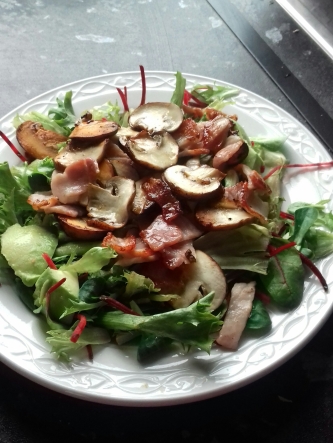
Avocado, mushrooms, bacon and salad – plant-based, hmm?

Happy New Year from all of us at the Diabetes Diet. Here’s wishing you health and happiness in 2018.

Anyone with an interest in health and fitness can’t have missed noticing the current furore around veganism. Proponents tout it as THE ethical and environmental way to eat, and it is very fashionable. Your local supermarket has probably vastly increased its vegan offerings (or the labelling of such foods anyway) and you’ll notice many restaurants and take-away chains have jumped on the bandwagon too.

There are even those who argue a vegan diet is helpful for diabetes, such as Dr Neal Barnard who promotes a vegan, fat-free way of eating as the way to reverse diabetes.

I don’t dispute veganism as an ethical choice. As far as environmental factors go, you could point out that wide-spread veganism would increase the production of mono-crops, a process that depletes the soil and cause issues. The recent over-consumption of coconut oil and avocados in the west has caused enormous problems in their countries of origin.

Health Benefits

When it comes to health, the bonuses of veganism often occur because people shift from a diet of highly processed foods and little fruit and veg to a way of eating that is plant-based. The health benefits may not come from ditching meat, fish and dairy per se, but more from vastly increasing how much fruit and veg they eat and getting rid of processed foods which are hard to find on a vegan diet*.

Let’s argue semantics here. I eat a plant-based diet. The bulk of the food on my plate is plants, nuts, some lentils and pulses and the odd wholegrain.

I just happen to eat meat, fish, eggs and dairy too. Yesterday, I ate scrambled eggs and chopped tomatoes for breakfast, an avocado, mushroom and bacon salad for lunch, and for dinner I had tomato, onion and barley stew with some haddock and steamed broccoli. I ate some peanuts for a snack.

That’s a plant-based diet, isn’t it?

Plant-based Taken to Mean Veganism

For whatever reason, plant-based is now taken to mean veganism. Perhaps someone somewhere thought plant-based sounded nicer than veganism, or they wanted distance from the term, which in the past might have had negative connotations.

Just as Dr Barnard puts forward an argument for veganism as a way of treating diabetes, so do we with low-carb eating. The global diabetes community, diabetes.co.uk, runs an award-winning digital health intervention for people with type 2 diabetes, pre-diabetes and obesity. It was developed using the feedback and opinions of more than 100,000 people who reported good results from low-carb. Like our approach to diabetes, the site’s website promotes lots of vegetables. Plant-based again, right?

If ethical concerns still bother you (as they do me), there are steps you can take.

  • Buy your eggs from the Farmers’ Market where they are likely to be free-range and organic.
  • Buy meat that has an RSPCA stamp on it, or again from the Farmers’ Market where animals are more likely to have been raised and slaughtered in a better way.
  • Eat dairy sparingly, and again choose organic options, preferably from local producers.
  • Investigate where your fish comes from and how it is farmed.
  • Base some of your meals around egg-free Quorn products and tofu.

Here’s to a plant-based 2018! And if you’d like to start a low-carb diet, check out our book – available in e-book and paperback on Amazon.

*Though the food industry is now doing its best to up its production of vegan junk food.

Curried Lentil Soup with Leftover Turkey

diabetes dietToo much turkey? Here’s an idea for something to do with those scraps of meat you have hanging around. This recipe uses lentils – carbohydrates, we know. But in soup, their impact will be minimal, and they add fibrous, protein-y goodness to your diet.

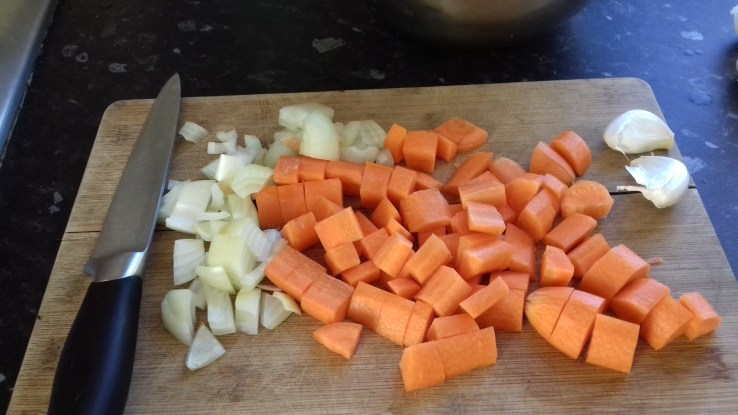
Other good things in this soup include turmeric (your liver will thank you for it at this time of year), chillies and garlic to ward off colds, and onions and carrots. I also made the stock from scratch, boiling up the turkey bones with a couple of onions and some carrots.

Enjoy – and all the very best from all of us at The Diabetes Diet. We wish you health, happiness and success in 2018.

Leftover Turkey and Curried Lentil Soup

  • Servings: 4-6
  • Difficulty: easy
  • Print

  • About 150g cooked, left-over turkey
  • 1 small onion, diced
  • 2 medium carrots, cut into chunks
  • 2tbsp rapeseed oil
  • 2 cloves garlic, crushed
  • 1tsp chilli flakes
  • 1tsp turmeric
  • 1/2tsp freshly ground black pepper
  • 150g red lentils
  • 1.25 litres fresh turkey or chicken stock
  • Salt to taste

Fry the onion and carrots in a large stock pot in the oil until softened – about five minutes. Add the lentils, chilli, turmeric and black pepper and mix well so the lentils are coated in everything.

Add the turkey, stock and garlic and bring to the boil. Turn down to a simmer and cook for 20 minutes until the lentils are softened. Add salt to taste – lentil can take quite a bit of salt.

Each serving has 14g of carbs (for 4) and 6g of fibre, so 8g net carbs. For six, it’s 9g carbs and 4g fibre per serving.


The Pulse of Life!

Diabetes and how you cope with it is an ongoing exploration. Recently, I’ve been experimenting with pulses such as lentils, and beans (kidney and butter) and even (shock, horror) whole grains such as barley.

I find their effect on my blood sugar minimal, and I love the variety they add to my diet. I was vegetarian for a long time, and lentils were a favourite food – lentil curries, patties and stews, all delicious.

Keto proponents don’t approve of lentils and beans because such diets promote extremely low carb intakes as sub 50g, but if you aim for a more moderate carbohydrate intake, such as 90-150g a day, you can easily add in pulses and beans. Remember too, that they have a high fibre content and you’ll probably be able to subtract that from the carbohydrate total when you work out how much insulin you need to cover a meal.

Apart from adding variety to my diet, I’ve also gone back to pulses and beans because of their fibre content. A lot of nutritional research these days points towards the importance of fibre, and it’s difficult to get much fibre on an extremely low-carb diet.

My body seems like the pulses and beans, and my blood sugar results confirm this. If your diet opens up and allows you more variety, this is always a good thing.

So, to celebrate here’s my recipe for hummus. Hummus is high in fibre and relatively low-carb. Used as a dip or sauce, you’ll only be adding minimal carbs to your diet.

Now, one thing I tried with this is the peeling the skins off thing. I’d read about this online, that if you want velvety-smooth hummus, you need to peel the chickpeas. U-huh. I wouldn’t do this every time as it’s possibly the most tedious job in the world, but for a special occasion, absolutely. You get beautifully smooth hummus.

Velvety-Smooth Hummus

  • Servings: 4-6
  • Difficulty: easy
  • Print

·         1 x 400g tin chickpeas (save two tablespoons of the water)

·         Juice of one lemon

·         1-2 cloves garlic, crushed

·         2 heaped tablespoons tahini

·         Salt to taste

Drain the chickpeas, reserving two tablespoons of the water. Peel the skins off. The easiest way to do this is to pinch each chickpea between your thumb and finger, and it should pop out of its skin. Do this above a bowl and be prepared for a few to ping across the room.

Pop into a food processor, along with the garlic and reserved water and whizz for a minute or so. You can also use a stick blender, but this is the less messy method.

Add the lemon juice and tahini and whizz again, for a couple of minutes, so you get a smooth, creamy texture.

Add salt to taste – about ½ to one teaspoon.

Use as a dip, spread on your favourite low-carb bread. It’s also lovely spread on lamb steaks.

Total carbs – 24g, minus 11g for the fibre.


Kris Kresser: Why has the American approach to heart disease failed?

Why Has the American Approach to Heart Disease Failed?
on April 18, 2017 by Chris Kresser 

Tsimane 2

A recent New York Times article correctly suggests that diet and lifestyle changes are far more effective ways to prevent and treat heart disease than statins and stents. But what diet, and what lifestyle? Is it as simple as avoiding “artery-clogging saturated fat,” as the author suggests? Read on to find out why the American approach to heart disease has really failed.
Jane Brody wrote an article in The New York Times called “Learning from Our Parents’ Heart Health Mistakes.” She argues that despite decades of advice to change our diet and lifestyle in order to reduce our risk of heart disease, we still depend far too much on drugs and expensive procedures like stents.
She says:
Too often, the American approach to heart disease amounts to shutting the barn door after the horse has escaped.
To support this argument, she refers to a recent paper published on the Tsimane, an indigenous population in the Bolivian Amazon. The study found that the rate of coronary atherosclerosis in the Tsimane was one-fifth of that observed in the United States (and the lowest that has ever been measured). Nearly nine in 10 Tsimane had unobstructed coronary arteries and no evidence of heart disease, and the researchers estimated that the average 80-year-old Tsimane has the same vascular age as an American in his mid-50s.
I certainly agree with Ms. Brody so far, and her analogy that the American approach to heart disease amounts to shutting the barn door after the horse has escaped is spot on.
The problem is what comes next, as she attempts to answer the question of why the Tsimane have so much less heart disease than Americans:
Protein accounts for 14 percent of their calories and comes primarily from animal meats that, unlike American meats, are very low in artery-clogging saturated fat. [emphasis mine]
Does saturated fat “clog” your arteries?
Artery-clogging saturated fat? Are we still using that phrase in 2017?
As I’ve written before, on average, long-term studies do not show an association between saturated fat intake and blood cholesterol levels. (1) (I say “on average” because individual response to saturated fat can vary based on genetics and other factors—but this is a subject for another article.)
If you’re wondering whether saturated fat may contribute to heart disease in some way that isn’t related to cholesterol, a large meta-analysis of prospective studies involving close to 350,000 participants found no association between saturated fat and heart disease. (2)

Does saturated fat really “clog” your arteries?

Are “clogged arteries” the cause of heart disease?
Moreover, as Peter Attia eloquently and thoroughly described in this article, the notion that atherosclerosis is caused by “clogged arteries” was shown to be false many years ago:
Most people, doctors included, think atherosclerosis is a luminal-narrowing condition—a so-called “pipe narrowing” condition.  But by the time that happens, eleven other pathologic things have already happened and you’ve missed the opportunity for the most impactful intervention to prevent the cascade of events from occurring at all.
To reiterate: atherosclerosis development begins with plaque accumulation in the vessel wall, which is accompanied by expansion of the outer vessel wall without a change in the size of the lumen. Only in advanced disease, and after significant plaque accumulation, does the lumen narrow.
Michael Rothenberg also published an article on the fallacy of the “clogged pipe” hypothesis of heart disease. He said:
Although the image of coronary arteries as kitchen pipes clogged with fat is simple, familiar, and evocative, it is also wrong.
If heart disease isn’t caused by “clogged arteries,” what does cause it?
The answer to that question is a little more complex. For a condensed version, read my article “The Diet-Heart Myth: Why Everyone Should Know Their LDL Particle Number.”

For a deeper dive, read Dr. Attia’s article.
Here’s the 15-second version, courtesy of Dr. Attia:
Atherosclerosis is caused by an inflammatory response to sterols in artery walls. Sterol delivery is lipoprotein-mediated, and therefore much better predicted by the number of lipoprotein particles (LDL-P) than by the cholesterol they carry (LDL-C).
You might think that I’m splitting hairs here over terminology, but that’s not the case. It turns out that this distinction—viewing heart disease as caused by high LDL-P and inflammation, rather than arteries clogged by saturated fat—has crucial implications when it comes to the discussion of how to prevent it.
Because while it’s true that a high intake of saturated fat can elevate LDL particle number in some people, this appears to be a minority of the population. The most common cause of high LDL-P in Americans—and elsewhere in the industrial world—is almost certainly insulin resistance and metabolic syndrome. (I explain why in this article.)
And what is one of the most effective ways of treating insulin resistance and metabolic syndrome? That’s right: a low-carbohydrate, high-fat diet!
News flash: diets high in saturated fat may actually prevent heart disease.
Perhaps this explains why low-carbohydrate, high-fat diets (yes, including saturated fat) have been shown to reduce the risk of heart disease.
For example, a meta-analysis of 17 low-carb diet trials covering 1,140 obese patients published in the journal Obesity Reviews found that low-carb diets were associated with significant decreases in body weight, as well as improvements in several CV risk factors, including decreases in triglycerides, fasting glucose, blood pressure, body mass index, abdominal circumference, plasma insulin, and C-reactive protein, as well as an increase in HDL cholesterol. (3)
(In case you’re wondering, low-carb diets in these studies had a null effect on LDL cholesterol: they neither increased nor decreased it.)
Saturated fat is a red herring.
Instead of focusing so much on saturated fat intake, which is almost certainly a red herring, why not focus on other aspects of the Tsimane’s diet and lifestyle that might contribute to their low risk of heart disease?

For example:
They are extremely active physically; Tsimane men walk an average of 17,000 steps a day, and Tsimane women walk an average of 15,000 steps a day—and they don’t sit for long periods. Ms. Brody does mention this in her article.
They don’t eat processed and refined foods. We have been far too focused on calories and macronutrient ratios and not enough on food quality. We now know that hunter–gatherers and pastoralists around the world have thrived on both high-carbohydrate, low-fat diets (like the Tsimane, who get 72 percent of calories from carbohydrate) and low-carbohydrate, high-fat diets (like the Masai and Inuit).

But what all hunter–gatherer diets share in common is their complete absence of processed and refined foods.
Perhaps if we stopped focusing so much on the amount of fat and carbohydrate in our diet and started focusing more on the quality of the food we eat, we’d be better off.
And of course we also need to attend to the many other differences between our modern lifestyle (which causes heart disease) and the ancestral lifestyle (which prevents it), including physical activity, sleep, stress, light exposure, play/fun, and social support.
The Tsimane study illustrates exactly why an evolutionary perspective on diet, lifestyle, and behavior is so important. It helps us to generate hypotheses on what aspects of our modern way of life may be contributing to chronic diseases like atherosclerosis and gives us ideas about what interventions we need to make to prevent and reverse these diseases.
Crust-less Pizza

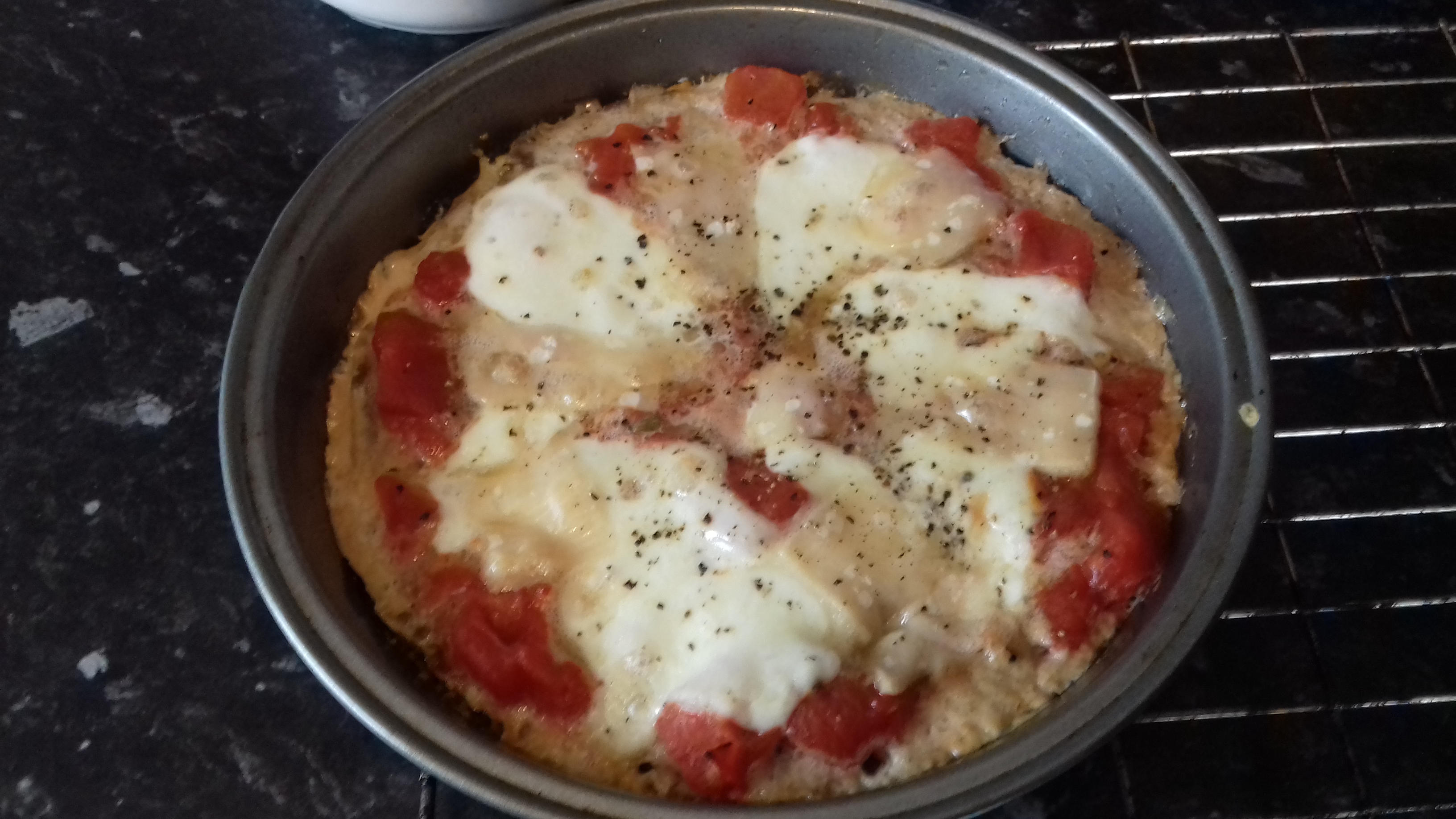
This is based on Nigella Lawson recipe I adapted – Meatzza. Basically, you use mince to create a base, and top with the traditional pizza favourites, tomato sauce and mozzarella.

Nigella’s recipe uses porridge oats. I swapped these for ground almonds. They are there to give the base substance. I also changed the herb from parsley to thyme. Serve with a green salad, or to keep the Italian theme going you could try this Keto garlic bread recipe on the Diet Doctor website.

Crust-less Pizza

  • Servings: 4
  • Difficulty: easy
  • Print

  • 500g minced beef
  • 2 cloves garlic, crushed
  • 3tbsp ground almonds
  • 50g grated Parmesan
  • 1tbsp thyme leaves
  • 1tsp salt
  • 2 eggs, beaten
  • 400g tinned chopped tomatoes
  • 1tsp dried oregano
  • 125g ball of Mozzarella
  • Fresh basil

Grease a 28-cm baking tin. Preheat the oven to 220 degrees C.

In a bowl, mix the meat with the garlic, ground almonds, half the grated Parmesan, thyme, salt and eggs. Do this with the tips of your fingers so you don’t overhandle the meat, as too much handling makes it tough.

Press the meat into the tin. Drain some of the liquid off the tinned tomatoes. Mix with the oregano and spread it over the meat crust. Slice the Mozzarella and put it on top, along with the rest of the Parmesan.

Cook in the oven for 25 minutes. Top with the fresh basil and serve.

Serves 4. 5g carbs and 1g fibre per serving.


BMJ: The PURE Study debunks the sat fat/heart disease hypothesis

cheese.jpg

The PURE study: Eating fat is associated with lower cardiovascular disease

From BMJ 9 Sept 17
PURE is a five continent observational study in relation to cardiovascular disease in mortality in almost 150 thousand people. It found that high carbohydrate intake was associated with a higher risk of total mortality whereas total fat and individual types of fat were related to a lower total mortality.
Total fat and types of fat were not associated with cardiovascular disease, myocardial infarction, or cardiovascular disease mortality, and the more saturated fat people ate the less strokes they had.
Like all observational studies correlation does not necessarily imply causation. The main message however is a series of negatives. There does not seem to be a connection between carbohydrate intake and cardiovascular disease, the association is with all- cause mortality. Perhaps high carbohydrate diets are simply a marker for poverty?
In contrast eating more fat, including saturated fat was associated with lower cardiovascular disease, meaning that we can abandon the saturated fat-cardiovascular disease hypothesis with some certainty.
So, what does “healthy food” look like?
A higher intake of fruit, vegetables and legumes was associated with a lower risk of non-cardiovascular and total mortality at three to four servings a day.
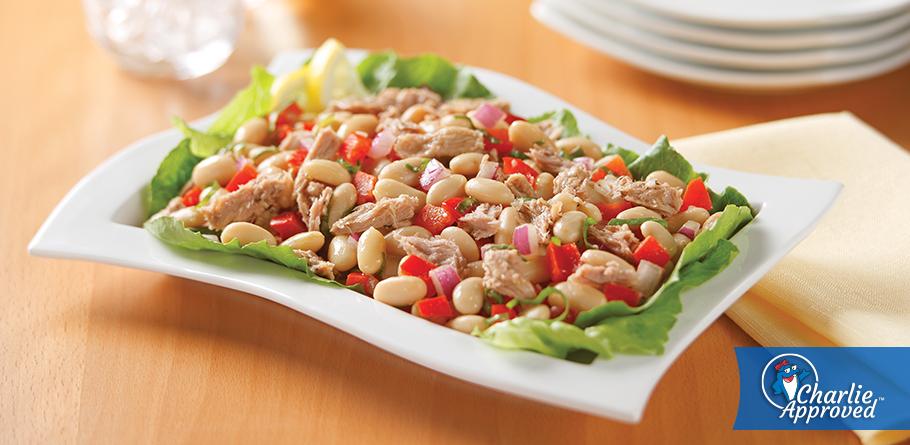
Great, says the author of this piece, Richard Lehman. His dream meal is cannelli beans and tuna salad with lots of olive oil, rib eye steak in butter, a salad, fruit, cheese and strawberries and cream.


Broccoli, Pea and Mint Soup

Regular readers will know I do love a soup recipe or two… This week I made and adapted one from the Sainsbury’s magazine.

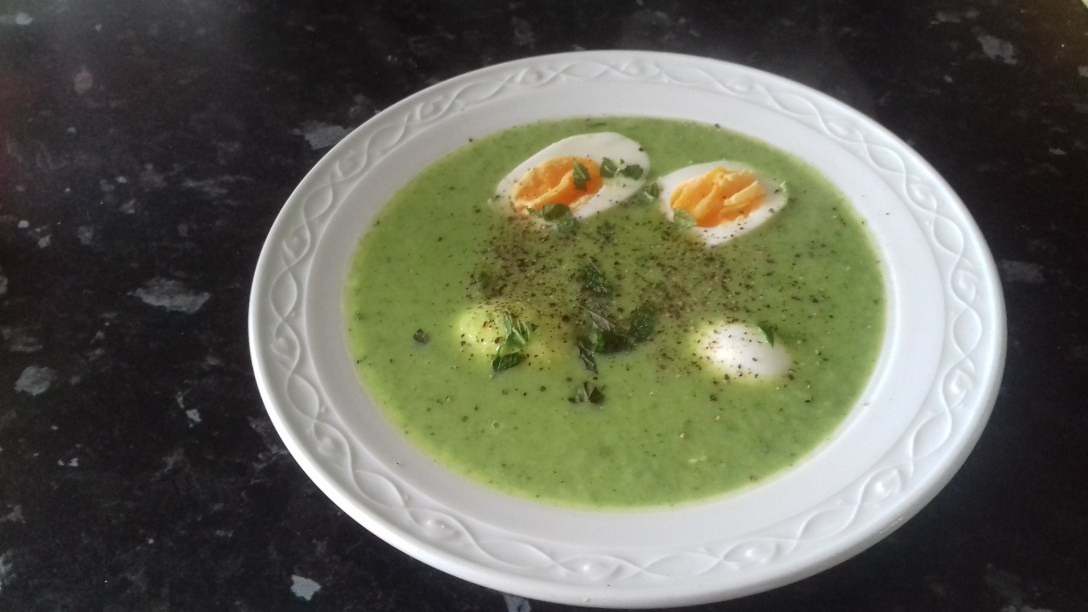
The Broccoli, Pea and Mint instructions appealed to me as the broccoli stalk AND the florets are used, so it’s less wasteful. In the magazine, the writers recommended adding fried smoked streaky bacon and crumbled goat’s cheese to the top, but I used boiled eggs instead as that turns your soup into a main course that’s really filling.

You could also add a sprinkling of grated cheddar or parmesan. And be heavy-handed with the black pepper, as the soup benefits from the warmth.

Most soup recipes you find specify stock, usually chicken or vegetable. I don’t bother unless I have some home-made chicken stock on hand. I find stock cubes or bouillon pointless. It’s just flavoured salt, right?

Anyway, I’ve also halved the quantities here. I live in a one-broccoli household, i.e. only one of us likes it and the other thinks it’s the food of the Devil. Much as this soup appeals, two portions of it this week will be fine for me.

Broccoli, Pea and Mint Soup

  • Servings: 2
  • Difficulty: easy
  • Print

  • Half a medium-to large sized head of broccoli
  • 1tbsp rapeseed oil
  • 2 spring onions, chopped
  • 125g frozen pea
  • 1tbsp mint leaves, chopped
  • 1tbsp parsley, chopped
  • 500ml water
  • Salt and freshly-ground black pepper

Chop the broccoli stalk finely. Heat the oil in a large saucepan and add the broccoli stalk and spring onions. Cover the pan and cook, stirring occasionally, for five minutes.

Add the water, bring to the goil, turn down to a simmer and cook for ten minutes.

Add the frozen peas and broccoli florets, bring back to a simmer and cook for another five minutes.

Take off the heat, add the mint and parsley, and a decent amount of salt and puree using a hand blender.

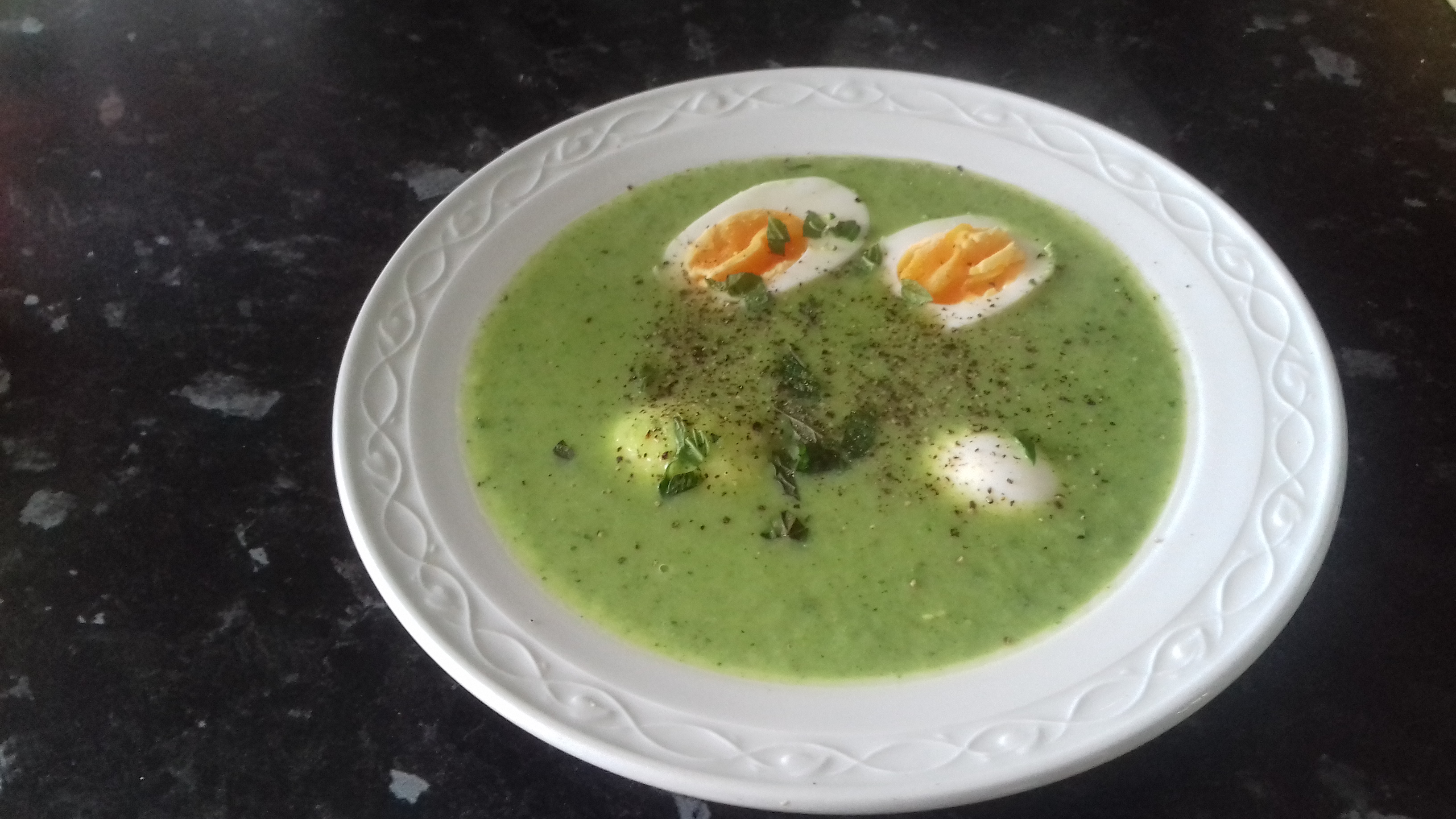
You can top with smoked streaky bacon, fried and chopped, a good handful of grated cheese, or (as I have done in the picture), boiled eggs, some more mint and a hefty grating of black pepper.

Each serving contains 11g carbs and 8g fibre.


What to Eat in October

We’re still working our way through home-grown courgettes (!!), tomatoes and carrots, but what else is seasonal at this time of year?

At the Diabetes Diet, we try our best to eat seasonally (it’s not always easy in Scotland), as seasonal food locally grown and produced tastes the BEST. It also helps you do your bit for the environment, by cutting down on food miles (the distance food travels to reach your plate) and it benefits your local economy. Wouldn’t you prefer to put money directly in a farmer’s pocket, than add to the vastly-inflated profits of a supermarket?

Anyway, October brings many of the benefits September does. While many fruits and vegetables are now gone for the year, there are plenty of delicious other options.

MEAT

  • Pheasant
  • Lamb
  • Partridge

FISH

  • Mussels
  • Mackerel
  • Oysters

VEGETABLES

  • Wild mushrooms (if you’re going to pick these, please make sure you know what you’re doing!)
  • Root vegetables, such as celeriac and carrots
  • Kale
  • Beetroot
  • Cabbage
  • Fennel

FRUIT

  • Apples
  • Damsons

Looking for some ideas for what to do with your seasonal ingredients? Puzzled about how you can make them low-carb so they fit with the way you eat? We have some suggestions for you…

Make gluten-free gravy using carrots and onions, and serve with pork and chicken.

Our carrot and almond soup recipe is an established family favourite. If you want to make it a main course, add some boiled eggs or poached chicken for added protein (and satiety). Or make yourself a delicious salad with the recipe for a Carrot and Dill version.

Love lamb? Our low-carb, gluten-free moussaka makes the most of lamb mince (making it more affordable too). Try this African stew, also.

Jovina Cooks Italian has inspired us hugely, and this Brindisi Fish Soup uses mussels and is packed with flavour. It also uses aubergines, which are seasonal in October too.

Hate cabbage? Add bacon, cheese and sour cream, and you can make anything palatable to even avowed cabbage loathers. Try this Cabbage Casserole recipe and convince the brassica haters it’s true.

Celeriac has a very distinctive taste. Make the most of it in this braised celeriac recipe. You can use it as a replacement for potatoes to accompany your roast dinner. We also have a yummy recipe for soup.