Jovina cooks Italian: Shrimp and tomato salad and Sausage with Peppers

What To Make For An Outdoor Summer Party | jovinacooksitalian

Salad Course: Grilled Shrimp Tomato Salad

IMG_0006

This is a popular dish, so I often divide the salad onto smaller serving dishes, so I can have them available in several areas.

Serves 6

Ingredients

  • Vegetable oil for the grill
  • 1/3 cup extra virgin olive oil, plus 3 tablespoons olive oil
  • 5 tablespoons mixed chopped fresh herbs, such as dill, basil, mint, and/or chives
  • 2 tablespoons white wine vinegar
  • 1 teaspoon lemon zest
  • 2 tablespoons fresh lemon juice
  • 1/4 teaspoon dried crushed red pepper
  • 1 garlic clove, minced
  • 1 teaspoon kosher salt, divided
  • 2 pounds peeled and deveined large raw shrimp
  • 1/2 teaspoon freshly ground black pepper
  • 2 pounds tomatoes,  quartered
  • Parsley sprigs for garnish

Directions

Oil the grill grates and preheat the grill to medium-high heat.

Whisk together the ⅓ cup extra virgin olive oil and next 6 ingredients (through garlic) in a small bowl. Whisk in 1/2 teaspoon kosher salt.

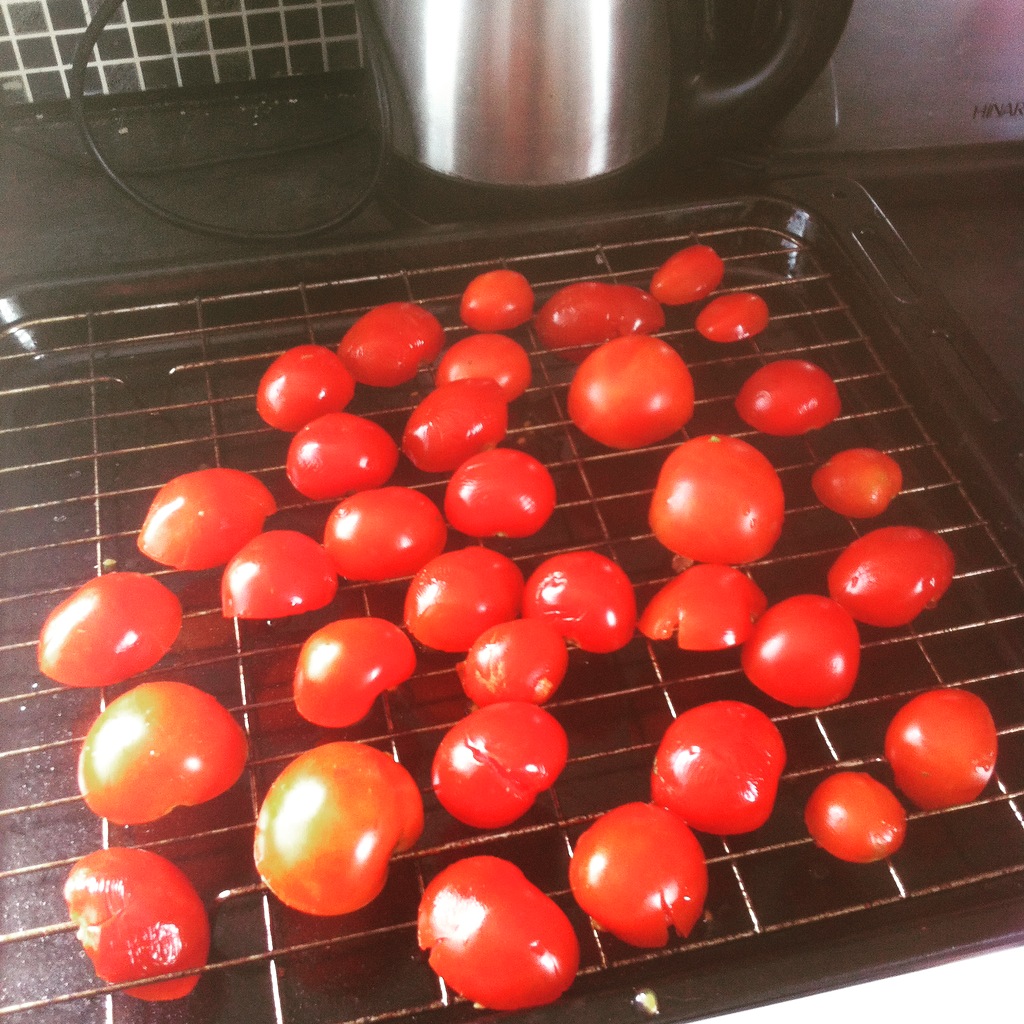
Arrange tomatoes on a large serving platter or in a large bowl, and drizzle with 1/4 cup of the vinaigrette.

Mix the shrimp with the 3 tablespoons of olive oil, the 1/2 teaspoon freshly ground black pepper, and the remaining 1/2 teaspoon kosher salt.

Grill the shrimp, covered with the grill lid, 2 minutes on each side or just until shrimp turn pink.

Mix the grilled shrimp with the remaining vinaigrette and arrange over tomatoes. Garnish with the parsley sprigs. Serve at room temperature.

Main Dish: Italian Sausage and Peppers

IMG_0001

This dish is always a big hit with everyone.

Serves 6

For the sausage:

  • 1 ½ lb. Italian sausage

Directions

Prepare an outdoor grill for cooking over medium-hot charcoal (moderate heat for gas).

Keep a third of the grill indirect heat. On a charcoal grill, this means spreading the coals over two-thirds of the firebox and leaving one-third coal-free.

On a gas grill, leave one burner off. Sausages should be grilled over indirect heat.

Lightly brush or rub the sausage with olive oil. This prevents sticking and makes them extra crisp. Use tongs and don’t break the sausage skin when turning.

Grill the sausages over the indirect part of the grill until crusty and golden brown on the outside and cooked through, about 30 minutes, turning them over after 15 minutes.

The safe internal temperature for ground meats—sausages included—is 160 degrees F.

Cut the sausages into two-inch lengths and set aside.

For the peppers and onions:

  • 1/4 cup olive oil
  • 6 sweet bell peppers or 20 Italian frying peppers, seeded, sliced into 2 1/2 to 3-inch long strips
  • 2 large sweet onions, halved and sliced
  • 4 garlic cloves, grated
  • 2 teaspoons dried oregano or 1 teaspoon of fresh oregano leaves
  • 1/2 teaspoon red pepper flakes (chili)
  • 1 teaspoon kosher salt
  • 1/2 teaspoon freshly ground black pepper

To finish the dish:

  • 2 cups Marinara (tomato) sauce

Directions

Heat the olive oil in a large saute pan over medium heat. Add the onions, the peppers, garlic, oregano, pepper flakes, salt and pepper and cook for about 10 minutes, until crisp tender.

Add the tomato sauce and heat.

Add the grilled sausage links to the skillet with the peppers and onions. Heat until the sausage is warm.

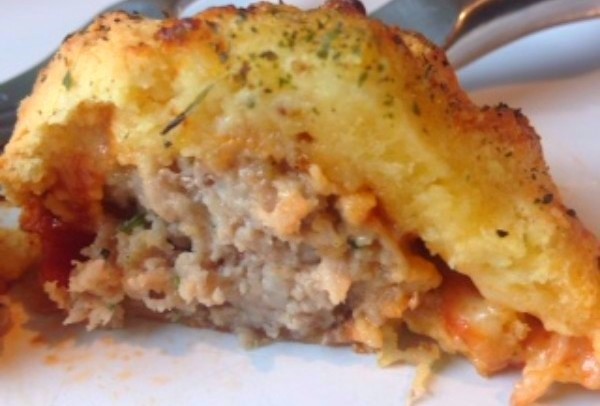
Low carb store: Meatball bombs


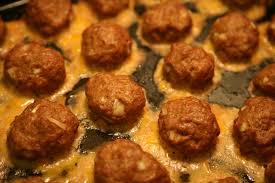
meatballs

This recipe makes four bombs and they each have 4g of carbohydrate.  We have meatball recipes separately on this site.


Ingredients

  • 120g grated mozzarella
  • 65g almond flour
  • 2 tbsp full fat cream cheese
  • 1 medium egg
  • 1/2 tsp dried herbs
  • 2 tbsp butter
  • 1 garlic clove
  • 4 cooked meatballs
  • 8 tbsp passata

Pre-heat the oven to 180c and prepare a baking sheet with a layer of greaseproof paper. Put the mozzarella and cream cheese in a bowl and microwave for 30 seconds – stir. Add the egg and almond flour and mix to a dough. Divide into 4 equal parts and flatten out gently with the palm of your hand. Place a meatball in the centre of each circle and top with a good dollop of passata and a sprinkle of mozzarella. Bring the sides up and around the meatball and squeeze together at the top to form a parcel. Crush the garlic clove and melt with the butter. Spoon the butter over each of the bombs and sprinkle with herbs. Cook in the oven for about 20 minutes or until golden brown. Devour immediately.

Book Review: Are you looking forward to Christmas… or just wanting to survive it?

Rick Phillips, one of our fellow bloggers, has enjoyed reading Lene Anderson’s book Chronic Christmas, which gives some tips for the less enthusiastic among us on how to make the best of Christmas.

happy-christmas

capture_313x480I was so excited to hear about Chronic Christmas Surviving the Holidays with a Chronic  Illness.  It came to me at exactly the right time of year, and I was in the mood for some fun and practical advice about the holiday season.  When this book arrived in the mail, I was excited to see what Lene might share to help me find that contentment and excitement about the holiday season.  As a person with choric conditions, I sometimes have difficulty getting into the season.  Lene’s words helped me discover some reasons I feel out of step with the rest of the world and gave me practical advice about how to overcome some of my barriers.

Lene shares such wonderful tips for slowing down and basking in the goodness of the holiday season.  Her writing style is easy; her essays are well conceived, and the result is a partial guide to managing the Christmas season with a good touch of fun.  She manages to capture the season in short bursts of narrative that can make even the grumpiest old man find his inner goodness.  Here are a few chapters that especially spoke to me.

December 2, Pace Yourself When Eating.

As a person with diabetes, I often feel left out of the annual celebrations because I see others enjoying food while I enjoy the Television.  In this chapter, Lene reinforces the well know notion that the holidays are not about the food.  Rather they are about who is eating the food.  Her chapter gives me permission to enjoy those who are at the gathering instead of the food at the gathering.   I think it is sometimes difficult for people with diabetes to know this and Lene approached the subject in a way that offers constructive tips.  For instance:

“Moderation is key, Instead of five pieces of Candy stick to one (okay, two).” (Andersen, 2016, p. 7).

“Instead of four glasses of eggnog, have one per occasion and drink sparkling water or tea for the rest of the evening. And so on. You won’t feel deprived. And you won’t stand out as that one person who’s nibbling on a lettuce leaf, making the other guests feel bad for scarfing down everything in sight.” (Andersen, 2016, pp. 7-8)

chronic-christmas-back_314x480December 8, Say Hello

Lene reminds us that we need not remain isolated because we have a chronic condition.  She suggests we try an experiment to break out of our shell.  She suggests that on December 8 we leave the book or earphones at home and practice looking up and out at the world.  She suggests we should look at and marvel in the crowds as they pass by.  She reminds me that people watching is both entertaining and a great way to connect to the world at large.  (Andersen, 2016).  This is great advice for the many times we feel isolated or somewhat alone in the world.  After all, connection is what the holiday season is all about.

For the person who cares about the person with a chronic condition Lene suggests that they offer a drive or a trip to a coffee shop to help people get out in the world.  She suggests:

“Chat with each other, but reach out to others as well. The people at the next table, the clerk, a security guard. Slow down, take the time, exchange a few words. You could very well make someone’s day and you might meet someone really interesting” (Andersen, 2016, p. 35).

These are terrific ideas for helping both ourselves and others.  In fact, opening up during the holidays might make everything brighter.  Lene’s advice gives us the reminder that we need not be isolated while others are engaged in the business of the season.

December 21 – Celebrate Disasters

For me, this was the best advice of the book.  When we celebrate disasters, we have a built in mechanism to make sure things go right.   I love how Lene starts this chapter:

“What do you remember from past Christmases — the times everything went according to plan or the moments when imperfection snuck into the celebrations? We work so hard to make the holidays perfect, but that’s not what makes for enduring family legends. You know the type — the ones that get told and retold, with everyone talking over each other, adding details, and laughing together. Those stories always originate in disasters” (Andersen, 2016, p. 93)

I totally agree with her observation.  The real stories of the season are the ones that revolve around disasters.  So I took this chapter as the best advice I received from Lene’s’ book.    This year, I vow to celebrate the many disasters in my life past, present and future. I will take time to celebrate this year: the time the lock was frozen on the storage barn where I stored the Christmas presents or the time the cat climbed/knocked over the Christmas tree because doing so can prolong the celebration of the season.

So how do I feel about Lene’s book?  I loved it.  You can pick it up on Amazon or Barnes and Noble along with some other retailers.   It is a great gift for those who love people with chronic conditions or those of us who live with chronic conditions.  I am glad I treated myself to this book, and I hope you will as well.   Reading it is way too much fun to miss.

References

 Andersen, L. (2016). Chronic Christmas Surviving the Holidays with a Chronic  Illness. Toronto Two North Books


13 Comments

Add a Comment

Cancel reply

Your email address will not be published. Required fields are marked *

Comment:*

Name:*

Website:

Notify me of follow-up comments by email.

Notify me of new posts by email.

– See more at: http://www.radiabetes.com/chronic-christmas/#sthash.gbWtn28A.dpuf

Low carb store: Steak au poivre

sirloin steak


  • 2 beef steaks
  • 1 tbsp black peppercorns
  • 1 tbsp olive oil
  • 2 shallots, finely chopped
  • 50g unsalted butter
  • 60mls Cognac
  • 100ml double cream


Preheat oven to 180°c. Season the steaks with sea salt and allow to come to room temperature.Coarsely crush the peppercorns and press into both sides of the steaks evenly.Heat a heavy griddle pan (preferably cast-iron) over moderately high heat until hot,then carefully add the oil. Add the steaks and cook to your liking turning only once. Transfer the steaks to a warm plate to rest. Pour off the fat from the pan then add the shallots and half of the butter and cook over low-medium heat until the shallots are well-browned.Add the Cognac (it may ignite!) and boil, stirring, until the liquid has reduced to a glaze (a few minutes). Add the cream and any meat juices from the steak plate and boil, stirring occasionally for a further 4-5 minutes. Add the remaining butter and cook over a low heat until the butter is incorporated into the sauce. Serve sauce with steaks and lightly cooked vegetables.

Low carb store: Moussaka

low-carb pizza


 Moussaka for two
  • 150g lamb mince
  • 1 shallot, chopped
  • 100g tomatoes, chopped
  • 1 tsp oregano, cinnamon,thyme
  • 1 garlic clove
  • 1 aubergine, sliced
  • 1 mozzarella ball, sliced
  • 2 tbsp olive oil


Heat 1 tbsp of olive oil in a frying pan and add the garlic and shallot. Lightly fry until they are soft.Add the lamb mince and cook until brown. Add in the oregano, thyme, cinnamon and tomatoes and stir through. Leave to one side. Heat the remaining oil in a frying pan and add the aubergine slices cooking until softened on both sides.Take an oven proof dish, layer half the aubergine slices on the bottom of the dish and add half the lamb mixture.Top with mozzarella slices and repeat, layering the same ingredients again. Bake in the oven at 180oC for 30 minutes. Serve with a green salad dressed in olive oil.

Spicy Tomato Sauce + Low Carb Options

diabetes diet recipesEveryone needs a spicy tomato sauce recipe in their lives and multiple options for its use.

Tomatoes are high in vitamins C, A and K, and they contain high levels of potassium and manganese. Tomatoes are also a good source of fibre. Cooking will reduce the levels of vitamins in tomatoes, but tomatoes contain the phytochemical lycopene which is boosted if tomatoes are cooked. High levels of lycopene are said to lower the risk of heart disease and certain kinds of cancer.

Here’s our Diabetes Diet recipe. Make it in large quantities and freeze it in portions for easy suppers.

Spicy Tomato Sauce

  • Servings: 4-6
  • Difficulty: easy
  • Print

  • 2 x 400g tins chopped tomatoes
  • 2tbsp rapeseed oil (I use the cold-pressed stuff)
  • 2 cloves garlic, crushed
  • 1 chilli, sliced (keep seeds in for extra heat, leave out for less)
  • 1 medium onion, finely sliced
  1. Add the oil to a large saucepan and then add the other ingredients. Bring to the boil, stirring from time to time.
  2. Turn the heat down and allow to simmer for 15 minutes. You should end up with a thick, concentrated sauce.
  3. Season to taste with salt and pepper.

Total carbs – 25g, minus 7g fibre, for 18g net carbs.

Now, the exciting bit: what to do with it…

  • Make braised celeriac chips and create low-carb version of Patatas Bravas
  • Serve with roasted chicken or a steak
  • Mix with minced beef for a chilli
  • Melt in a little coconut cream and some curry powder to make a curry sauce
  • Dilute with fish stock, and add in white fish and prawns to make a fish soup
  • Dice up roast chicken and add to the sauce, finishing off with a tablespoon of double cream.


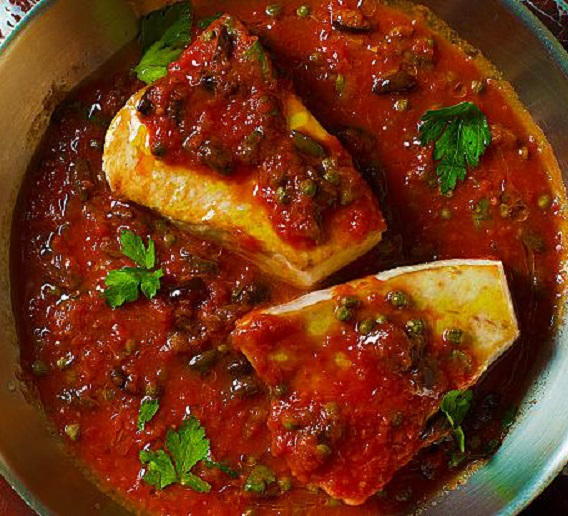
Jovina cooks Italian: Swordfish Messina Style

swordfish messina.pngPesce Spada alla Messinese (Swordfish Messina style)

Ingredients (serves 4)

1 lb (600 gr) swordfish cut into palm-sized pieces slices
2 cloves of garlic, chopped
2 spring onions, chopped
20 capers (if salted, rinse well first)
10 black olives, chopped
4 anchovy fillets
1 cup white wine
2 cups tomato passata (sauce)
15 oz can chopped tomatoes
Extra virgin olive oil
Salt and pepper
A pinch of crushed dried chili pepper
Parsley, chopped

Directions

Brush the swordfish slices with olive oil and set aside.

In a skillet heat enough olive oil to cover the bottom of the pan. Add the spring onions, garlic, capers, olives, chili pepper and anchovy fillets and cook until the anchovies melt into the oil and the onion is soft.

Put the slices of swordfish in the skillet and add the white wine. Burn off the alcohol and then add the tomatoes. Mix well, cover and cook for 30 minutes on very low heat.

When ready to serve, sprinkle with parsley.

PUBLIC HEALTH COLLABORATION: WHAT TO LOOK OUT FOR WHEN STARTING A LOW CARBOHYDRATE DIET

PHC-Space-Top


FOR EVERYONE

As you start a low carbohydrate diet your kidneys get better at excreting salt thus you will usually find that you lose a lot of water from the tissues of the body.  This can make you instantly slimmer, particularly around the legs, but also can give some cramps in the muscles when you exert yourself.  Be aware of this and add extra salt to your food, and drink plenty of water.  When you are on a low carbohydrate natural foods diet you will be consuming considerably less sodium chloride, which is present in many processed foods including sweet ones.  Bread for instance has a lot of added salt that most people are completely unaware of, therefore feel free to be liberal with the salt cellar.


BLOOD PRESSURE

Blood pressure comes down, partly due to less water retention, but also due to lowered natural insulin levels in the body.  As the weight comes down as well, blood pressure tends to drop.  For most people who are not on any antihypertensive drugs they may feel slightly lightheaded from time-to-time.  This can be abolished by adding more salt to the diet.

For people who are on medication to reduce their blood pressure they should have their blood pressure measured by their general practitioner and cut back on medication on embarking on a low carbohydrate diet if their blood pressure is under 140/90.  After a few weeks on a low carbohydrate diet they will be adjusted to a lower level of blood pressure.  Thereafter blood pressure only requires to be checked on several occasions with each extra half stone of fat loss.

It is helpful to buy your own blood pressure monitor as measurements done when you are relaxed at home tend to be more accurate than those undertaken in a surgery.

As many blood pressure medications have more than one use, and different effects on the body, it is worth discussing with your general practitioner which ones would be better to cut out altogether or which ones could be reduced in dose.  This is because certain drugs such as ACE inhibitors and sartans have an extra protective effect on the kidney and this can be important for diabetic patients. They also help improve heart function in cardiac failure.

Beta-blockers are sometimes given to people with atrial fibrillation, or who have had a heart attack, or who suffer from angina, and continuing these may be a priority for some individuals.

BLOOD SUGAR REDUCTIONS

Blood sugar reductions happen rapidly with a low carbohydrate diet.  This is mainly due to the lack of sugar and starch being turned into blood glucose.  This has several effects.

The most pronounced and rapid effect could be on the eyesight.  The lens of the eye adjusts to a particular blood sugar and if the level goes suddenly up, or suddenly down, your vision can become blurry, particularly for reading print.  It is worthwhile avoiding getting new spectacles for about 6 months to give time for the lens of your eye to adjust otherwise you can end up having to get another pair of spectacles at a very short interval and this can be rather expensive.


INSULIN and ORAL HYPOGLYCAEMIC DRUG USERS NEED TO TAKE EXTRA PRECAUTIONS

Type 1 diabetics will have been using insulin from the time of diagnosis.  Increasing numbers of Type 2 patients are going on insulin as their pancreas needs more support as time goes on.  A rapid change in pattern of sugar and starch intake can give dangerously low levels of blood sugar unless the insulin dose is proportionately reduced from the outset of the diet.  The amount of reduction will depend on how high your blood sugars run normally, and how strict your low carbohydrate diet is.

For many people who are taking insulin, or sulphonylurea drugs which also have a marked blood sugar reduction effect, starting on a moderately low carb diet of 100g or so a day may cushion the effect somewhat.

Most diabetics will need to cut their insulin quite dramatically, particularly if they go on less than 50g of carbohydrate a day.  It is normal to have to cut insulin by a half or even two thirds in some individuals.

A close eye on blood sugar monitoring needs to be done and we would recommend that, for particularly people who are operating machinery or driving, they start a low carbohydrate diet over a period of holiday when there are other people around who can assist them should they have low blood sugars, and also people to undertake driving on their behalf.


Your own general practitioner or hospital endocrinologist is the best person with whom to discuss your planned reduction in insulin or sulphonylurea medications.

Many patients on sulphonylureas are able to stop these drugs completely prior to starting a low carbohydrate diet and thus remove the risk of low blood sugars completely.  People who use insulin however are not able to do this and must have a degree of background insulin to prevent them developing dangerously high blood sugars and ketoacidosis.

  The normal blood sugar ranges between 4 and 7 at most times.  Drivers must not drive unless their blood sugar is at least 5, and they should re-check their blood sugar after every 1-2 hours of driving.  To treat a hypo use 15-20g of glucose and do not drive till blood sugars are completely normal and you have fully recovered.

Setting an alarm to check blood sugars in the middle of the night, and taking blood sugars at 2½ hourly intervals through the day is advised in the first few days for insulin users.

The normal correction dose is one unit of rapid acting insulin for every 2.5 units of blood sugar elevation. This can be helpful to know if you have cut down your insulin doses a bit too much.

Aiming for blood sugars between 6 and 8 mmol can be a safe strategy in the first 2 weeks after starting a low carbohydrate diet.  Thereafter the blood sugars can be tightened up when insulin requirements are more predictable.  To prevent blood sugars going up and down unpredictably it is best to stick to 3 main meals a day and avoid snacking.

EDUCATIONAL COURSES

For insulin users and people on sulphonylureas it is best to fully understand the implications of a low carbohydrate diet and know how to control your blood sugars and insulin as well as having a good grasp of carb counting prior to undertaking a low carbohydrate diet.  There are many educational resources on the web to do this.  Some of these resources are Dr Bernstein’s Diabetes University on you tube, diabetes.co.uk website and Low Carbohydrate Course which is web based, and diabetesdietblog.com which has two written courses.

LONG TERM

Although it can be daunting to think about the initial difficulties that can occur with a low carbohydrate diet, the long term benefits of improved blood sugars, weight, blood pressure and lipids make the outlook for pre-diabetics, the overweight and people suffering from diabetes much brighter indeed.  It is worth educating yourself about your condition and how to effectively use a low carbohydrate diet to change your health destiny.  The extra planning that you need to do for meals, more frequent shopping for fresh ingredients and often increased expense are worth the long term health benefits.

ALCOHOL

Alcohol can be a pleasant part of life.  Many alcoholic drinks are high in sugar, such as beer and sweet wines, and also cocktails.  These need to be eliminated for success in a low carbohydrate diet.  Spirits such as whisky, gin and vodka have less impact on the blood sugar, and dry red and white wines are also suitable.

For insulin users, and particularly Type 1 insulin users however, alcohol can tip them into unexpected hypoglycaemia if they are consuming more than 1-2 units of alcohol without a corresponding increase in dietary carbohydrate.  This is because alcohol limits the ability of the liver to manufacture glucose, and also blood sugars tend to run much more towards the normal range, around 4.6, when diabetes undergoes an apparent reversal on a low carbohydrate diet.

EXERCISE

Exercise is a very beneficial and pleasant adjunct to a low carbohydrate diet for increased mood and health.  For insulin users and those on medication such as sulphonylureas, adding exercise into the regime early on in the stages of a low carbohydrate diet add an increasing layer of complexity to blood sugar management.  We therefore recommend that unaccustomed exercise is avoided for the first 2 weeks until blood sugar stability is achieved.


Dr Katharine Morrison


Public Health Collaboration: Free booklets


LA2-vx06-konsthallen-skulpturThis is the link to the Public Health Collaboration site where you can download for free or order print versions, at a modest cost, of illustrated health booklets that will help you:

 

know what to eat for a wide variety of good health outcomes

plan your meals

count your carbohydrates

lose fat

https://www.PHCuk.org/booklets/


Hopefully you will end up somewhere between the extremes of our sisters up there!

Jovina cooks Italian: Neapolitan Ragu

untitled


Neapolitan ragù is one of the two most famous varieties of Italian meat sauces called ragù. It is a specialty of Naples, as its name indicates. The other variety originated in Bologna.

The Neapolitan type is made with onions, meat and tomato sauce. A major difference is how the meat is used, as well as the amount of tomato in the sauce. Bolognese versions use very finely chopped meat, while the Neapolitan versions use large pieces of meat, taking it from the pot when cooked and served it as a second course. Ingredients also differ.

In Naples, white wine is replaced by red wine, butter is replaced with olive oil and lots of basil leaves are added. Bolognese ragù has no herbs. Milk or cream are not used in Naples. Neapolitan ragù is very similar to and may be ancestral to the Italian-American “Sunday Gravy”; the primary difference being the addition of a greater variety of meat in the American version, including meatballs, sausage and pork chops.

Ingredients

  • 1 pound rump roast
  • 1 large slice of brisket (not too thick)
  • 1 pound veal stew meat
  • 1 pound pork ribs
  • 2 large onions, sliced
  • 6 tablespoons of extra virgin olive oil
  • 2 tablespoon butter
  • 1 tablespoon tomato paste
  • 1 cup of red wine
  • 1 1/2 pounds tomatoes, pureed
  • Salt and pepper to taste
  • Fresh basil leaves

Directions

Season the meat with salt and pepper. Tie the large pieces with cooking twine to help them keep their shape. In a large pot heat the oil and butter. Add the sliced onions and the meat at the same time.

On medium heat let the meat brown and the onion soften. During this first step you must be vigilant, don’t let the onion dry, stir with a wooden spoon and start adding wine if necessary to keep them moist.

Once the meat has browned, add the tomato paste and a little wine to dissolve it. Stir and combine the ingredients. Let cook slowly for 10 minutes.

Add the pureed tomatoes, season with salt and black pepper and stir. Cover the pot but leave the lid ajar. (You can place a wooden spoon under the lid.)

The sauce must cook very slowly for at least 3-4 hours. After 2 hours add few leaves of basil and continue cooking.

During these 3-4 hours you must keep tending to the ragú, stirring once in a while and making sure that it doesn’t stick to the bottom. Serve with your favorite pasta.