Madame Saucourt’s Ratatouille
Hotel Mas des Serres in Saint Paul de Vence.
Source: Mediterranean Grains and Greens by Paula Wolfert
Ingredients
5 pounds eggplant
5 pounds zucchini
5 pounds sweet onion, peeled, halved, and thinly sliced
1 quart extra-virgin olive oil
2 tablespoons crushed garlic
2 tablespoons chopped fresh mixed herbs: rosemary, savory, peppermint, thyme, and celery
1 bay leaf
1/2 tablespoon sugar
1 teaspoon salt
1 teaspoon freshly ground black pepper
2 cups dry yet fruity white wine
2 pounds ripe red tomatoes, cored and seeded
5 pounds red bell peppers
A few drops of red wine vinegar
3 tablespoons chopped mixed herbs for garnish: basil, parsley, thyme
Directions
Stem and peel the eggplant. Cut the flesh into 1″ cubes and place them in a deep kettle filled with very salty water. Keep submerged with a non-corrodible plate for at least 1 hour
Stem and peel the zucchini. Cut the flesh into 1″ cubes and place in a deep colander. Toss the zucchini with salt and let stand 1/2 hour.
In a very large heavy skillet or heavy-bottomed roasting pan cook the chopped onions in 1/2 cup water and 1 cup olive oil until the onions are soft and golden, about 30 minutes. Add the garlic, chopped herbs, bay leaf, sugar, salt, pepper, and 1 cup of the wine. Cook over medium heat, stirring often, for 10 minutes.
Coarsely chop the tomatoes with their skins in the work bowl of a food processor. Add to the skillet and continue cooking at a simmer for 11/2 hours. Whenever the onion-tomato mixture starts to stick or burn, “deglaze” with a few tablespoons of water and scrape with a wooden spoon.
Grill the peppers; when cool, peel, stem, seed and cut into small pieces. Set aside.
Rinse and drain the eggplant and zucchini and lightly press dry with toweling.
Slowly heat the remaining 3 cups of olive oil in a wide pan or fryer until medium-hot. Add the zucchini in batches, and fry until golden on all sides. Transfer the zucchini with a slotted spoon to a colander set over a bowl to catch any excess oil. When all the zucchini has been fried, fry the eggplant in the same manner. From time to time return the drained oil in the bowl to the pan.
Spread the zucchini, eggplant, and peppers over the simmering onion-tomato mixture and pour in the remaining wine. Cover and cook at a simmer for 11/2 hours. From time to time remove the cover to help evaporate some of the liquid.
Place a colander over a large bowl and pour the contents of the skillet into it to drain. Stir carefully to avoid crushing the vegetables while trying to encourage any trapped oil and juices to drain. Quickly cool down the captured juices in order to remove as much oil as possible. If there is a lot of juice, boil it down until thick. Reserve all the frying oil and oil from the vegetables for another use. Pour the juices over the vegetables, taste for seasoning, add vinegar, and carefully stir to combine. Serve hot or cold. Sprinkle with fresh herbs.
Coquilles St-Jacques
Serves 6
Ingredients
8 oz. button mushrooms, minced
6 tablespoons unsalted butter
3 small shallots, minced
2 tablespoons minced parsley
1 tablespoons minced tarragon, plus 6 whole leaves, to garnish
Kosher salt and freshly ground black pepper, to taste
3/4 cup dry vermouth
1 bay leaf
6 large sea scallops
2 tablespoons flour
1/2 cup heavy cream
2/3 cup grated Gruyère
1/2 teaspoon fresh lemon juice
Directions
Heat mushrooms, 4 tablespoons butter, and 2⁄3 of the shallots in a 4-qt. saucepan over medium heat; cook until the mixture forms a loose paste, about 25 minutes. Stir the parsley and minced tarragon into the mushroom mixture; season with salt and pepper.
Divide mixture among 6 cleaned scallop shells or shallow gratin dishes. Bring remaining shallots, vermouth, bay leaf, salt, and 3⁄4 cup water to a boil in a 4-qt. saucepan over medium heat. Add scallops; cook until barely tender, about 2 minutes.
Remove scallops; place each over mushrooms in shells. Continue boiling cooking liquid until reduced to 1⁄2 cup, about 10 minutes; strain.
Heat broiler to high. Heat remaining butter in a 2-qt. saucepan over medium heat. Add flour; cook until smooth, about 2 minutes. Add reduced cooking liquid and cream; cook until thickened, about 8 minutes. Add cheese, juice, salt, and pepper; divide the sauce over scallops.
Broil until browned on top, about 3 minutes; garnish each with a tarragon leaf.
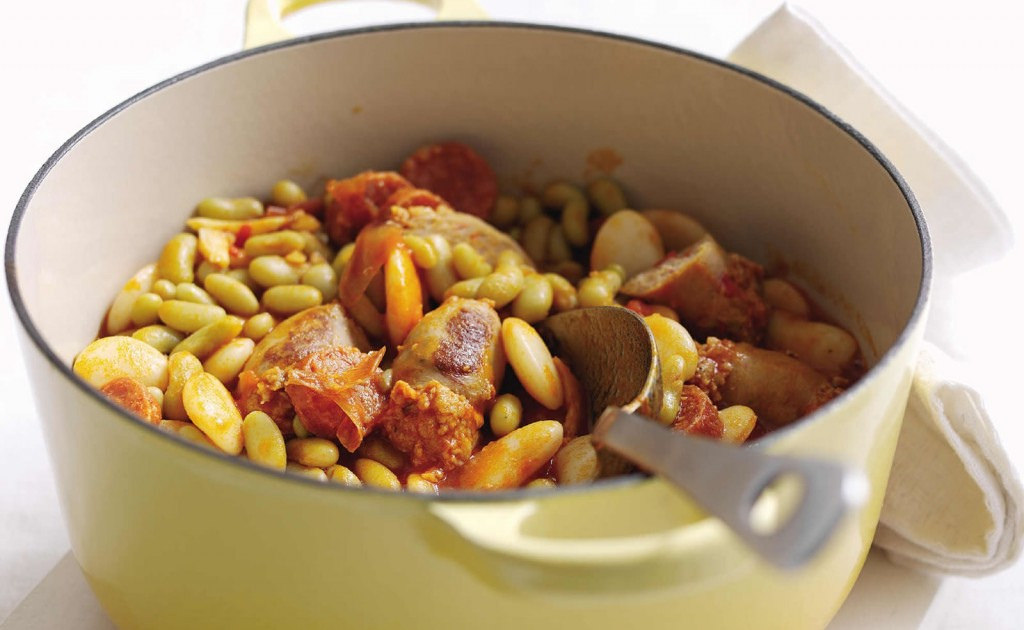
French Cassoulet
This hearty dish from southwestern France, known as a cassoulet, is a one-pot meal. A slow-simmered mix of beans, pork sausages, pork shoulder, pancetta and duck topped with a bread crumb crust , takes its name from the earthenware casserole in which it was traditionally made. My comment:You don’t need to use the breadcrumb crust.
Serves 6-8
Ingredients
1 lb. dried great northern beans
10 tablespoons duck fat or olive oil
16 cloves garlic, smashed
2 onions, chopped
2 carrots, chopped
2 large ham hocks
1 lb. pork shoulder, cut into 1″cubes
1⁄2 lb. pancetta, cubed
4 sprigs oregano
4 sprigs thyme
3 bay leaves
1 cup whole peeled canned tomatoes
1 cup white wine
2 cups chicken broth
4 duck legs
1 lb. pork sausages
2 cups bread crumbs (preferably not on a low carb diet!)
Directions
Soak the beans in a 4-qt. bowl in 7 1⁄2 cups water overnight.
Heat 2 tablespoons of duck fat in a 6-qt. pot over medium-high heat. Add half the garlic, onions, and carrots and cook until lightly browned, about 10 minutes. Add ham hocks along with beans and their water and boil. Reduce heat and simmer beans until tender, about 1 1⁄2 hours.
Transfer ham hocks to a plate; let cool. Pull off meat; discard skin, bone, and gristle. Chop meat; add to beans. Set aside.
Heat 2 tablespoons duck fat in a 5-qt. dutch oven over medium-high heat. Add pork and brown for 8 minutes. Add pancetta; cook for 5 minutes. Add remaining garlic, onions, and carrots; cook until lightly browned, about 10 minutes.
Tie together oregano, thyme, and bay leaves with twine; add to pan with tomatoes; cook until liquid thickens, 8–10 minutes. Add wine; reduce by half. Add broth; boil. Reduce heat to medium-low; cook, uncovered, until liquid has thickened, about 1 hour. Discard herbs; set dutch oven aside.
Sear the duck legs in 2 tablespoons duck fat in a 12″ skillet over medium-high heat for 8 minutes; transfer to a plate. Brown the sausages in the fat, about 8 minutes. Cut sausages into 1⁄2″ slices. Pull duck meat off bones. Discard fat and bones. Stir duck and sausages into pork stew.
Heat the oven to 300˚F. Mix beans and pork stew in a 4-qt. earthenware casserole. Cover with bread crumbs; drizzle with remaining duck fat.
Bake, uncovered, for 3 hours. Raise oven temperature to 500˚; cook the cassoulet until the crust is golden, about 5 minutes.