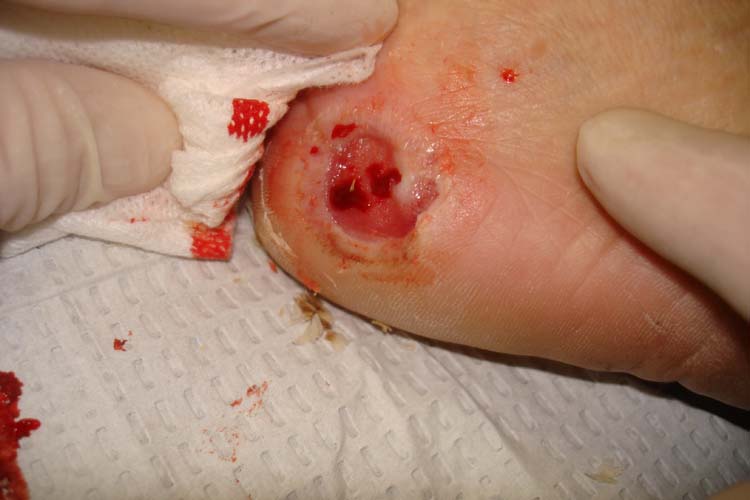
NICE puts its best foot forward with evidence based improvements to prevent amputations

The 2015 Footcare guidelines are forward thinking, evidenced based and if implemented widely should help reduce amputations in diabetics.  The problem is that at the moment best possible practice is not happening in many areas including my own.

For instance, NICE states that diabetic patients should get information that includes: a clear explanation of their problem, pictures of diabetic foot problems, care of the other foot or leg, foot emergencies and who to contact, footwear advice, wound care, and last but not least, information about diabetes and the importance of blood sugar control. (4.2)

They need this because life expectancy for diabetics is up to 15 years shorter than for their non-diabetic counterparts and 75% of them will die of macrovascular complications. 10% of diabetics will get a foot ulcer at some point in their lives.(1.1)

For every £150 spent on total NHS expenditure £1 is spent dealing with ulcers and amputations. (1.2 2012). Diabetes is the most common cause of non-traumatic amputations and ulcers precede 80% of these. 70% of people die within 5 years of amputation.

The number of amputations for diabetics ranges 4 fold for various reasons across the UK.(1.3) With evidence for best practice available the 2015 guidelines hope to bring poorer performing areas into line.  Preventing ulcers and amputations would be very worthwhile not just for the individuals concerned but for the sheer cost of them.

To enable the best possible care NICE recommends that a diabetic foot protection and treatment service is available in the community and in hospitals. (2.3)

The team should include:

Diabetology

Podiatry

Diabetes specialist nurses

Vascular surgery

Microbiology

Orthopaedic surgery

Othotics/biomechanics

Interventional radiology

Casting

Tissue viability

NICE recommends that those with active diabetic foot problems are referred to the foot protection service and that referrals within 24 hours be made for grangrene, suspicion of Charcot’s arthropathy, ulceration with limb ischaemia, clinical concern that there is a deep seated soft tissue or bone infection, ulceration with fever or any signs of bone sepsis. (2.2)

NICE recognises that special arrangements for the housebound, those in nursing homes or in care may need to be made. (2.3)

They also warn that ankle/ brachial pressure index results may need to be interpreted carefully in diabetics because calcified arteries may falsely elevate results and so give falsely reassuring readings. (2.3)

Health care professionals should also know that there is a raised cardiac risk in those with diabetic foot problems. (4.2)

Once a diabetic foot problem is recognised clinically X rays and MRIs may be needed for further investigation. (6.1)

For mild infections antibiotics that cover gram positive organisms should be given. (6.2) This could be for instance flucloxacillin.  For severe infections both gram positive and negative organisms should be covered. This would require the addition of eg metronidazole. For severe infections they recommend that IV antibiotics are started first and the switch to oral antibiotics should be based on the clinical response. For those with bone infection the course should be for six weeks.

Charcot’s arthropathy occurs more commonly in those with neuropathy and renal failure. (7.1).  Suspect this if there is a red, warm, swollen foot with deformity, even if pain is not reported. Refer this condition urgently and keep the person off the foot. X ray first of all and if no abnormalities are seen do an MRI.

When making a decision on the frequency of follow up for patients with diabetic foot problems, take into account their overall health, how healing has progressed  or any deterioration.  (4.8). Ensure that the monitoring interval is maintained in the community or in the hospital.

I know that in Ayrshire where I practise there is no such entity as a diabetic foot protection or treatment service although the services are available separately,  and I would be interested to know how it is in your areas.  The information to diabetics is certainly not as comprehensive as NICE would like.  I can see the importance of this because of the need for urgent assessment and treatment of minor problems so that they don’t become limb threatening.

As a GP the main thing I need to do is to recognise diabetic foot problems. If the problem is mild I would treat and review promptly but for severe problems hospital admission is needed. After all most cases will require X rays, MRIs and intravenous antibiotics. There is not the seamless service for diabetics inside and outside of hospital that NICE has found makes such a difference to amputation rates.

For the best advice on caring for your feet if you have diabetes I would recommend Dr Bernstein’s Diabetes Solution. At the present time I don’t know of any good photographic sites that would provide the pictures that would help diabetics understand their foot issues. Any suggestions from our readers?


NICE 20015 Diabetes guidelines reveal magical thinking for our diabetic youngsters (again)

NICE have done a major diabetes review over all areas and the new guidelines went out to consultation recently.   I was lucky enough to be sent them by the Royal College of General Practitioners but only given 2 weeks to respond to them. So far I have only managed to study the children and young people’s guideline but my critique of the others will follow.

The new guideline gets some things correct in my view. The target hbaic for one. It is now 6.5%  or 48 mmol, because the group have finally realised that tight blood sugar control is the actual key to preventing complications from diabetes. (7.2)  Okay, it took a long while, but at least they got there in the end. Previously target hbaic levels have been set too high at 7.5%.

Even NICE however are concerned that children and young people will find this terribly hard to attain. They certainly will, especially, if they attempt to follow the unchanged and still illogical, non-evidence based, consensus plans which are to eat lots of carbohydrate and make sure you avoid saturated fat. Yet they have a sense of humour about themselves and state that children and parents “should develop a good working knowledge of nutrition and how it affects diabetes”. (3.4)

Obviously Emma and I think you should too, and this is why you should read our book and not pay too much attention to what an NHS dietician or diabetologist tells you about what to eat.

There was only 0.3% improvement in hbaic after learning about carbohydrate counting. Not a single low GI study showed a 0.5% improvement in hbaic. Unless you specifically understand  to greatly limit carbohydrate intake, no significant improvements in blood sugar control will be made.

The entire report is littered with study after study which show that our diabetic youngsters have very high hbaic levels indeed. Mean levels of 8.5 to 11.5% are common in diabetic children and adolescents no matter what parameters are under scrutiny.  Meanwhile, although structured education is increasingly popular, and costs £683 per person, it too fails to make any changes to hbaic over 6 months or 12 months. (20) None of the structured education programmes could produce even a 0.5 % reduction in hbaic though one study did show a reduction in severe hypoglycaemia.  Could it be the lousy rubbish they teach about what constitutes a healthy diet perhaps?

There is no longer a consensus view that diabetics should “eat the same healthy diet as everyone else”.  The American Association of Clinical Endocrinologists has been the first major group to tell diabetics to limit carbohydrate to 90-120g per day and to adjust this if they are not reaching target blood sugars.  Consensus opinion in this context is just another word for a bunch of bullies and failure to remove these appalling dietary recommendations is in my opinion reprehensible, immoral and disgusting. They don’t have to keep consensus opinions. SIGN got rid of them. So can NICE.

Meanwhile, NICE, seem to let diabetologists off the hook and explain that the avoidance of undue hypoglycaemia, is a barrier to attaining decent hbaic levels. (5.7) They have again refused to see that a low carb diet can be a straightforward way of minimising blood sugar variability and that it has been proven by Dr Bernstein and Dr Neilsen. Why? Because they did not look at this sort of evidence. Indeed no new dietary evidence was looked for at all, before they embarked in a hugely expensive operation into researching the current guidelines.

They notice that even kids realise that their blood sugars are not under control and that young though they may be, this affects them poorly psychologically.( 7.7)  It must be very disheartening to be doing everything you are told yet not achieving single figures on your meter.  You feel tired and out of sorts when your blood sugars are high, but at least it doesn’t “show”. Low blood sugars single you out as different from your friends, and continually remind you that you are a patient. Indeed NICE have the proof that depression can result from poor glycaemic control. (10.3)

Albuminuria is correctly recognised by NICE as the first sign that the kidneys are being damaged by high blood sugars. Yet the recommend a low protein diet to “prevent” it. (11.43)  Why? High blood sugars from high carbohydrate diets are the major cause of the kidney damage in the first place. Again, the recommendation is neither evidence based or thought out at all. They again have ignored research by eg Facchini and Saylor who showed that high protein, high polyphenol, low carb diets improved kidney disease in diabetics.

One of the useful things this review stated was that there was no harm found in injecting insulin through clothes. I know this can sometimes facilitate insulin injections in public places.

Another is the unusual but serious issue of Diabetic Ketoacidosis. It can occur even when diabetic kids on insulin have normal blood sugars. (18 recommendation 177). DKA should be suspected if there is nausea or vomiting, abdominal pain, fast breathing, dehydration and a reduced level of consciousness. Blood ketone testing is preferable to urine testing.

After an episode of DKA, NICE recommends that the factors that could have led to the episode are explored with the diabetes team. (18) Non adherence to therapy needs to be considered especially if DKA is recurrent. Diabetics should get advice on how to reduce future episodes and the management of intercurrent illness is particularly important. We cover some of these aspect in our book but for the best possible advice on this I recommend Dr Bernstein’s Diabetes Solution. I also recommend that you become familiar with this well before you get ill.

When it comes to the increasing numbers of children and adolescents with type two diabetes, the blood sugar targets have been similarly set for a hbaic of 6.6% or 48 mmol/mol. (14).

The dietary advice is the same rubbish as for type ones. NICE states that “healthy eating” ie high carb, low protein, low fat diets, “can reduce hyperglycaemia, reduce cardiovascular risk, and promote weight loss”.  They don’t produce any evidence to back this up of course, it’s neatly packaged as “consensus”. (13.17)

Albuminuria was present in 29% of this young population independent of the duration of the diabetes. First morning samples are preferred for testing. (17).

The age of transfer to adult clinics is discussed in the new document. As an example of typical blood sugar levels, in Finland the mean age of transfer to adult clinics was 17.5 years. Average hbaics one year before transfer ie at age 16.5 was 11.2% + or – 2.2% and at age 17.5 the average hbaic was 9.9% + or – 1.71%.  These kinds of averages litter the report and indicate that diabetic complications are inevitable for our young diabetics unless they radically change what they are doing regarding diet and blood sugar management.

Health economists have been busy bees regarding diabetes expenditure and costs. For your typical person on multiple daily injections the cost is £2,155 per year. (20) This includes initial instruction and seeing consultant diabetologists and nurses at typical hospital clinics in the NHS. For those who inject 2 or 3 times a day the cost is £1,500.  The MDI was shown however to be cost effective compared to the less frequent injections, which use mixed insulins, due to the long term reduction in complications. The typical baseline hbaic was 11.4% in 10-14 year olds in England and Wales.  Scary, isn’t it! (Adhikari 2009). All sorts of cost for complications are listed  and these make interesting  if somewhat gruesome reading. An amputation with the provision of a prosthesis for example costs £15,000.

Reduction in complications occurs with every reduction in hbaic.  Similarly lifetime complication costs are reduced with adequate monitoring. Five times a day seems to be the optimal, minimal  testing frequency.

NICE have been very good at telling us what is going on in the UK with diabetes management of children and young people. They have a lot  of new,  sensible and research based recommendations. Unfortunately they chose NOT to review dietary recommendations and until they do this, hbaics of 6.5% will remain pie in the sky. Unless you just ignore them and eat low carb of course!

Chocolate orange muffins: how to de-carb a standard recipe

I found this recipe in this weeks Observer magazine. Of course the recipe was neither low carb or gluten free or even for muffins, but with a few tweaks I managed to produce these lovely muffins.

dark chocolate 85g

unsalted butter 120g

granulated sugar 120g ( I substituted 4 rounded dessertspoons of a mixture of splenda, z-sweet and truvia )

ground cinnamon 2 pinches ( this recipe could use a bit more than this)

ground all spice 2 pinches ( again, a bit more wouldn’t hurt)

vanilla extract one teaspoon ( and add chocolate essence one teaspoon if you have this)

zest of half an orange ( I used zest of one whole orange for very full orange flavour )

3 eggs

milk 2 tablespoons ( or use double cream )

ground almonds 150g

plain flour 60g ( I used wheat free white flour but think you would easily get away with more almonds here or you could use whey protein powder instead, either plain, chocolate or vanilla)

baking powder 1/2 teaspoon

Pre-heat the oven to 180 degrees. Gas mark 4.

Melt the chocolate in the microwave and use a wooden chop stick to stir or melt in a bowl over simmering water on the hob.

Mix the butter, sugar substitute, spice, essences, zest together until light and fluffy.

Beat in the eggs and the almonds and chocolate till fully incorporated. This is most easily done one egg/ a few spoons of almonds at a time.

Add the flour or extra almonds and baking powder.

Mix thoroughly.

Either cook as a cake in a buttered/cake released springform cake tin or put into muffin cases for muffins.

The muffins took 25 minutes and the recipe says the cake takes 30 minutes.

Either way it is best to check your muffins at 20 minutes. Use a cocktail stick, special heat conduction stick (Lakeland Ltd) or your finger to check doneness. Sticks will come out dryish, the top will spring back when pressed with your finger when done).

Serve with whipped double cream with a little vanilla essence.

Cauliflower Cheese

This is my very easy take on cauliflower cheese making the most of pre-prepared supermarket ingredients.

Easy Cauliflower Cheese

  • Servings: 4-6
  • Difficulty: easy
  • Print

  • Frozen cauliflower florets (or prepare from fresh) equivalent of one cauliflower
  • Frozen chopped onions (or prepare from fresh) one handful
  • Lazy garlic (or prepare from fresh) one teaspoon
  • 250mls double (heavy) cream
  • Pre-grated mature cheddar cheese (or grate yourself) 3/4 of a bag
  • English mustard (or use French if preferred for a milder flavour) one teaspoon
  • White pepper ground one teaspoon
  • 1-2 oz unsalted butter
  1. Put on the oven at 190 degrees.
  2. Put cauliflower in the microwave to cook. Add some water to a microwavable pot and seal with lid or cling film.
  3. Cook as directed or around 7-9 minutes. Check for firmness. Cook as you like either firm or sloppy or somewhere in between.
  4. Meanwhile melt butter in a saucepan. Add the onions and garlic and brown.
  5. Take off the heat and add the double cream.
  6. Add the pepper and mustard and stir.
  7. Add the grated cheese and stir (leave some cheese over).
  8. Drain the cooked cauliflower and put in a Pyrex bowl or similar oven-proof dish. Pour over the cheese sauce.
  9. Sprinkle on the remaining grated cheese and put in the oven for 20 minutes.
  10. Remove and serve immediately.

Goes well with sliced meats, especially ham.

Chinese Duck Breast

Chinese Duck Breasts

  • Servings: 2
  • Difficulty: easy
  • Print

  • Two duck breasts with skin on
  • Coarse sea salt
  • Chinese Five Spice seasoning
  1. Put on the oven at 180 degrees.
  2. Score your duck breasts with a sharp knife and rub in the coarse sea salt, followed by the five spice powder.
  3. To a COLD frying pan add the duck breasts skin down and cook for 4-5 minutes till there is a good amount of fat in the pan from the melting duck fat.
  4. Turn the duck breasts over and cook for 2-3 minutes till seared.
  5. Put in tin foil and cook for a further 15-20 minutes in the oven.
  6. Take out and rest for 10 minutes.

Serve.

Rack of Lamb Roast

Rack of lamb

white wine (half a glass)

rosemary dry or fresh

coarse sea salt

black pepper

easy garlic or garlic chopped finely

unsalted butter

olive oil

Marinade your rack of lamb for a few hours in white wine, garlic, chopped rosemary and black pepper.

Heat your oven to 190 degrees.

Melt butter and olive oil in frying pan. Bring to a high heat. Sear the lamb.

Place in foil along with remaining oil mixture.

Bake in oven for 20 minutes for medium done rack of lamb.

Warm your plates before serving.

Plate out 3-4 chops per person. Spoon over some of the oil over the chops.

Serve with vegetable of your choice.

Book review and discussion: What experts say about solving the obesity epidemic

“The shape we are in: how junk food and diets are shortening our lives” by journalist Sarah Boseley is a £13 paperback in which many of the factors that have contributed to the obesity epidemic are discussed.

For much of her material Sarah has gone to obesity “experts” but not a single low carber.  So she has ended up with a  different opinion from what we may have on the causes of the massive surge in obesity over the last 30 years.  Although I don’t share the government “experts” view as to the benefits of a low fat diet,  I think that reading the opinion of “the other side” is a good way to broaden my view and possibly learn a few things that could actually improve the situation. With this in mind I was looking for what I recognise is familiar and  true and also had a chuckle at some of the material as well.

Very little was contentious. I have starred * my own contributions (which I would have given had she interviewed me!)

Behavioural changes at family/individual level: 

Eat meals at meal times at a table with your family. Make meals from proper food. Not processed junk.

Stop dieting and eat good food all the time.

Reduce the amount of processed food that we eat.

Do 45 minutes or more exercise a day to improve mood and use calories.

Don’t snack or eat only healthy snacks such as nuts, cheese and fruit.

Stair climb and walk at every opportunity.

Health service changes:

Offer cognitive behavioural therapy to the overweight.

Expand the provision of bariatric counselling and probably offer this at younger ages.

Advertise the futility and actual harm of crash diets and make such an idea an object of ridicule.

Advise on muscle building exercise for all*

Advise on the benefits on health and physique of the low carb diet*

Educational changes:

Teach cooking in primary school and beyond.

Expand the range of foods served in schools.

Stop serving puddings in schools.

Political changes: 

Tax sugary drinks.

Stop junk food sponsorship of sports events.

Have proper labelling of food.

Subsidise fresh, wholesome food.

Ban sugary food in schools hospitals and workplaces.

Put in cycle paths, street lighting, pavements and redesign towns to make walking attractive.

Have stairs, showers and secure bike parks in offices.

Limit fast food advertising especially to children.

Give proper meal breaks in the workplace.

Put calories/carbs on drinks as well as food.

Food production and service changes:

Reduce portion sizes.

Stop check out sweets and goodies marketed to children.

Stop buy one get one free promotions.

Cut salt, sugar and fat in manufactured foods.

Get food manufacturers to produce more genuinely healthy products.

Decrease plate sizes at buffets.

Actually, I don’t have any gripe with these.  I would simply say that my idea of good food is meat/fish/eggs/cheese/nuts/veg and some fruit with butter, cream, olive, coconut and avocado oil NOT starch, fruit juice, industrial fats. I would also prioritise weight /resistance training over cardio because it make you burn more calories, makes you stronger, doesn’t wear out your joints, and reduces osteoporosis better than cardio.

As you can see the obesity problem and therefore solution is multi-factorial. There are things we can do ourselves, but there  is a much wider framework regarding political will, town planning, working hours and facilities, food manufacturing and advertising, food costing, and education by health services, schools and the media.

We can’t go back to the so called “Good Old Days” like this attractive, affluent, family circa 1949. Will the government get so fed up with the devastating health bill that that they will take some of the steps outlined in Sarah’s book? Or will corporate interests, the low fat/high starch dogma and the high working hours culture win out?

Would older men and women be better off with a bit more testosterone?

Book Review:  Testosterone is your friend by Roger Mason.

This slim volume, written by research chemist Roger Mason, reviews  evidence for testosterone replacement in both  men and women. Up until the age of 30, both genders do pretty well, but after that it is a slow trundle downhill as far as our sex hormones go. By our 50’s men produce more oestradiol than their same aged wives do, and a multitude of problems that we consider “just normal ageing” develop.

Men don’t get problems from high levels of testosterone,  but do get problems when the levels go too low.  Women do best with  mid range levels about 2.1 free testosterone. Levels of 1-3.2 are considered normal range in the UK.

Should you wish to supplement levels  sublingual or transdermal preparations work well,  but injected, implant and oral tablets do not.

Too low levels of testosterone cause obesity, diabetes, osteoporosis, heart and artery disease, cancers, memory loss and sexual dysfunction. When levels are normalised to those found in your average 30 year old for both genders, benefits include an improved all cause total mortality, increased lean muscle mass, lower cholesterol, stronger bones, lower body fat, and higher HDL.  Mood, blood sugars, energy and sense of well being all improve. Prostate enlargement and prostate cancer can be reduced by replacing testosterone in men in good time. Skin, hair and immunity all improve.  Blood pressure is improved in women if the mid range level  is achieved. Testosterone reduces seizure threshold in epileptics.

Studies are reviewed which indicate that all these assertions are valid. So why is testosterone replacement therapy lagging behind so much compared to oestrogen replacement? Indeed the only testosterone preparation licenced for women in the UK was taken off the market in the last couple of years due to being a marketing failure.

As a GP I can say that testosterone replacement for men is getting off the ground but not in the pro-active way that oestrogen is given to peri-menopausal and post meno-pausal women. Instead we wait till problematic symptoms occur eg breast enlargement in men, diabetes in men of normal weight, or sexual dysfunction occurs. Then we test. Then we refer to over subscribed clinics and the man eventually gets prescribed something suitable. It is a true case of shutting the barn door after the horse…..etc.

The main thing that put me off prescribing for men was that the fine print said that I had to do a digital rectal examination on such men every six months in order to detect possible prostatic cancer. From what Mr Mason says, it would look as if testing and treating men over the age of 40 could make a big difference not just to prostate health but for a very wide range of health problems. It should be remembered that these diseases all seem to have their own very expensive screening programmes, drug and surgical treatments in place. Perhaps a single bullet aimed at the core problem would be less expensive overall?

When it comes to women, after the menopause there is a dwindling amount of testosterone and secreted by the ovary and after a surgical removal of the ovaries or hysterectomy there is rapidly none. The adrenal glands are able to secrete some testosterone, but not enough. Collagen loss, bladder problems, wrinkles, weaker bones, loss of muscle and gaining of fat and all the rest follow on. There is increasing interest in adding testosterone into HRT prescriptions but at present women need to use preparations licenced only for men and not all GPs are therefore willing to prescribe.

In my own practice, several of us are using these preparations and checking our prescribing with blood tests done at monthly intervals till we hit the right dose. As a rough guide, men need 8 squirts of Testogel daily and women need 3. This will usually give deficient men and women adequate levels, but since this is not a developed area, follow up blood tests are needed to individualise the dose.

What about our three lovely ladies here? They are just having a natter about their new year resolution. They have been off to the  gym weight training for an entire month now and are a bit disappointed with their results. The middle one is telling the blonde that at least her bicep is coming along better than her glutes. No doubt they are hacked off that it is so much easier for their boyfriends with all that testosterone running around.   It’s so unfair!!!

Book Review: The world turned upside down, the second low carbohydrate revolution by Professor Richard Feinman

Well produced book for the scientifically minded reader

By Katharine Morrison

This book covers in detail subjects that are often ignored in other low carb books. These are the precise biochemistry covering the metabolism of carbs, fats and proteins in humans and the flaws regarding diet trials covering both design and statistics.

Richard Feinman is a professor in a New York university who is at ease with both subjects. His writing is erudite and not always that easy to follow for the non scientist, as he delves into areas of complexity that other authors gloss over.

There are many coloured tables and I think this book is best read on kindle for pc or on paper format as they show up better in full page and colour format. I think this book is aimed for students, doctors, scientists, diabetologists, cardiologists, and nutritionists who think they know what they are doing but who still support a high starch/ low fat diet for people in general and diabetics in particular. They will be able to see exactly where they have been led astray by old ideas that do not stand up to serious scrutiny.

This book is particularly well produced and I did not come across a single typo in the entire text.

There is much to satisfy those who have already converted to the low carbohydrate lifestyle who wish to learn more about the history, science and statistical shennanigans that go on with dietary studies into low carbohydrate diets.  For new comers it is not a “how to do it book”, like ours. There is a recipe section but it is a bit thin and disappointing. Perhaps Professor Feinman hasn’t spent as long in the kitchen as Emma and I have!

Pork chops in creamy sage sauce

This is a very quick and tasty meal that you can produce with very little effort, particularly if you cheat with the onion and garlic.

Pork chops 1 or 2 per person

Dried sage one heaped teaspoon per person (or use fresh if you can get it)

Olive oil and butter for frying

Frozen or fresh cut white onion, one heaped dessert spoon per chop.

One teaspoon very lazy garlic or one clove per chop

Double cream

Salt and pepper

White wine

Put on oven to warm at 150 degrees

Marinade the pork chops in a little white wine and sage, salt and pepper, for at least 30 min

Heat frying pan with olive oil and butter

Fry chops till some browning on both sides and fat

When done, about 3-4 mins per side depending on thickness, put in oven proof dish and leave to warm in the oven.

Turn down the heat under the frying pan

Add onion and garlic and fry till soft and lightly browned

To cooked juices in the pan add double cream and allow to thicken

To serve pour the sauce over the cooked pork chops

Goes well with any green vegetable dish