Diabetics are experiencing far less polyneuropathy in the last 25 years

Photo by Anete Lusina on Pexels.com

Adapted from BMJ 28 Oct 2023

In Denmark the records of 10,000 people were examined. Since 1996 vibration perception has been done in type one and type two diabetes patients in a specialist diabetes centre.

In middle aged type one patients, distal symmetrical polyneuropathy fell five fold between 1996 and 2018.

In older people with type two diabetes the incidence of polyneuropathy halved.

As polyneuropathy is often the precursor to ulceration and amputation, this is good news indeed.

Upper limb stiffening is very common in diabetes

Photo by Angela Roma on Pexels.com

Adapted from BMJ 3 June 23

A study of 2000 people published in Diabetes Care, has found that disorders of the upper limb caused primarily by the stiffening of tendons are three to five times more common in Type One diabetics compared to the general population.

Women with diabetes are more commonly affected than men for most tendon problems except for Dupytren’s Contracture which often affects the pinky and ring finger tendons at the palm. (This problem also tends to be inherited more if you have Viking ancestors.)

The tendons affected in the shoulder cause frozen shoulder, carpal tunnel syndrome at the wrist and forearm, and trigger finger in the fingers.

Good glycaemic control improves school grades in type one diabetes

Photo by Pavel Danilyuk on Pexels.com

Adapted from Medscape article by Peter Russell 6 Dec 2022

Children with type one diabetes have more school absences than classmates who do not have the condition, but difficulties with blood sugar control were linked to the most absences.

Despite lower attendances many children with type one diabetes achieve good exam grades and go on to higher education. But those with higher HbA1c levels were more likely to get poorer grades and found it harder to get a place at college level.

Cardiff researchers think that children who struggle with their glycaemic control could benefit from more clinical and educational support.

Researchers looked at over a quarter of a million children aged 6 to 18 and over a thousand children with type one diabetes who attended schools and colleges in Wales between 2009 and 2016. Factors such as the child’s household socioeconomic status, neighbourhood deprivation, sex and age were taken into account.

The results showed that type one children were absent for 8.8 sessions per year more than children without diabetes. Those with the best glycaemic control missed 6.7 sessions per year and children with the poorest levels of control missed 14.8 sessions.

Children in the quintile with the best glycaemic control got results 4 grades higher than those without diabetes at the age of 16. However for those in the lowest quintile of HbA1c control attainment was 5 grades lower than their classmates who did not have the condition.

Those with the best glycaemic management were 1.7 times more likely to gain a place in higher education than the general population whereas those in the lowest quintile for glycaemic management were 0.4 times as likely to go onto higher education than those who did not have type one diabetes. In essense those in the highest quintile were almost three times more likely to attend higher education than in the least optimal quintile.

Dr Robert French, one of the researchers was impressed that children with diabetes under adequate control were as likely to progress to higher education as their non diabetic peers even though they lost more school days to diabetes.

Overachievement for children with type one diabetes who effectively managed their glycaemic control could be due to factors unrelated to glucose levels and could reflect socioeconomic conditions, family support and effective self management.

Robert French et al. Educational attainment and childhood onset type one diabetes. Diabetes Care 1 Dec 2022 45(12) 2852-2851.

My comment: I know from my own experience of being a parent of a child with type one diabetes that the formulation of strictly kept routines around blood sugar testing, meals, homework, activity, and sleep made a big difference to my son’s blood sugar control and educational attainment. By my son’s diagnosis it had been already discovered that 9 out of 10 diabetic children had worse school attainment than average for their peers and that high blood sugars affected concentration, mood and memory. It would seem that for most diabetic children the educational gap has been greatly improved in the 20 years since. The overachievement affect is understandable when a child or young adult is given more family support, and this is usually maternal support, during their adolescent years, than is perhaps the case for non diabetic children. The adoption of a low carb diet makes glycaemic control much easier for all diabetics and this is even more important when the hormonal surges of puberty are causing glycaemic uproar, and the need to perform in exams can determine future career paths.

New drug can delay the onset of type one diabetes

Photo by RODNAE Productions on Pexels.com

Adapted from Medscape Nov 20 2022 by Miriam E Tucker a freelance journalist from Washington DC.

At last humans have caught up with mice!

Since my son was diagnosed with type one diabetes, some 28 years ago, it has been possible to reverse type one diabetes in mice. At last the huge effort to find a suitable agent to use in humans, and particularly children, has been approved by the FDA.

Thank you everyone who has contributed to this marvellous discovery. The Juvenile Diabetes Research Foundation was set up with this end point in mind and they have been successful in the development of the new drug which they helped fund. The thing is that now such an agent is available, we need to be able to find the people who would most benefit from taking the drug. Thus screening for early type one diabetes is going to become crucial.

The new drug is called Teplizumab-mzwv (Tzield, Provention Bio) and it is a anti-CD 3 monoclonal antibody. It was approved in Nov 17 21 and is the first human disease modifying therapy for impeding the prevention of type one diabetes. It delayed onset by around 2 years and longer in some subjects.

It is given by an intravenous infusion once daily for 14 days and costs around $200,000 dollars for the course of treatment.

It is licensed for children over the age of 8 years. The group it is targeting is those who are asymptomatic but who have raised blood sugar levels and at least two type one diabetes antibodies. Most of those screened are first degree relatives of type ones. The JDRF is offering a screening blood test for $55. But because 85-90% of people who do develop type one diabetes don’t have a first degree relative, screening will need to be developed further.

In Bavaria, Germany, screening of all schoolchildren for type one diabetes has been done, and the organisers said that a major benefit, was that education about the signs of diabetes occurred so that diagnosis occurred before Diabetic Ketoacidosis developed. This is known to cause deaths and wears out the pancreas much faster.

In another study 2 year olds and 6 year olds in the USA and western Europe were screened for islet autoantibodies and this detected almost all of those children who developed type one diabetes by mid adolescence.

Using a genetic risk score at birth has been suggested as more cost effective by Dr William Hagopian of the Pacific Northwest Research Institute in Seattle. 10% of newborns have HLA genes that can identify 80% of those who will get childhood type one diabetes.

My comment: I’m particularly pleased to see that the JDRF has been successful because if my son has offspring they have a one in three chance of developing type one diabetes in childhood. As time goes on, it is to be hoped that the interventions will become cheaper and more effective.

Babyhood antibiotics increase the risk of type one diabetes in childhood

Photo by CDC on Pexels.com

Adapted from Diabetes in Control Antibiotic Treatment increases risk for type one diabetes by Chardae Whitner May 15 2021

Both prenatal and first year of life antibiotic exposure may increase the risk for developing type one diabetes in childhood.

It is believed that early life risk factors which include antibiotic treatment can influence the risk of type one diabetes by affecting the gut microbiome. This affects the development of the immune system. Type one diabetes children have been found to have lower microbial diversity in their gut compared to children without diabetes. Antibiotic exposure in early life delays microbiota maturation.

Sweden has the highest rates of type one diabetes in the world despite a relatively low antibiotic prescription rate. They studied siblings, some affected by diabetes and some not. They looked at antibiotic prescriptions, mode of delivery, sex, birth year and genetic predisposition to type one diabetes. The children studied were born between 2005 and 2013. 797,318 children were studied.

Overall 800 prescriptions for antibiotics were issued in the first year of life. These were most commonly for ear infections, then respiratory tract infections, urinary tract infections, and then skin and soft tissue infections.

Exposure to antibiotics prenatally was associated with an increase in type one diabetes in childhood of 1.15 (so weakly associated). Antibiotic exposure in the first year of life raised this a little to 1.19. (still weak. You would need to have 1,475 babies have antibiotics to have one extra case of childhood diabetes before the age of ten).

Siblings of type ones have a risk of 1.36, so this is a stronger risk than antibiotic exposure.

Caesarian section did give an increased rate of type one diabetes in childhood but sex, genetic predisposition and birth year did not. The risk was 1.10 in vaginally delivered babies and 1.60 in the little caesars. So this was again a bit stronger than sibling risk.

Wernroth, Mona-Lisa et al. Early childhood antibiotic treatment for otitis media and other respiratory tract infections is associated with risk of type one diabetes. Diabetes Care May 2020.

My comment: My son Steven has type one diabetes and had a strong family history on his dad’s side of autoimmune disorders including type one diabetes in several generations. He also was a caesarian section delivery and also had a peri-orbital skin infection when he was about seven months old that required antibiotics. Poor wee soul! These days no one gets a caesarian section without a good reason and antibiotics are well thought out. There isn’t much you can do about being a sibling of someone with diabetes. What you can do is take vitamin D in pregnancy and give it to your children from birth onwards.

#WorldDiabetesDay

Happy #WorldDiabetesDay to you! This year’s theme is Family and Diabetes. While the day (and the month) is more aimed at raising awareness of the undiagnosed condition and family members looking out for the signs of diabetes in partners, parents, siblings etc., my day will reflect on my family and how thankful they make me.

I was diagnosed with type 1 at the age of nine (there I am, just post-diagnosis on the right). Since then, diabetes care has come along in leaps and bounds. In those days, you used syringes made of glass, tested your urine and not your blood and relied heavily on your body and not a machine to tell you what was wrong. (Ah, the young yins! Don’t know they’re born…)

As a nine-year-old weeping copiously at the prospect of no sweeties or birthday cake again ever, I wasn’t 100 percent au fait with what was now going on with my body. I scared the living daylights out of my parents several times by fainting first thing in the morning. The most memorable time when I jumped up on the kitchen window ledge to let our pet cat in and fell off it. Onto a stone floor.

Bite me…

As biting my tongue often went along with fainting, my dad would try to stop me by inserting his own hand. I bit that instead.

Still, my parents were a game pair—happy to downplay the condition so I never felt disadvantaged. It took me until my 20s to realise I had a chronic illness. Duh, I know, but diabetes never felt that way to me growing up. My mum’s favourite cry was, “Have you got your Dextrosol?” whenever I left the house. (Again, the young yins. Not having to use Dextrosol for their hypos.) But other than that, they never mentioned it as a limiting factor or felt I could not do anything because of the diabetes. Fair enough, I announced no plans to be an athlete, truck driver or pilot, but they waved me off to a university in another country, a kibbutz, solo living and more without fuss.

Whenever I called home or visited, questions concentrated on my job, my personal life, what I was doing… diabetes never took centre stage.

Then, as I got older they generously funded a pump for me for a few years. When it gave up the ghost, I decided against further funding as I didn’t want to take any more of their money. They would have handed it over gladly. And still would, even though there are no longer two of them…

Ah, the mood swings…

Any family member of someone who has diabetes will raise a wry eyebrow if you talk about the mood swings. Figures, after all, that if you have a chronic illness tiredness is a frequent friend of the not very nice sort. It makes you sullen and snappy. Who better to take that out on than your nearest and dearest?

Then, there are the ‘hypo experts’; mums and partners who can tell you are hypo before it strikes you the excessive yawning is more to do with plunging blood sugar levels than a late night the day before. Grr. Double grr because they are almost always right.

I have my own little circle of mood bearers—once upon a time my mum, dad and sisters. (Still my poor old mum to some extent). Nowadays, my husband. He’s awfully good at spotting hypos. Awfully brilliant at lots of other things too. Running upstairs to bring me supplies when I run out of needles and other equipment. Keeping me in jelly baby supplies. Factoring in blood glucose checking stops whenever we are out and about. Finding me ice-cold water when high blood sugars kick in. Accepting that I am terrifically rubbish at late nights, which means we do not go out that much. (Tip—I organise a lot of things for a Sunday afternoon.) Checking restaurants to see if they offer low-carb options before booking them.

Diabetes does not come alone. Yes, it includes tiredness and a whole slew of other complications you do your best to avoid. But if it takes a village to raise a child, it takes warm, supportive, kind and patient folks to nurture a diabetic.

Here’s to them all—my family. Thank you thank you thank you.
#LowCarb Vegetarianism and other adventures

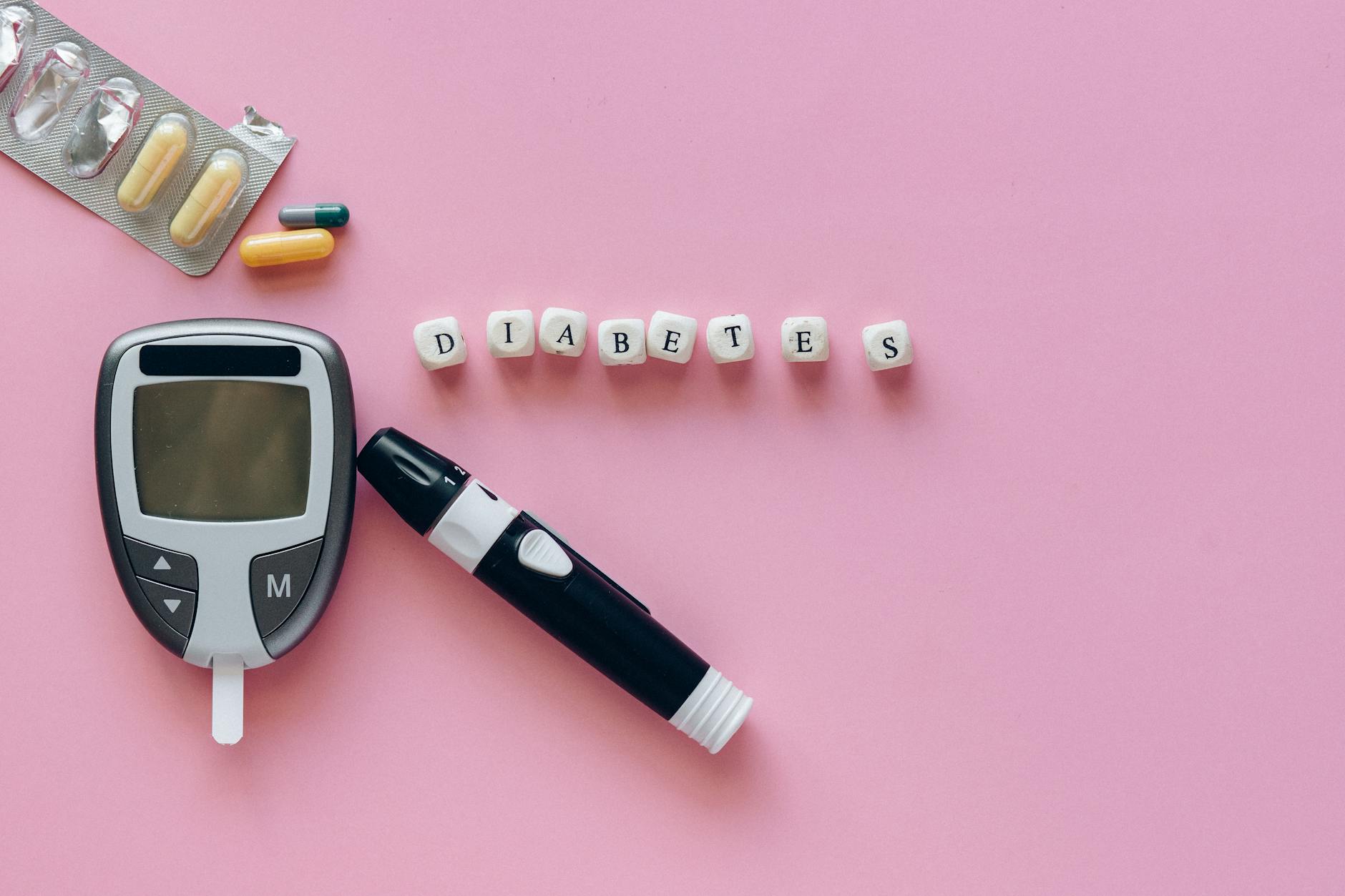
meat-free alternatives Maybe it’s the Extinction Rebellion folks gluing their hands to pavements, disrupting flights and parking their uncooperative crusty* posteriors on roads throughout central London.
Or it could be the underlying anxiety about eating meat that has always bothered me since I took it up again after more than 20 years of vegetarianism. But lately I have drastically cut down on the amount of it I’m eating and embraced the substitutes.

Vegetarianism and particularly veganism aren’t natural fits with a low-carb diet, the one I follow because I believe it’s the best one for helping people with type 1 and type 2 diabetes manage their blood sugar levels. Heck, the good Doctor Morrison and I even wrote a book about it!

Quorn slices

But the meat substitutes have come much further than the last time I ate them. Quorn makes decent fake ham slices. Cauldron sausages and marinated tofu work for me too—all of them low carb, though not as low-carb as the real thing. Even the Diet Doctor—the best source of everything you need to know about a low-carb diet in general—recognises that many people do want to follow a low-carb diet that they can square with their conscience and the website offers low carb vegetarian and even vegan plans these days.

While I question some of the health claims people make for a plant-based diet (and I’m picky about the word being used to mean ‘veganism’—I’ve always based the bulk of my diet around vegetables), poor Mama Earth’s resources will run out far too quickly if meat consumption continues at its current levels.

As I have no children, I can tick that big box on the green credentials list but the other two are eating a plant-based diet and not flying anywhere. As someone who’s not that fussed about travel, the latter might be easily achieved too. That just leaves me with what I choose to eat. As I don’t do absolutes any more, opting to be a vegetarian with limited dairy most of the time is what appeals.

Low-carb vegetarian recipes

How about you? Have you changed your diet because of environmental concern s or do you plan to? We do have veggie options on our website if you are looking for low-carb meat-free recipes. They include low-carb curried cauliflower cheese, aubergine and pepper parmigiana, baba ghanoush, Tofu with teriyaki sauce and crustless spinach and feta quiche.

*As Boris Johnson called them. Maybe he was attempting ‘wit’ as a distraction from the chaos he is in midst of creating in the UK.

Diabetes and the roller-coaster ride

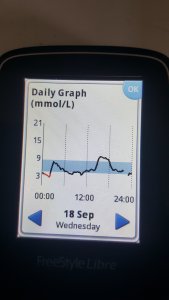
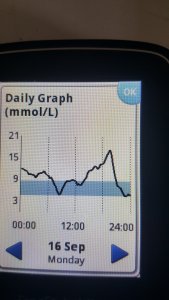
Just a quickie from me this week… I thought I’d share an interesting info-grab with you. The flash glucose monitoring system collects all sorts of info which is easy to see at a glance, such as your daily graph.

The graph shows you how often you have been in or out your target blood sugar range. The Monday one here (right) is me on holiday. Happy days, eh? Let’s loosen the reins on low-carb eating as boy, do the Cretans know how to do miraculous things with potatoes. While over there, I tasted what must count as the BEST CHIPS IN THE WORLD. A bold claim, I know.

And Wednesday is me back from holiday, determined to jump back on the low-carb wagon*. Goodness me, those graphs tell their own story, hmm? From wild jumps—the roller-coaster ride, to a far more sedate and steady line. A week’s potato bingeing is fun, but long-term I prefer to stick with the graph that doesn’t soar and plummet all over the place.


*Sorry for all the mixed metaphors.

Seven observations on using the FreeStyle Libre for a week

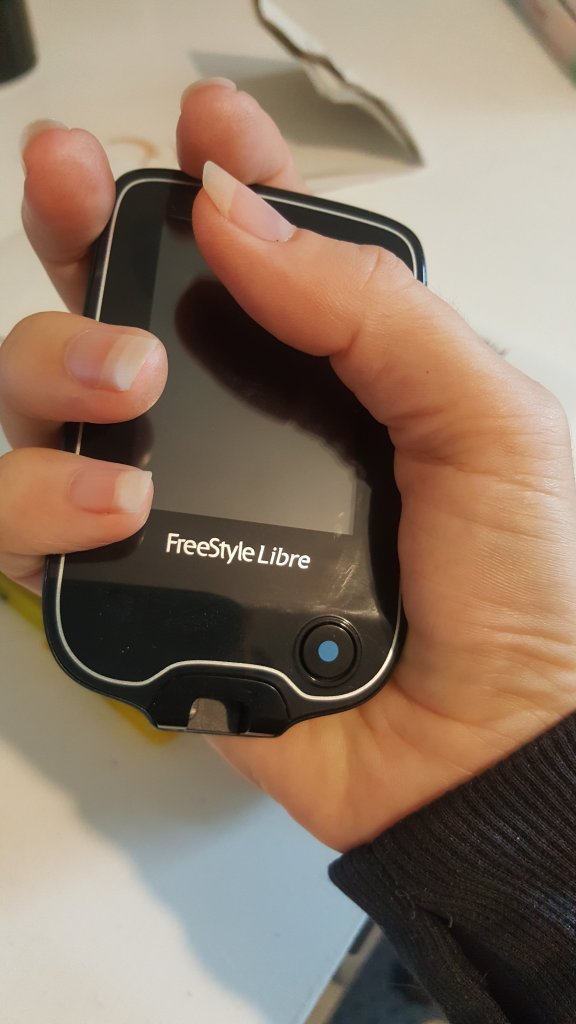
hand holding FreeStyle libre meter
You will prise this from my cold, dead hand…

Blood, I miss the sight of you… I’d gotten used to those tiny beads that popped from the tips of my fingers several times a day. This week, not so much.

And as misses go, it’s a rubbish one, right?

As the proud new owner of a FreeStyle Libre (may the universe rain her blessings down on NHS Greater Glasgow and Clyde), I know the much-vaunted advantages. Ability to test more often and easily. Probable positive effect on your HbA1c levels (the long-term measure of blood glucose in the body) and reduced likelihood of complications.

Here, then, are my observations on the lesser quoted points you notice when you wear one…

  1. I’m clumsy as heck. Yes, I keep bumping into door frames. Maybe I always have walked into them on a regular basis but when I hit my right arm (the one I’m wearing the sensor on) off a door frame, I notice. Three times in the first four hours of wearing it.
  2. The absence of black dots. Those of us who’ve spent our lives doing five or six blood tests a day (see above) can hold out fingers tips covered in tiny black dots. Occasionally, the skin peels away in protest. Three days in and mine VANISHED.
  3. Oh, the joy of the night-time test! You wake up, roll over, grab the sensor from our bedside table and wave it in the direction of your arm. Voila! The result. No messing around opening that wee case up, taking out the tube of sticks, popping it open, finding a stick and taking three attempts to insert it into meter, pricking your finger and missing the stick with the dot of blood, etc. And all done in the dark because you don’t want to disturb your other half.
  4. No more vampire impressions. I did blood tests on public transport, in offices, when out and about, in the gym, the cinema, the pub, restaurants and more. And I was discreet about it, but when your finger bleeds you suck it to get rid of the excess, right? Some folks think that is disgusting or that you should always wipe it on a tissue or surgical wipe. Who has the foresight to carry all that around as well as everything else?
  5. Having to remind yourself you can test whenever the heck you want. I’ll get used to the feeling quickly but I’m still adjusting. Shall I test again? No, no I only pricked my finger an hour ago and I’m only prescribed XX amount of sticks every months so no… Stop right there, lady. Shall I run the meter over my sensor again? Yes, yes, yes!*
  6. Staring at your graph. Oh the fascination of watching what your blood sugar levels get up to over eight hours. Telling yourself you will record this properly, oh yes you will, and work out patterns so you can make educated adjustments, rather than relying on guesswork.
  7. Missing the sight of blood. As you might have guessed, the intro to this piece was a big, fat lie. I’m one hundred percent happy that bloody fingers are a thing of the past (ish, you still have to do some).

* Ten’s the recommendation, in case you were wondering. Too many’s not good on the sanity levels.

My people all together – #type1diabetes

blood testing equipment type 1 diabetesEver sat in a room and thought, “I am with my people”? That was my experience this week as I attended an education session the NHS had put on; my attendance a condition for prescription of the Abbot FreeStyle Libre.

I doubt I’ve ever been in a room with so many other type 1 diabetics. Sure, type 1 is a hidden condition. Perhaps others travel on trains with me or flit about the offices of the University of Glasgow dropping their test strips wherever they go?* Still, my original statement holds. I reckoned on about 200 people there, with perhaps a third of them partners or parents.

All shapes and sizes

I arrived at the Queen Elizabeth University Hospital early and watched in fascination as folks trooped in to the lecture theatre. We come in all shapes and sizes—all ages, all colours and all creeds. Who were the ones with diabetes? I put it down to those of us who carried our precious bag—the FreeStyle Libre and the doctor’s letter handed out when we registered—tightly. I’d expected lots of young people, but that wasn’t the case. The average age, I reckon, was mid to late 30s. Every time I saw someone who looked a lot older come in, I cheered silently.

Take that, reduced life span, and shove it where the sun don’t shine.

Our session took the form of a PowerPoint presentation by one of the diabetologists at the hospital, followed by some Q and As. I didn’t bother asking anything. As an introvert, I’m not going to raise my hand in a room that full of folks—even if they are my people. But there were plenty who didn’t suffer from shyness who dived in.

Can you scan your sensor through clothes? Yup. (So handy!)

Can you swim with it? Yes, but only half an hour is recommended. (Seriously, do people swim for longer than that? It’s the world’s most boring form of exercise unless you’re in open water.)

How long does it take for the prescription to come through once you hand the letter to your doctor? About 48 hours.

Can you connect it to your phone? Yes—there’s an app for it.

What happens if it keeps falling off? Some people have slippier skin than others. Thankfully, the two times I tried the sensor it stayed in place for its allotted fourteen days.

Talking to my people

I longed to talk to my people, but didn’t. See above-mentioned introvert tendencies. Who would I have chosen? The Indian girl who talked about running, exercising and wearing a sensor? The man behind me who asked if the Libre 2—the one with alarms that sound if your blood sugar levels go up or down too rapidly—would be available for us in the future? The glamorous young couple where I couldn’t work out which one would hold out the fingers covered in black dots from too much finger-pricking?

No. The one I’d have picked out was the woman I guessed to be in her late 30s who came in with an older man and woman I took to be her mum and dad. I watched her sit down near me and wiped away a wee tear. That might have been me once upon a time, attending with my lovely, supportive ma and pa. My father died nine years ago and how I’d love to have shared this new, wonderful development in diabetes care with him.

Session over, my precious bag and I got onto the bus to go home. “A new chapter, Emma B,” I said to myself. “How terribly exciting.”

*About to become a non-problem. Yay!