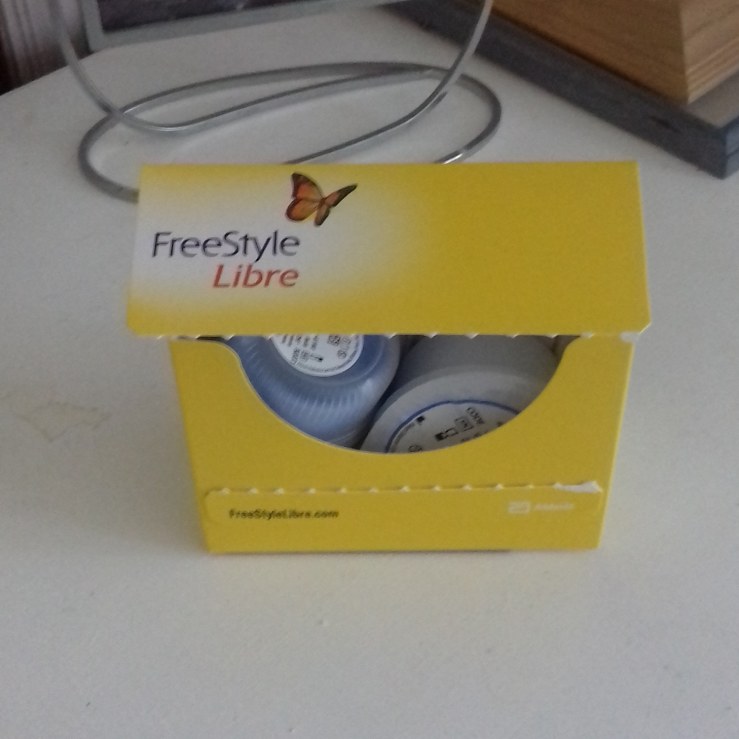
 Hashtag love the NHS—and the NHS in Scotland if we’re going to be specific.
Off I trotted to the diabetic clinic on Thursday armed with my best persuasion skills. Oh pleasy-weasy dear doctor, may I have a FreeStyle Libre flash glucose monitoring system? One of my arguments was going to be—Hey, you won’t be paying for it for too long. Did you see the recent research that tells me I can expect to knock eighteen years off my life expectation?!*
In the end, my polished debate wasn’t needed. Just as well as I couldn’t sell hot-water bottles to the Inuit. Or ice-cold beer to Australian sun-bathers for that matter. I brought the subject up. The doctor queried the number of blood tests I do per day and voila. I’m on a list. I’ll need to go to an education event and after that, a letter wings its way to my GP recommending she prescribes the sensors.
Sensors
Flash glucose monitoring for those of you who aren’t familiar with it is where you wear a sensor on your body (usually your upper arm) and you can take a reading from it using a monitor. It differs from blood testing in that it’s super quick and easy. You don’t need to prick your finger and you can check endlessly and the sensor works through your clothing.
Those of us who tend towards obsessive compulsive disorder—it’s hard not to when you’ve got diabetes—might baulk at that, but I am looking forward to monitoring what happens to me during exercise. And when I’m eating.
The device doesn’t come with an alarm—i.e. a warning when your blood sugar goes too far up or down, or it changes rapidly but there is software for that. The cat lover in me is delighted the manufacturers chose to call the software MiaoMiao, and this sends readings to your phone every five minutes, and will warn you of spikes.
Hello Big Brother!
You can even connect it to others’ devices, so they can monitor you too. I’ll skip that as it feels too Big Brother-y to me. Most type 1s hate other people telling them when they are hypo. Imagine how much worse this would be!
Incidentally, all this new diabetes-related tech has had a knock-on effect on the hospital I go to. Thursday’s clinic was running one hour late because it was so busy. The doctor told me he can’t get the GP support (where a GP handles some of the patients to gain experience in diabetes care), thanks partly to the fast development of new tech.
Our GPs are under so much pressure, it’s too difficult for them to keep up with all the tech that type 1s use these days—pumps, continuous glucose monitoring, flash glucose monitoring, software and more. My appointments have been spaced eight months apart for the last few years and that’s likely to change to a year from now on.
But in the meantime, I have my new toy and a whole heap of questions for Google. Can you wear it in the steam room? How much is MiaoMiao? How many actual blood tests do I still need to do to calibrate the thing?
Thanks again NHS Scotland. I look forward to reporting back.
*Whatevs. I debated discussing the research here and decided it wasn’t useful. Doom-laden stuff is such a turn-off isn’t it?
 A continuous glucose monitoring system, the MiniMed 670G self-adjusting insulin pump, a personal trainer AND an unlimited food budget so I can buy organic, ethically sourced food all the time…
 And finally…drum roll… the NHS! Here in the UK, we folks with type 1 diabetes get free healthcare and prescriptions. I mump and moan occasionally about wanting the latest tech, but I’ve had diabetes for more than 30 years and in that time, I’ve never paid for medications, appointments or equipment. Our fabulous healthcare system has existed 70 years now. It’s shaky on its feet sometimes, but you can’t argue with the wonderful principles at its core—free healthcare for all, based on clinical need.
 We veterans remember them fondly and with the odd head shake in disbelief. Did it really used to be like that? by ‘eck, we have come far… Recently, I wrote a book, Artists Town, which features. a type 1 protagonist. My book is set in the early 1990s and life for we pancreatically-challenged has changed substantially since then.



 From Diabetes in Control May 2017. Cheapest treatment associated with increased risks of cardiovascular events and death.
 Diabetes Diet