A study in Lancet Public Health has found that every year spent in a classroom improves life expectancy, while not attending is as deadly as smoking or heavy drinking.
Researchers from Norway and the USA examined data from 59 countries including Brazil, China, the UK, and the USA. They found that all cause adult mortality fee by 2% for every year in full time education.
Compared to no formal education, if you reached college or university level education, your total mortality fell by 34%. But not attending school was equivalent to smoking 10 cigarettes a day or drinking 5 or more alcoholic drinks a day for ten years. The effects were similar in rich and poor countries regardless of sex, social class or demography.
Money is part of this effect. Education leads to higher lifetime earnings and that in turn improves housing and diet. It also helps you access and understand information that can guide you to make better life choices.
For women, higher educational levels reduce maternal and child deaths, better child health and lower fertility rates. Educated women tend to use contraception, marry later, have fewer children and be better informed about their children’s needs.
According to an article in Archives of Diseases of Childhood published in 2024, food induced allergic reactions are less common during flights than on the ground.
Contrary to popular belief, nut particles are not transmitted through aircraft ventilation systems so do not pose substantial risks to passengers with nut allergies.
The most effective preventative measure you can take is to wipe down your seat, tray, and areas around your seat.
Adapted from BMJ 21 Jan 2023 Gestational age at birth and later cognition.
It is always a worry for parents when they have a premature baby. Will my baby be physically normal? Will they have brain damage?
A Danish study looked at almost 800,000 children who had been born between 1986 and 2003. Comment: this is of interest to me because I was born at 34 weeks and weighed 2 pounds 3 ounces. Also I worked in obstetrics in 1984 and neonatal paediatrics in 1986.
They compared their characteristics at birth with language and mathematics assessments at age 16. The assessors had no knowledge of the children. Sex, birth weight, malformations, parental age at birth, parental educational level, number of older siblings and shared family factors between siblings were adjusted for, as these are known to have effects on intelligence levels.
The results showed that for both language skills and mathematics, levels plateaued off at 34 weeks and remained constant till 41 weeks. Babies born at 42 or more weeks actually showed a slight decrease in language and mathematical skills.
For babies born at 27 weeks or more, there was a reduction in both language and mathematical skills. Week on week there was a steady improvement till 34 weeks. Mathematical skills were over twice much impaired compared to language skills.
Exactly how these differences affect real life outcomes such as educational attainment or lifetime income has not been assessed in this study.
In October we had our class reunion from Glasgow University Medical School some 42 years after we qualified. We met for dinner at the iconic Central Hotel Glasgow for dinner.
It was an evening full of nostalgia and it was great to see old classmates, several who had come from as far away as New Zealand and Malaysia to meet up again. Our very hard, and long working hours as junior doctors, forged deep friendships and common bonds of respect. 120 to 145 hours a week was usual, and pay was one third of the basic rate after the first 40 hours of work.
We have had several reunions over the years and I’m fortunate to have attended all of them. I graduated when I was 22, on the younger side, since I went to university from 5th year rather than the more common 6th year at secondary school. At university, some students, perhaps looking for more academic or science based careers, also added science degrees and graduated later than 1982.
We had reunions at various life stages: early parent-hood around our mid thirties, settled in our careers, around our mid forties, around the age of early retirement in our mid 50s, and now with almost everyone retired in our mid 60s.
This was for me, the happiest reunion, because I was finally completely retired from medical practice. At the last reunion, around half of the doctors who had become GPs had retired. Although I was extremely envious of their new found freedom, I was determined to avoid the unfair financial penalty on our pensions and vowed to continue till the age of 60. Due to having a portfolio career, I did a step-wise reduction, stopping forensic/custody work when I was 61 and legal work when I was 63.
It took just over a year after that, before I was finally free of court appearances, follow up reports, and case decisions. It took many months to finally declutter my house and to dispose of my case reports and paperwork. Retirement is an event or series of events, but it is also a process.
The doctors who are still working were mainly in laboratory based roles, where patient contact is very limited, or in medical politics, education or academia, where there has been a long and competitive climb to the top. Some surgeons and consultants who have well established private practices are also continuing. There were very few NHS doctors still at “the coalface”. And to those few that are, I warmly salute you! There are real staffing problems and access to experienced doctors is so necessary.
It was uplifting to hear of the achievements of so many doctors. One Mauritian doctor had set up the first renal service with dialysis and transplants there. Not only had he spent years away from home as a student in Scotland: he had to return to London for years to gain the expertise to develop services and train people in Mauritius. My experience of Mauritius has sadly only been from watching romantic comedies on Netflix, but I do know where I would rather have been!
One woman had become the first female head of the medical school and head of the university Senate. This was smashing a few glass ceilings. This was all while working as a GP and bringing up a family.
Several doctors had great achievements in sports medicine. A daughter of one, gained a medal in the recent Paris games. Another has taken young women players on football matches abroad and attended Wimbledon as an events doctor. Some have been well known football and rugby club doctors.
When it comes to sports, there were several accomplished sailors and one woman who seemed quite normal in her 20s but who has transformed into Wonder Woman. She can swim, cycle, sail and do almost anything better than any man.
It doesn’t always work out for the sporty ones. One man had a terrible accident and sustained punctured lungs and seven fractures. He lived to tell the tail and is even back skiing. (He must be mad).
One woman had six children while working as a GP for over 30 years. One man had married three times. That’s optimism for you!
There had been huge successes in transplant and other surgery techniques from within our year group. One man had become the head of the NHS in England and you will have seen him on the television. Several doctors had fallen in love with people of different nationalities and moved to the other side of the world. Others were in Europe and Scandinavia, but not only changed countries but languages too.
Several people who started in one field or another changed medical careers completely. GP to Palliative care, GP to Psychiatrist, Surgeon to Radiologist, Surgeon to Politician, Psychiatrist to Research Fellow. It is difficult to change to careers in medicine because essentially you have to start right at the bottom of the heap again in another field of study, apprenticeship and exams.
It was with considerable sadness that we also remembered the doctors who have died. One died of cancer in his mid thirties, several have died of cancer and heart attacks around their early 50s.
As the years continue, I expect we will see a diminishing number of people coming back. Some will be happy to just be living their lives, some will find the journey and expense too daunting, some have family and health burdens of their own.
I remember the fresh, young, hard working, fun and idealistic people we once were, and I’m grateful to see that we got through our careers, had the families we wanted to have, and can have some time to ourselves at last.
PHC have just released the new Real Food Healthy Lifestyle course.
It is an online course led by Liz LePlan, the PHC Ambassador Co-ordinator.
It comprises eight recorded sessions and takes people through the low carbohydrate approach. You can find it here. https://phcuk.org/support/
There is also a new Facebook group to support our work in Scotland and to try and reach out to more like-minded souls and help people who want to improve their health. We would really like you to join the group and share your own success stories and tips. Please also invite your friends and any healthcare practitioners that you know. https://www.facebook.com/groups/lowcarbrealfoodphcscotland
If you would like to watch a replay of the main event that the PHC runs each year, the Annual Conference then it is now available on YouTube.
This year the conference coincided with the 75 year anniversary of the NHS and had the theme ‘Fixing the NHS – one person at a time’.
Adapted from Medscape article by Peter Russell 6 Dec 2022
Children with type one diabetes have more school absences than classmates who do not have the condition, but difficulties with blood sugar control were linked to the most absences.
Despite lower attendances many children with type one diabetes achieve good exam grades and go on to higher education. But those with higher HbA1c levels were more likely to get poorer grades and found it harder to get a place at college level.
Cardiff researchers think that children who struggle with their glycaemic control could benefit from more clinical and educational support.
Researchers looked at over a quarter of a million children aged 6 to 18 and over a thousand children with type one diabetes who attended schools and colleges in Wales between 2009 and 2016. Factors such as the child’s household socioeconomic status, neighbourhood deprivation, sex and age were taken into account.
The results showed that type one children were absent for 8.8 sessions per year more than children without diabetes. Those with the best glycaemic control missed 6.7 sessions per year and children with the poorest levels of control missed 14.8 sessions.
Children in the quintile with the best glycaemic control got results 4 grades higher than those without diabetes at the age of 16. However for those in the lowest quintile of HbA1c control attainment was 5 grades lower than their classmates who did not have the condition.
Those with the best glycaemic management were 1.7 times more likely to gain a place in higher education than the general population whereas those in the lowest quintile for glycaemic management were 0.4 times as likely to go onto higher education than those who did not have type one diabetes. In essense those in the highest quintile were almost three times more likely to attend higher education than in the least optimal quintile.
Dr Robert French, one of the researchers was impressed that children with diabetes under adequate control were as likely to progress to higher education as their non diabetic peers even though they lost more school days to diabetes.
Overachievement for children with type one diabetes who effectively managed their glycaemic control could be due to factors unrelated to glucose levels and could reflect socioeconomic conditions, family support and effective self management.
Robert French et al. Educational attainment and childhood onset type one diabetes. Diabetes Care 1 Dec 2022 45(12) 2852-2851.
My comment: I know from my own experience of being a parent of a child with type one diabetes that the formulation of strictly kept routines around blood sugar testing, meals, homework, activity, and sleep made a big difference to my son’s blood sugar control and educational attainment. By my son’s diagnosis it had been already discovered that 9 out of 10 diabetic children had worse school attainment than average for their peers and that high blood sugars affected concentration, mood and memory. It would seem that for most diabetic children the educational gap has been greatly improved in the 20 years since. The overachievement affect is understandable when a child or young adult is given more family support, and this is usually maternal support, during their adolescent years, than is perhaps the case for non diabetic children. The adoption of a low carb diet makes glycaemic control much easier for all diabetics and this is even more important when the hormonal surges of puberty are causing glycaemic uproar, and the need to perform in exams can determine future career paths.
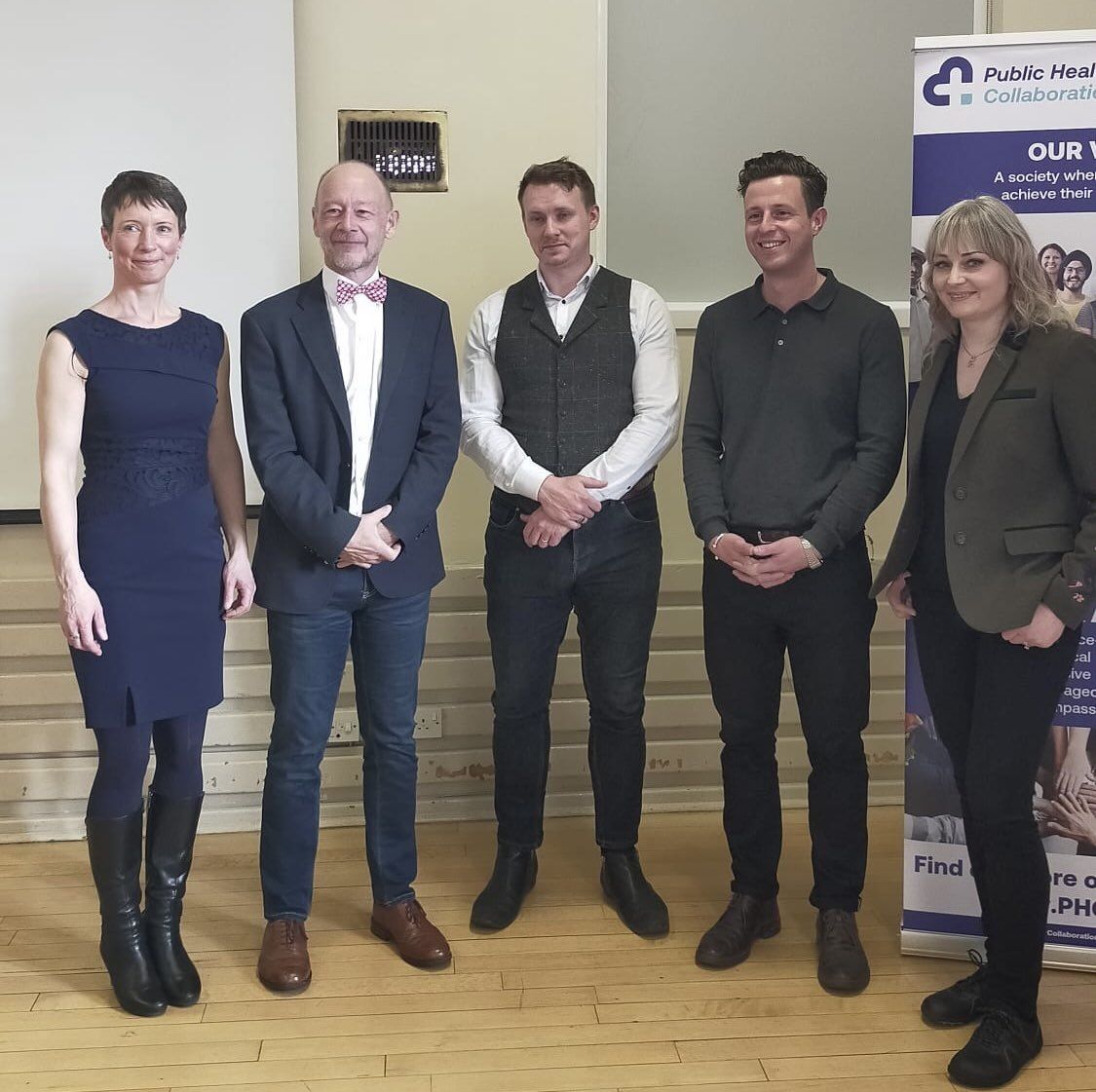
I attended the PHQ conference in Edinburgh on 17 March 23. This was the first such meeting in Scotland and it was well organised, interesting and well attended.
Moira Newiss is on your far left of the photo in her navy dress and black boots. Moira organised the meeting and also spoke about her experience of having post viral fatigue twice in her life. This led her to explore the functioning of the mitochondria in our cells. She found that the mitochondria don’t function normally and become depleted in chronic fatigue syndrome and fibromyalgia but that primitive pathways in the cell using ketones for fuel are still active. She started a ketogenic diet and recovered completely from her chronic fatigue syndrome. She now runs for a hobby.
Dr David Unwin is standing next to her and is wearing a bow tie and suit. He is now 65 years of age and has been promoting low carb diets in his practice for the last ten years with great results. He is having so much fun that he doesn’t want to retire!
He found that in many cases type two diabetics can reverse their condition completely by the adoption of a low carb or ketogenic diet. Statistical analysis showed that the people most likely to reverse their condition had had been diagnosed in the previous 18 months. There is thus a great window of opportunity for advice and coaching to be provided to these patients at the earliest opportunity after diagnosis.
Results after 18 months are more variable, with a great improvement in diabetes seen, but sometimes not to the extent that complete remission occurs. Some medication support is often still necessary. Insulin may be able to be substantially reduced or stopped but some alternative medication may still be required.
Monitoring of patients blood sugars will still be required for both groups lifelong in case high blood sugars return. This can be due to secondary beta cell failure and may require tightening up of the diet, the addition of medication and sometimes insulin. If higher blood sugars and weight loss is reported, pancreatic cancer requires consideration and this is detected by urgent MRI scans. Sometimes a patient has been wrongly diagnosed as type two when they are really type one. In all cases they will need to see their GP for diagnosis.
Dr Iain Campbell is standing next to Dr Unwin and is wearing a waistcoat and white shirt. Iain told us about his struggles with bipolar disorder. There certainly could be a creative advantage to this illness, as Iain spent his young day in a rock band and even now is a successful composer. He has now settled into fatherhood and medicine and since starting a ketogenic diet has been mentally stable. My comment: Dr Christopher Palmer in the USA has also researched this phenomenon and there is a blog article on this site about him. Iain works at the university of Edinburgh, and has done preliminary studies in other patients who have bipolar disorder and has found that anxiety, depression, mood swings and impulsiveness all improve with a ketogenic diet. Further research is planned.
Dr Rachel Bain, on your far right, is a psychiatrist and works with Ally Houston, who is standing beside her, to promote coaching for mental health patients in the low carb diet. The site is metpsy.com.
Rachel explained that the gut and brain are very intimately connected and share the same neurotransmitters. The gut microbiotica are affected by what we eat. This affects our mood. If leaky gut occurs inflammatory substances can gain access to our blood vessels and cross the blood /brain barrier to cause neuro-inflammation. This is one cause of degenerative brain conditions such as Alzheimer’s disease and Parkinson’s disease. The foods most likely to disrupt the junctions between the gut cells are sugar, starch, gluten and alcohol. She and Ally as well as other team members treat people who have Attention Deficit Disorder, Obsessive Compulsive Disorder, Binge Eating Disorder, Bipolar Disorder and Schizophrenia. They don’t aim for a person to stop their medication so much as to gain control of their lives.
Ally Houston used to be a physicist but is now a chef and low carb coach. Comment: Ally also appears in a previous blog post on the site. He explained what coaching was and wasn’t. It isn’t telling someone what to do. It is exploring with the person how their life works now and how they can introduce positive changes around eating sugar, starch, vegetable oils, exercise, stress reduction and sleep.
The services at met.psy.com are out with the NHS and there is a fee for the services, but it is very reasonably priced.
PHQ are expecting videos of the conference to be available on You Tube now or very shortly.
Around one in four UK adults is living with obesity. Previous research has established that the most effective way to lose weight is through behaviour change with diet and physical activity counselling. It has not been clear whether one to one sessions or group sessions produce the better outcome. Thus a review of 7 studies which included 2,576 participants from the UK, US, Australia, Germany and Spain was done.
The study looked at the outcome of reaching at least a 5% reduction in body weight after a year. This means that a person of 100kg would lose 5kg.
Compared to one to one sessions, people in group sessions:
Lost on average 1.9kg more weight
Were 58% more likely to lose at least 5% of their body weight
Group classes had 12-55 hours treatment time and those in one to one sessions had 2.5 to 11 hours.
The costs of treating people in groups is also lower than one to one sessions. The quality of life of people who are obese would be more likely to improve and their would be fewer cases of diabetes, heart disease, stroke, and cancer that all require medical treatment.
NICE are intending to publish revised guidelines on the treatment of obesity in 2023.
Healthcare professionals can now confidently say that group educational programmes are at least if not more effective than one to one sessions when referring or advising patients. Social support in groups and more intensive interventions may account for greater success but for some people eg who are anxious in groups or who need translators, or even just patient preference, will mean that one to one sessions will still need to be offered. Further research into what specific factors improve results would be helpful.









 Diabetes Diet